City Eyes

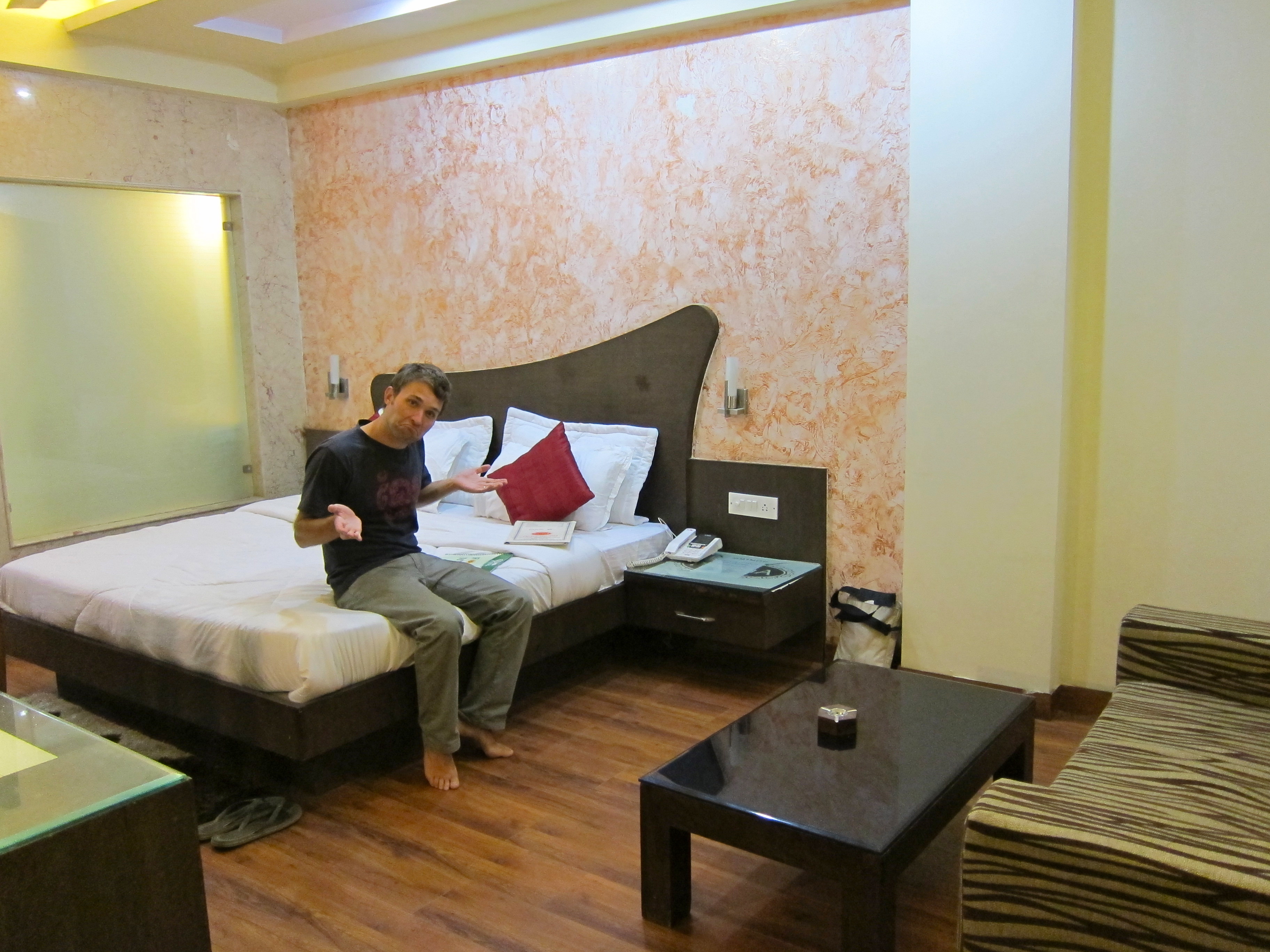
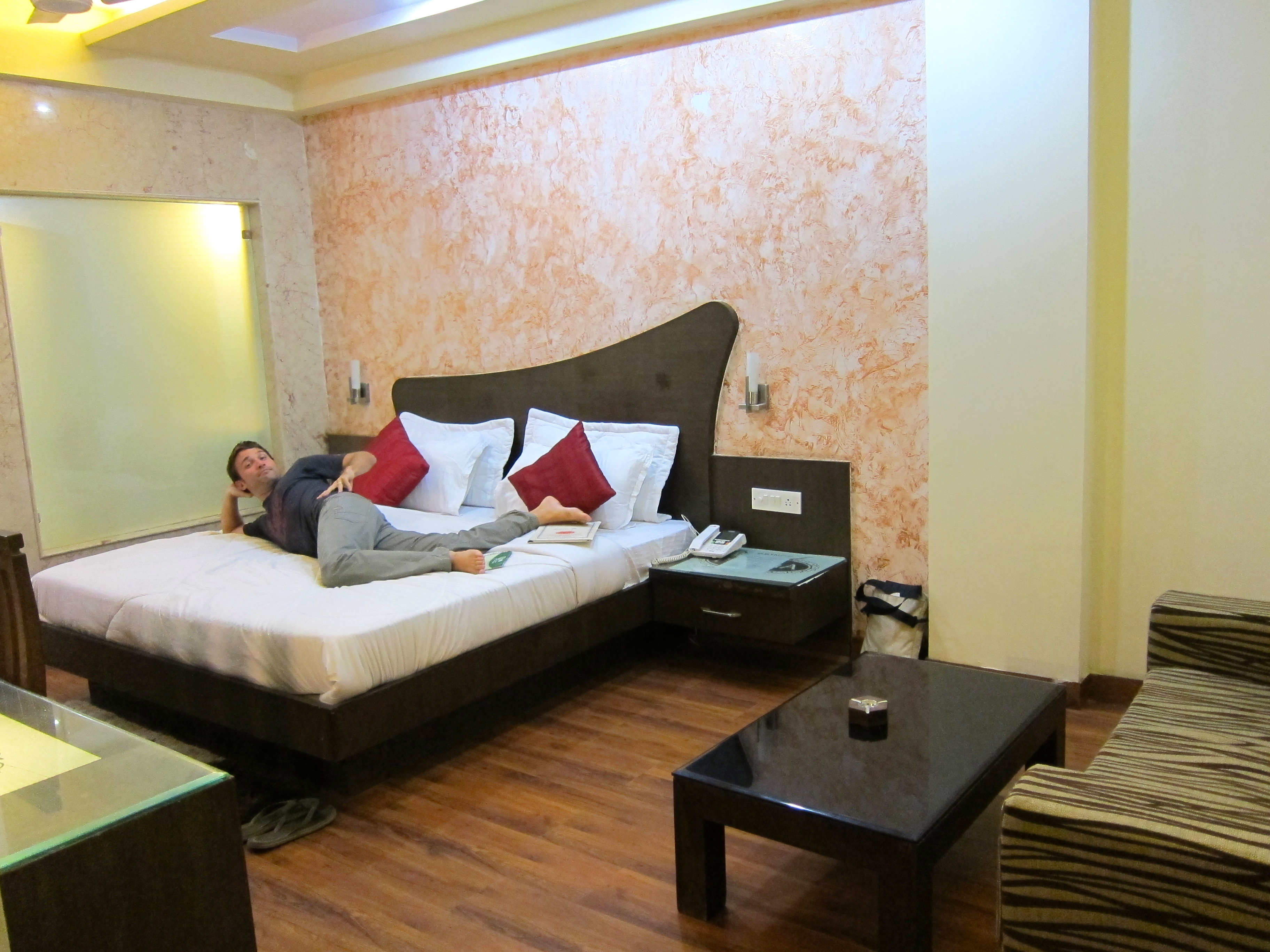
The convenience of our evening arrival in India did not foreshadow what was soon to come; a private driver from the hotel was waiting – right on time – at the Delhi airport, and we were comfortably escorted to what appeared to be the swankiest hotel room we’d had our whole trip.

IMG_1203IMG_1204IMG_1205http://www.flickr.com/photos/12339764@N00/6850439124/in/set-72157629618994675

Yes, things were comfortable at first, but the real India took little time to show its face…

It began with the electricity: turn on several lights at a time, or plug the teapot into an outlet, and snap: a short circuit for the entire wing of our hotel. I had some work to finish up that night, so the need for power was imminent; minutes within arrival, there I was, out in the hall looking for a maintenance person to fix our room. This time, ironic convenience was on our side: the breaker panel just outside our door, loose wires dangling out the top, was left ajar for guests to correct their circuit glitches themselves. India, we would soon learn, always has an answer; it’s the questions you end up asking that are crazy.

Flipping the circuit back taught us the benefits of an Indian power surge: when the power comes back, either after the daily citywide outages, or a routine circuit crash in the room, it really comes back. You can charge a Macbook Air in 20 minutes, or boil a teapot in less than 1! Anyway, with the power back again (at least until the next city-wide outage) we were left to battle the wifi, for which we’d already requested a password, but the young gents at the front desk just couldn’t take their eyes off the cricket match to help. No rush, it turned out: when we did eventually get a password, the internet didn’t work anyway, and we were told it wouldn’t work for the remainder of the night. Work would have to wait for tonight…

I suppose I could mention some other missteps of the evening: the delivery boy from the restaurant who smiled and never returned with our change, or our luxurious-looking many-headed shower that spat a stream of either steam-pipe-hot or numbingly cold water horizontally out the wall (which Steph then collected from across the room in a bucket for bathing).  These were the sort of daily inconveniences that we would get used to, and that was just the scene inside our room…

Delhi, India

Delhi, India

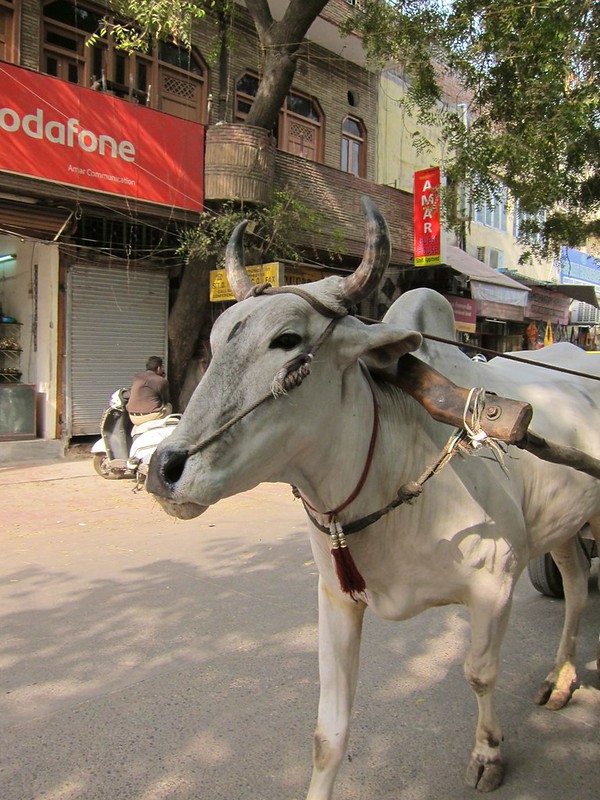
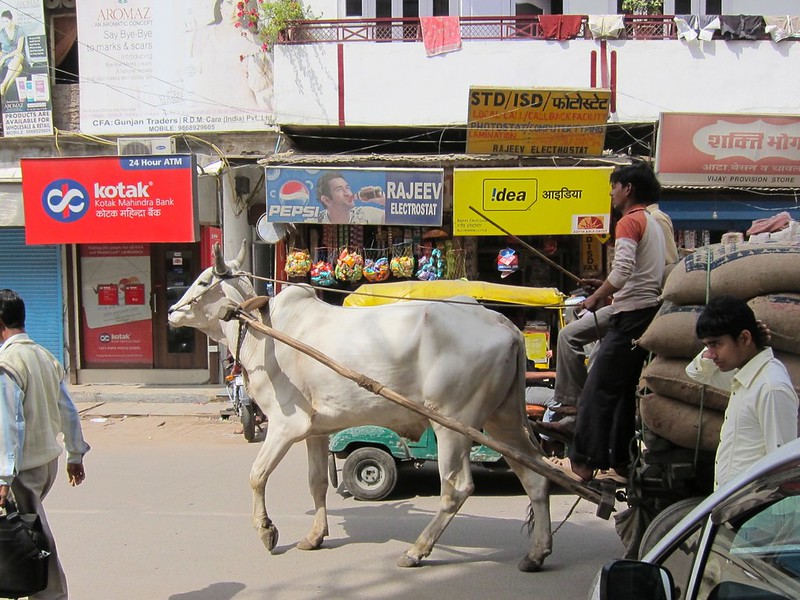
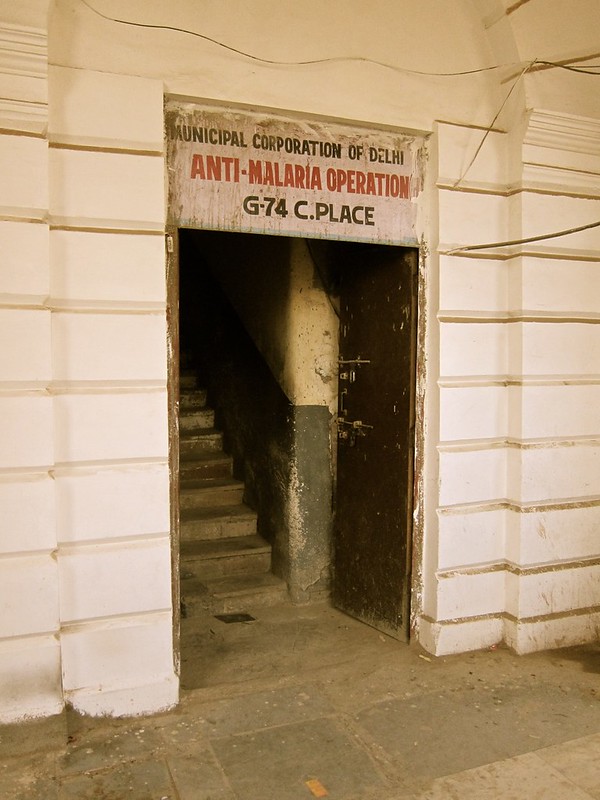
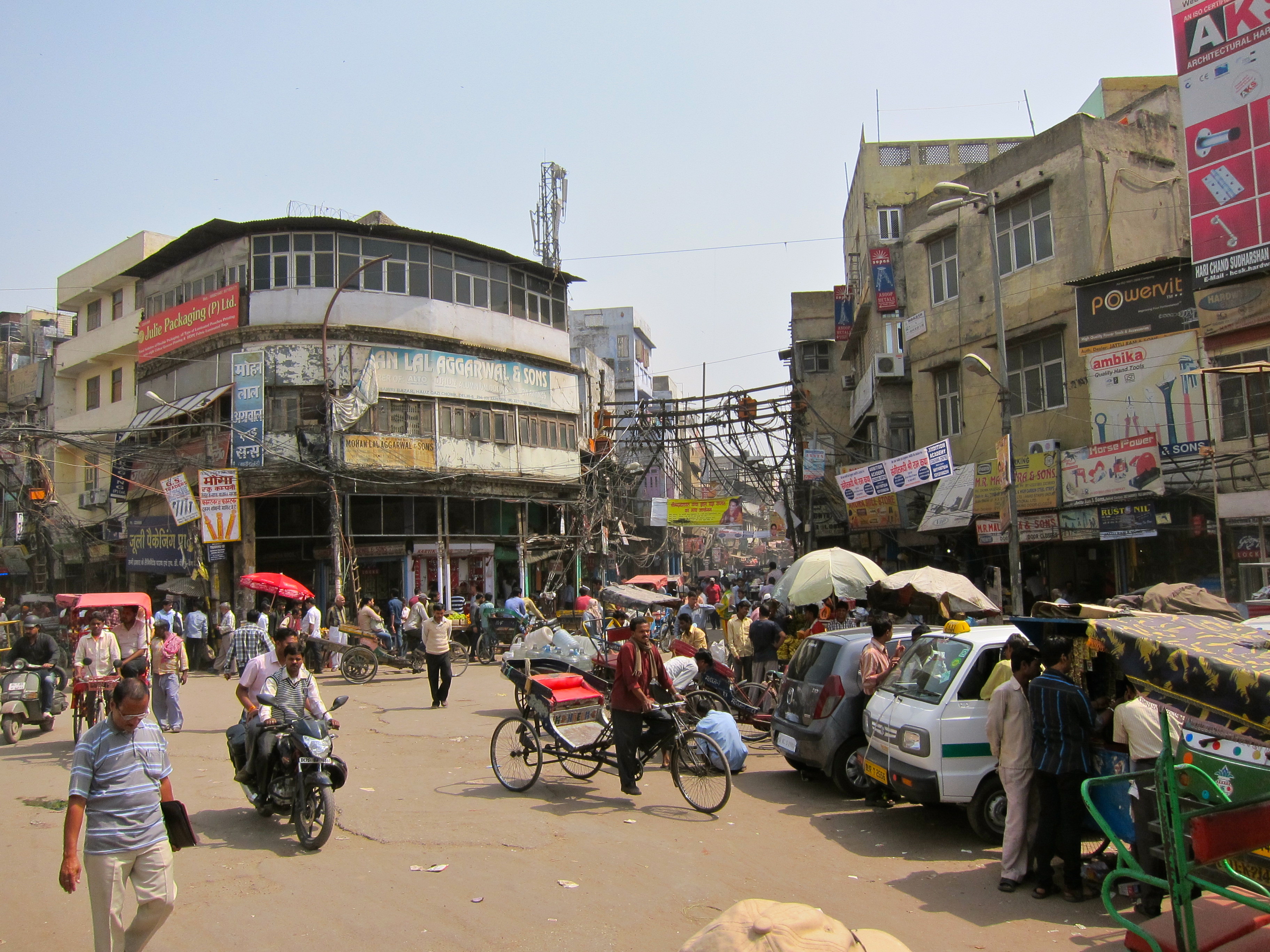
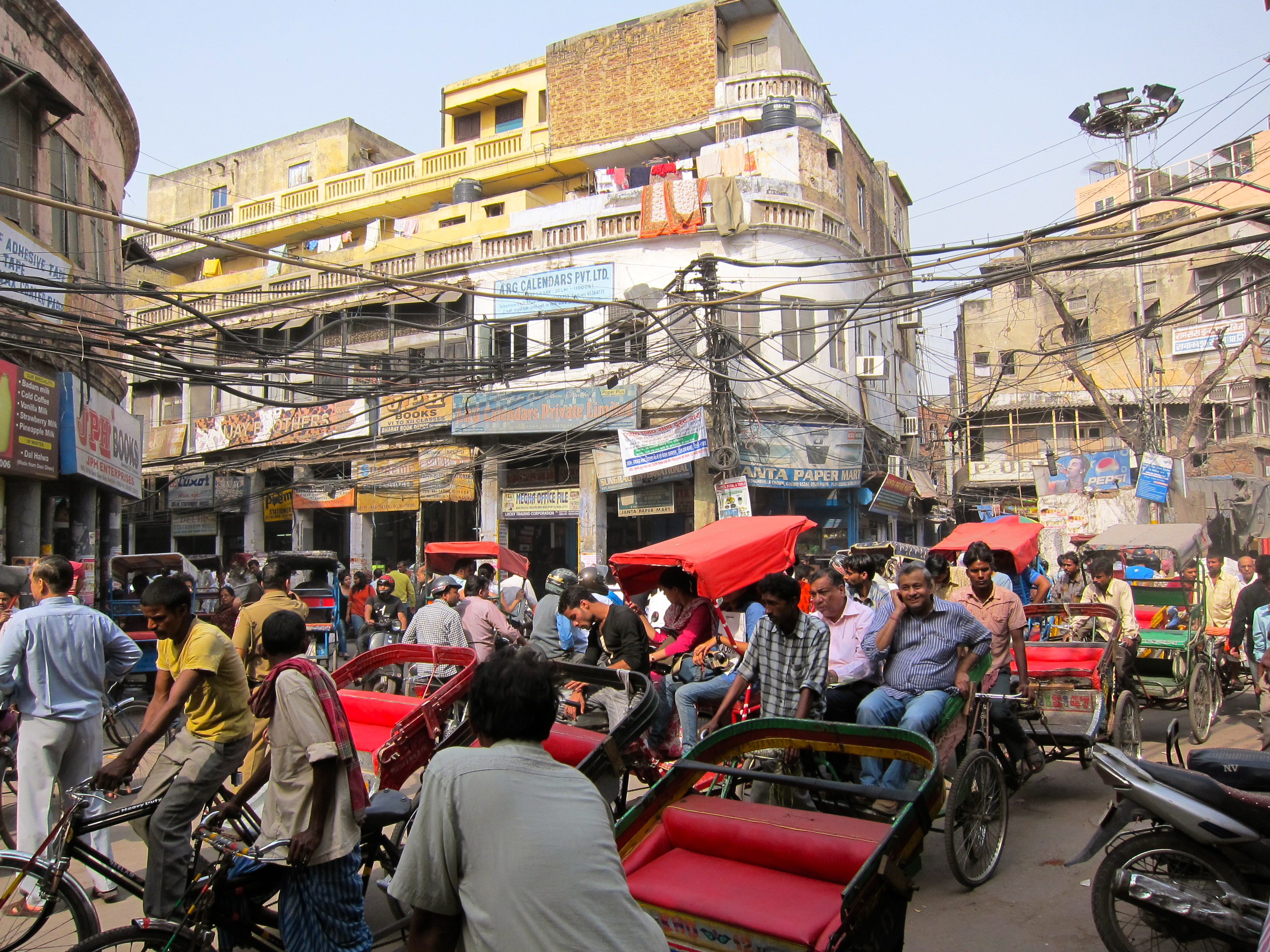
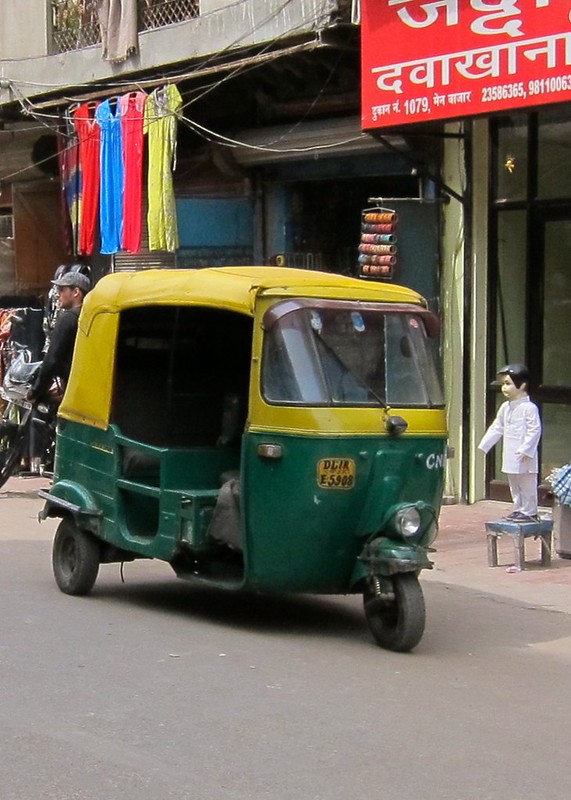
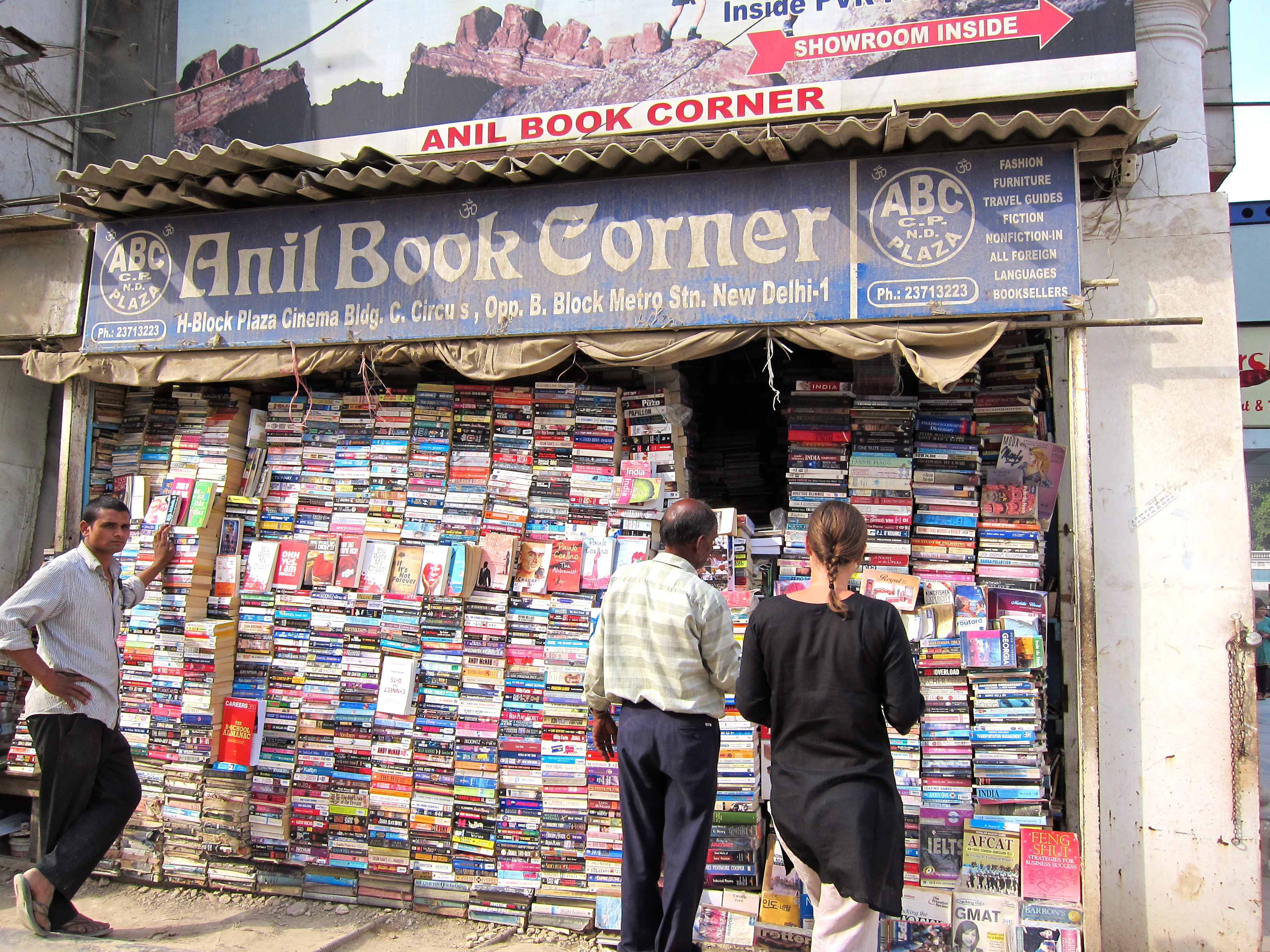
In our travels, we’ve visited some of the poorest, resource-strapped locales, and certainly aren’t new to uncomfortable settings. Yet New Delhi still felt like a category of its own. Utterly overcrowded, filthy, cows wandering aimlessly in the streets and eating out of dumpsters, car horns that seemed to be on by default, dangerous obstacles everywhere… did I mention the filth? Poop – presumably not all from the cows – in the gutters alongside the roads. The smell was a constant flux, from rich masalas and buttery naan, to feces, to exhaust, to body odors, and back to something nice again. This mess seemed to extend to any area we visited; as a major world city, the conditions there really took us by surprise. To be frank, the place looked like a giant construction zone. Even Connaught Place, a major trendy shopping district, sat tangled in a nest of wires, busted concrete, piles of sand, and well, more poop it seemed.

IMG_1234Malaria clinic at Conaught Place.

Delhi, India

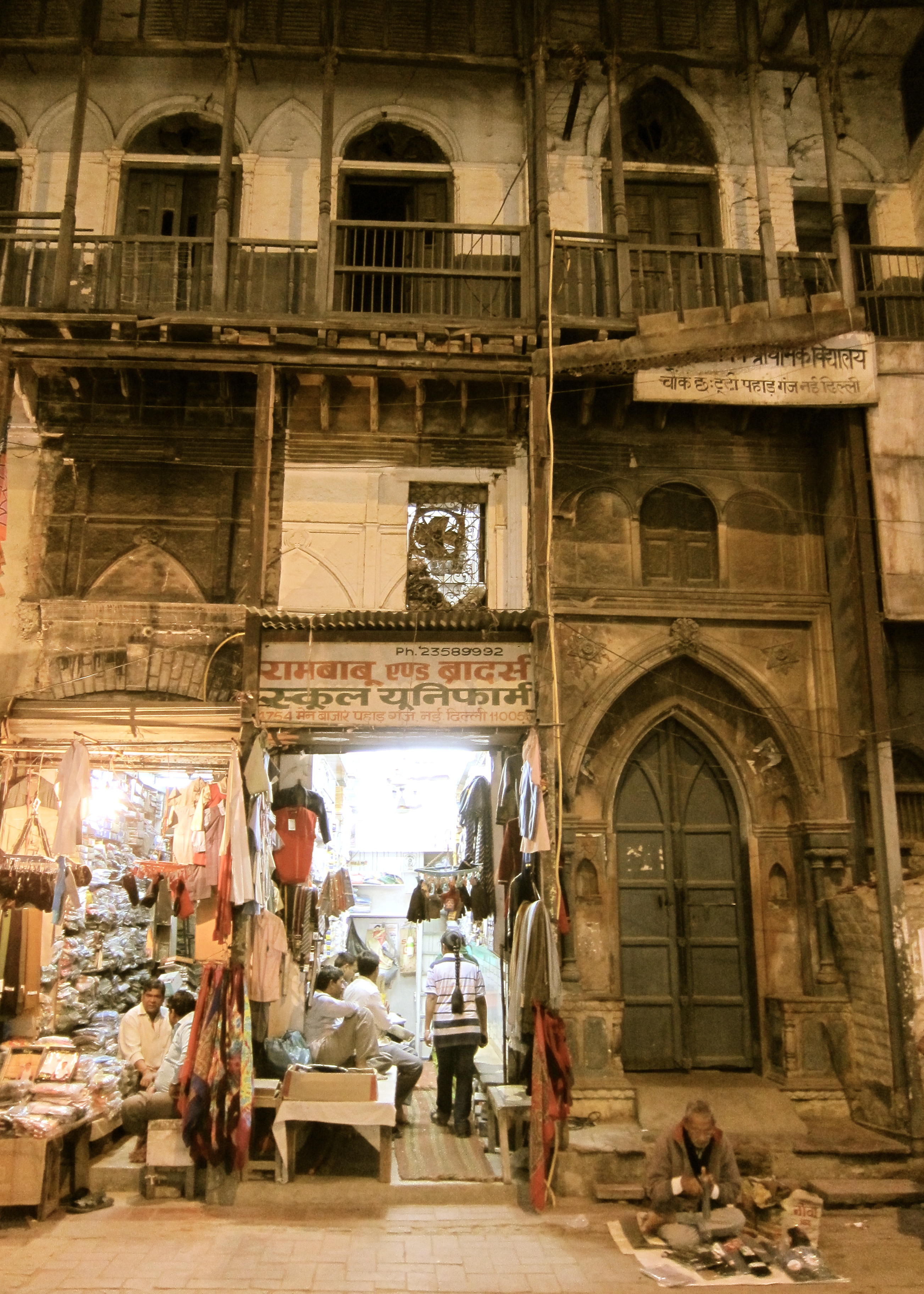
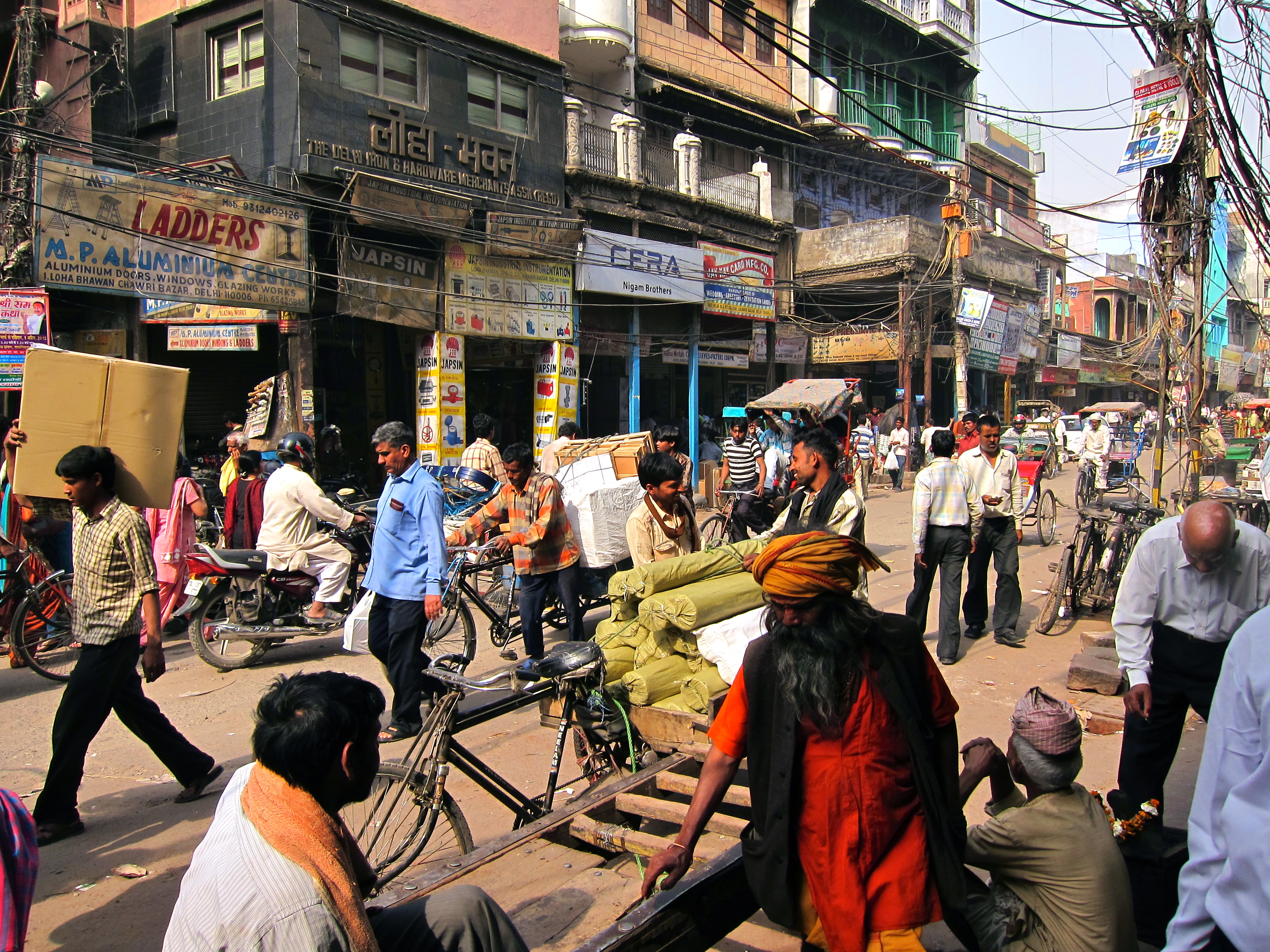
To our further surprise, New Delhi proved to be a mere primer for Old Delhi, the former city center and home to even further overcrowding and in-your-face poverty. If there was ever a moment that we felt we had never travelled anywhere before, getting off the metro one morning in Old Delhi was certainly it. Delhi is one of the (maybe the) oldest cities in the world, and as Steph said, Old Delhi appeared as if nothing had been removed since its founding thousands of years ago, but rather layered and layered on top of all that was already there. Signs over signs over other signs… power lines wrapping buildings like yarn… the obstacles seemed to multiply as well.

Shots from Main St., Old Delhi:

IMG_1290IMG_1246

IMG_1284http://www.flickr.com/photos/12339764@N00/6850462304/in/set-72157629618994675

Delhi, India

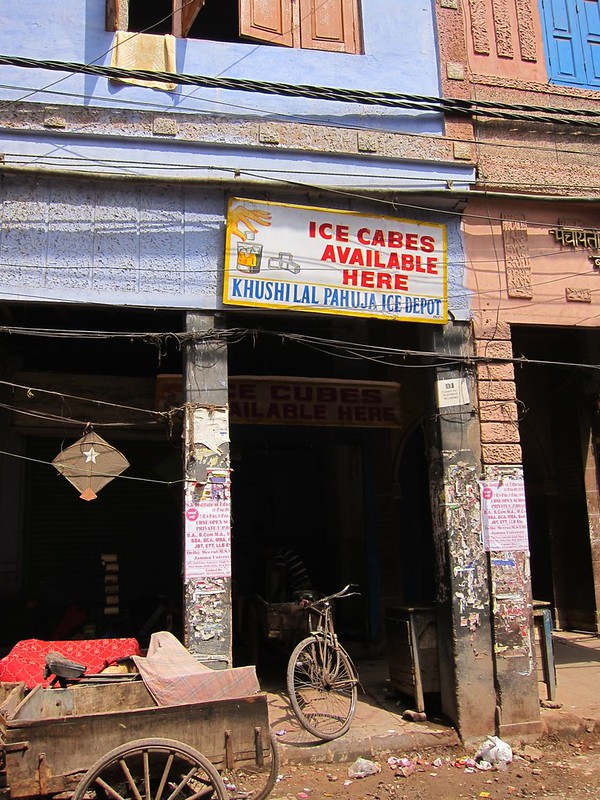
We carefully navigated the tight streets, jammed with ox carts, cars, bicycles, and scooters as flashes from welding lights sparked from the metal work shops along the sides, and vendors surrounded themselves with pots of burbling masalas and cooked chapati over tall, open flames. Every garage-front had a group of men sweating away on some sort of craft that might have been made in that spot for hundreds of years: ice cubes, cart axels, grain bags, and more. Each store seemed to specialize in, and sell just one thing: a door handle store, one for hinges, and another for car bumpers.

Delhi, India

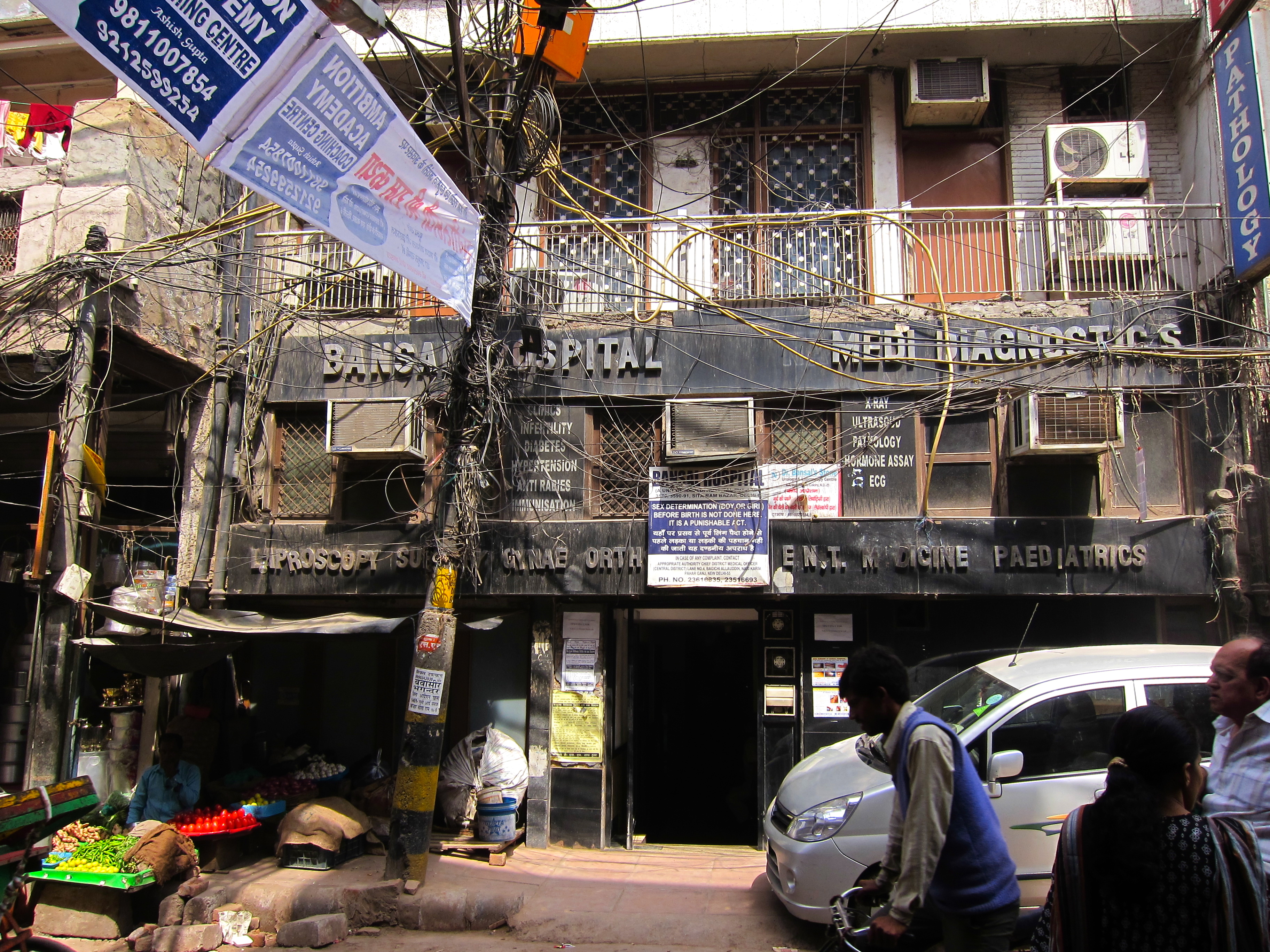
Screen Shot 2014-12-17 at 5.32.30 PMAn Old Delhi hospital. Eek. Watch you toes in that traffic:

IMG_1248Our plan was to make our way to visit Jama Masjid Mosque, the largest mosque in Delhi. The way there, while not physically far, involved a maze of alleyways, forking and twisting around buildings, beneath dusty drapes stretched overhead to block out the midday sun. Around one corner, a garbage heap with women sifting for anything of worth, the next, a traffic jam of people and carts; all along, we were met with unflinching stares.

But try as it may, the place was still impossible for us to dislike. How could you not find this place fascinating, what in all its post-apocalyptic haze? And of course, amongst the mess, there was plenty to legitimately appreciate as well.

Delhi, India

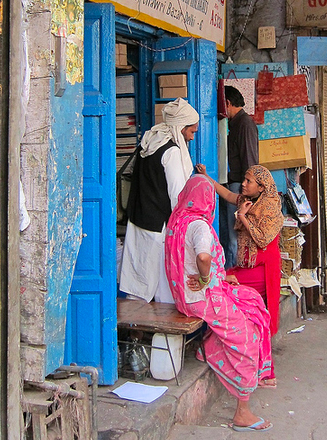
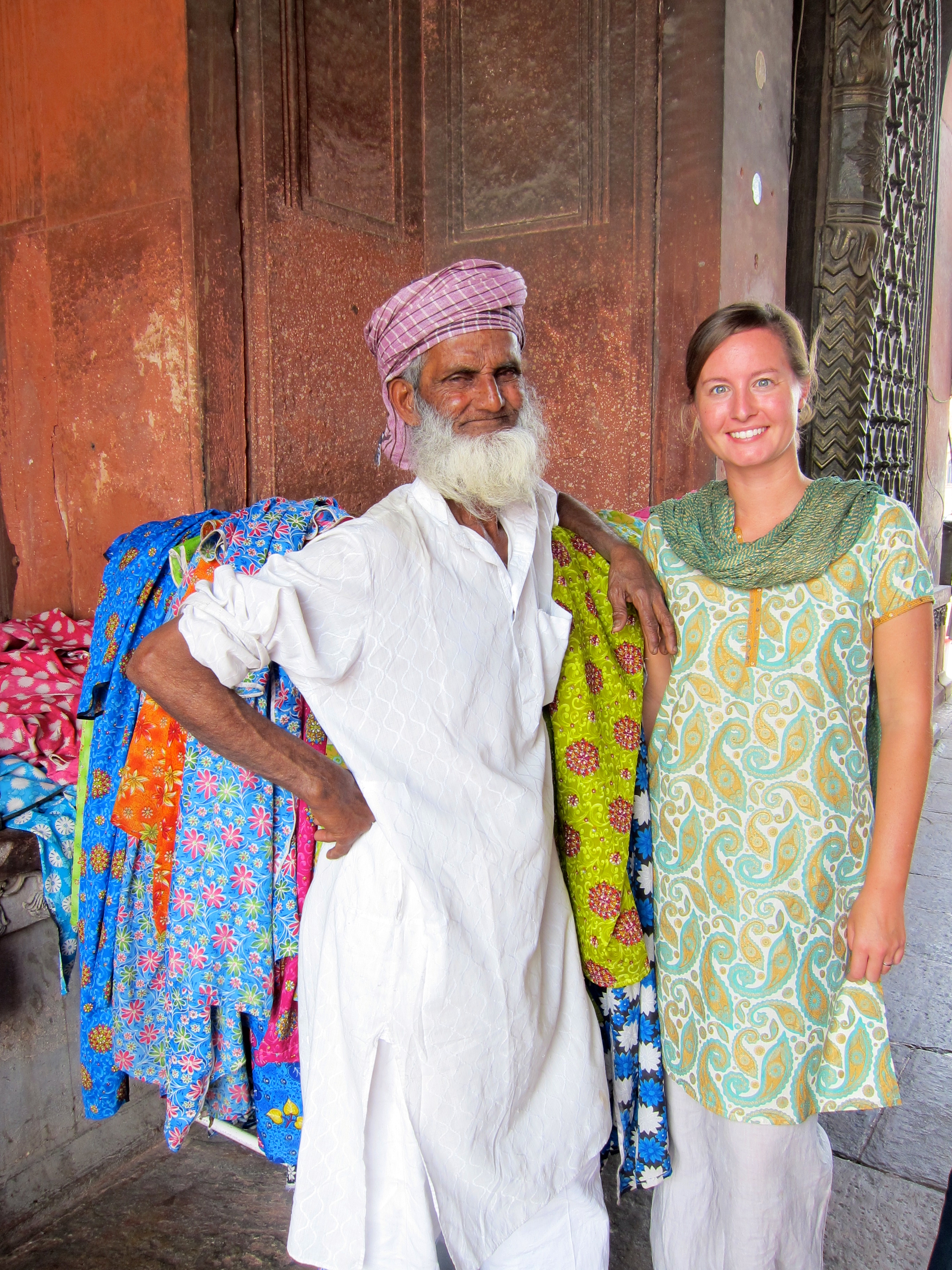
For one, the colors. It seemed every woman on the street was draped in a beautiful sari of a different vivid color combination, and thick gold on their face, neck, ears, and wrists.

Delhi, India

Screen Shot 2014-12-17 at 5.33.58 PMThe foods were bright as well, more like bubbling vats of paint than anything fit to eat. But indeed, they were fit to eat, at least in the sense that they were delicious – as for safety, that’s anyone’s guess (the term “Delhi Belly” didn’t just happen for nothing).

IMG_1286Cheesecake-ish treats from a sweet shop:

Delhi, India

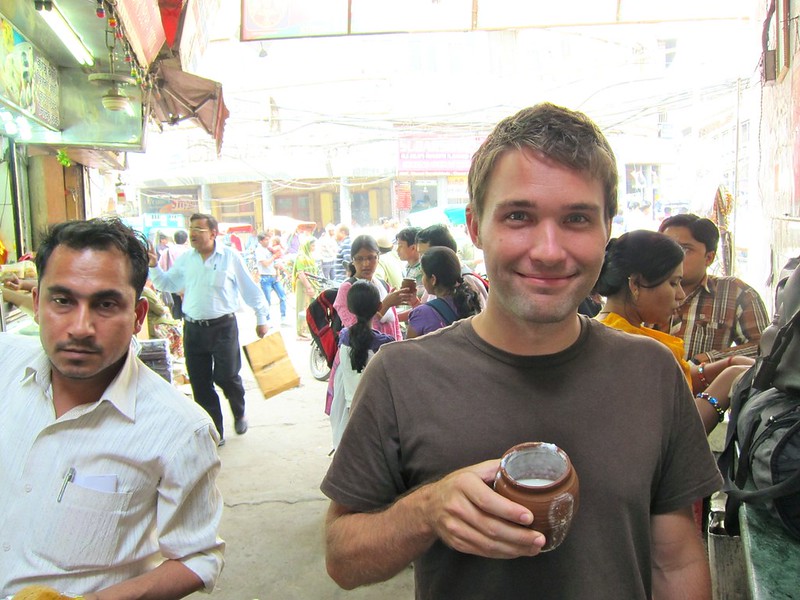
A cool, yogurt lassi in a clay pot (which was destroyed after use!)

Delhi, India

Also, despite the universal, intimidating stares, most every person we talked to was friendly and helpful, which was critical in finding our way to Jama Masjid.

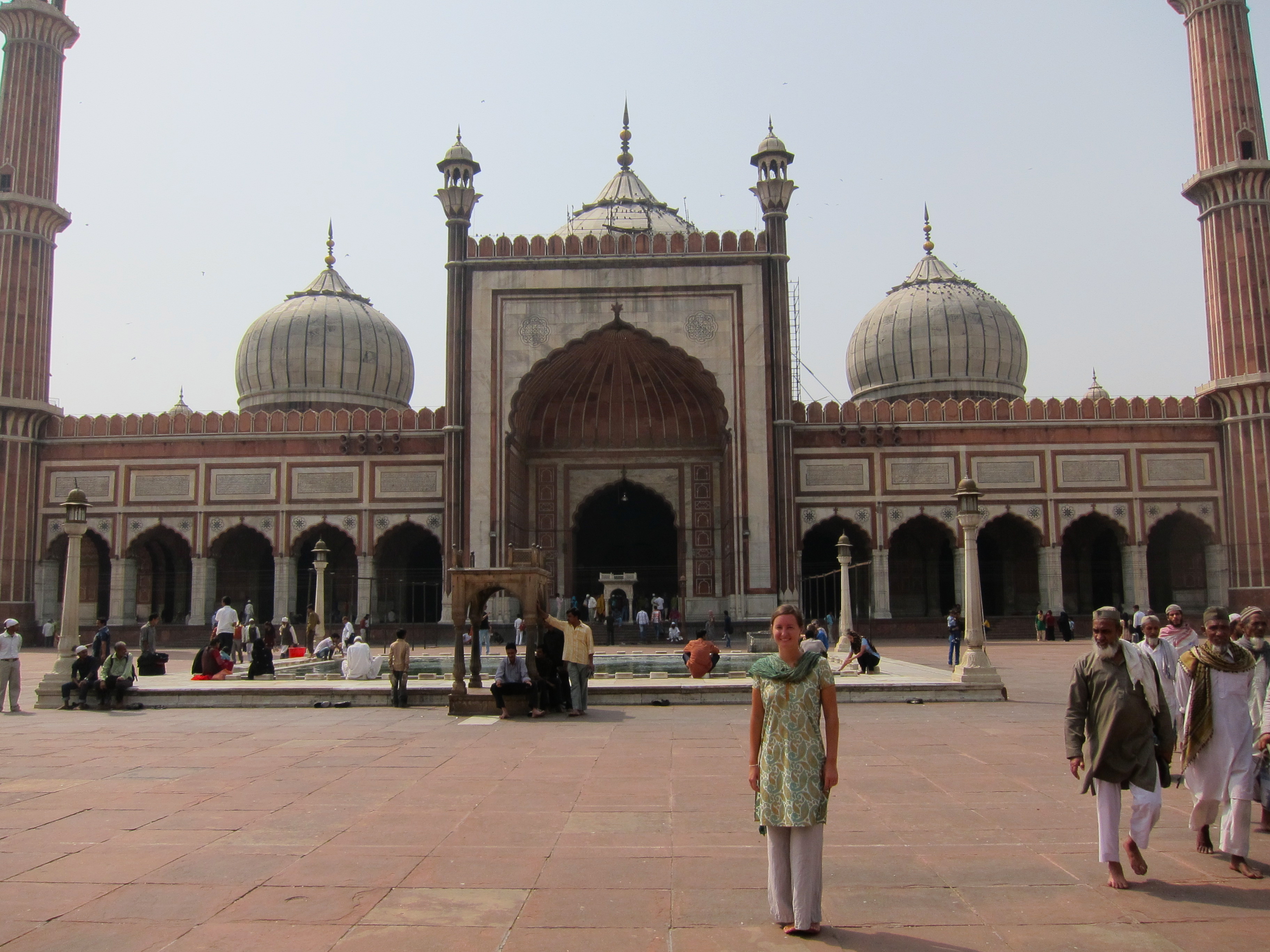
The front entrance to Jama Masjid

Delhi, India

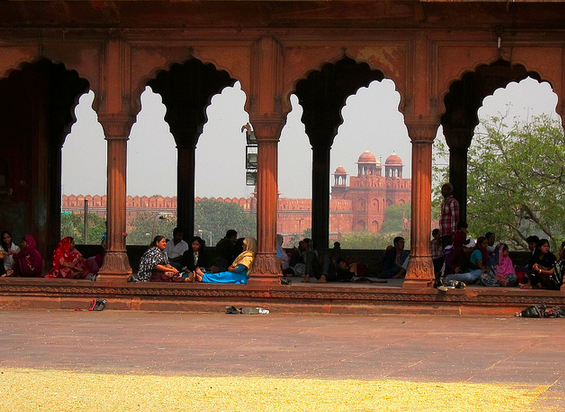
View from the interior, with Red Fort in the backdrop

Screen Shot 2014-12-17 at 5.45.42 PM

Steph in the courtyard. Behind her, worshippers drink and bathe in the small pool of water.

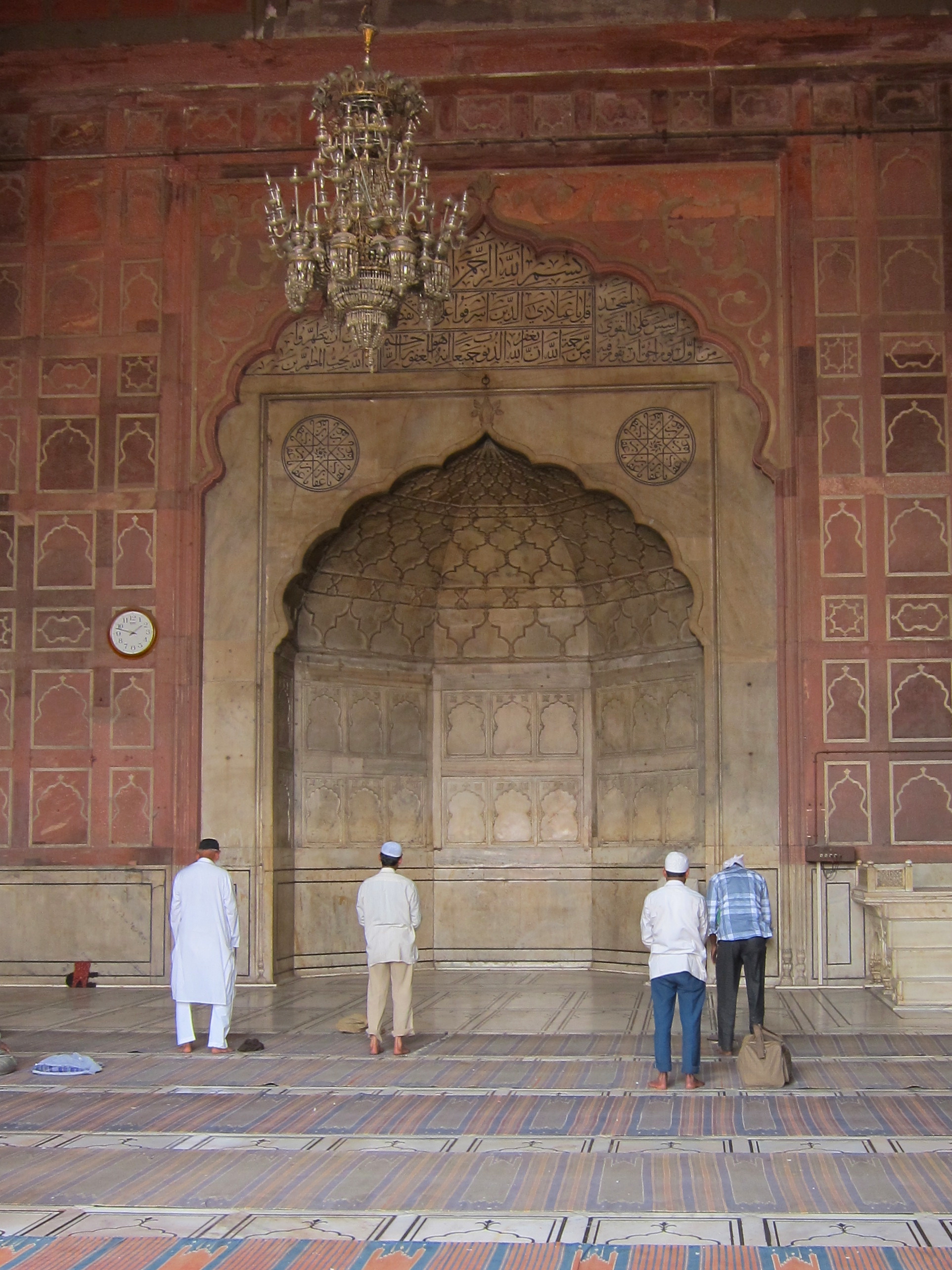
IMG_1260Worshippers in prayer, facing Mecca.

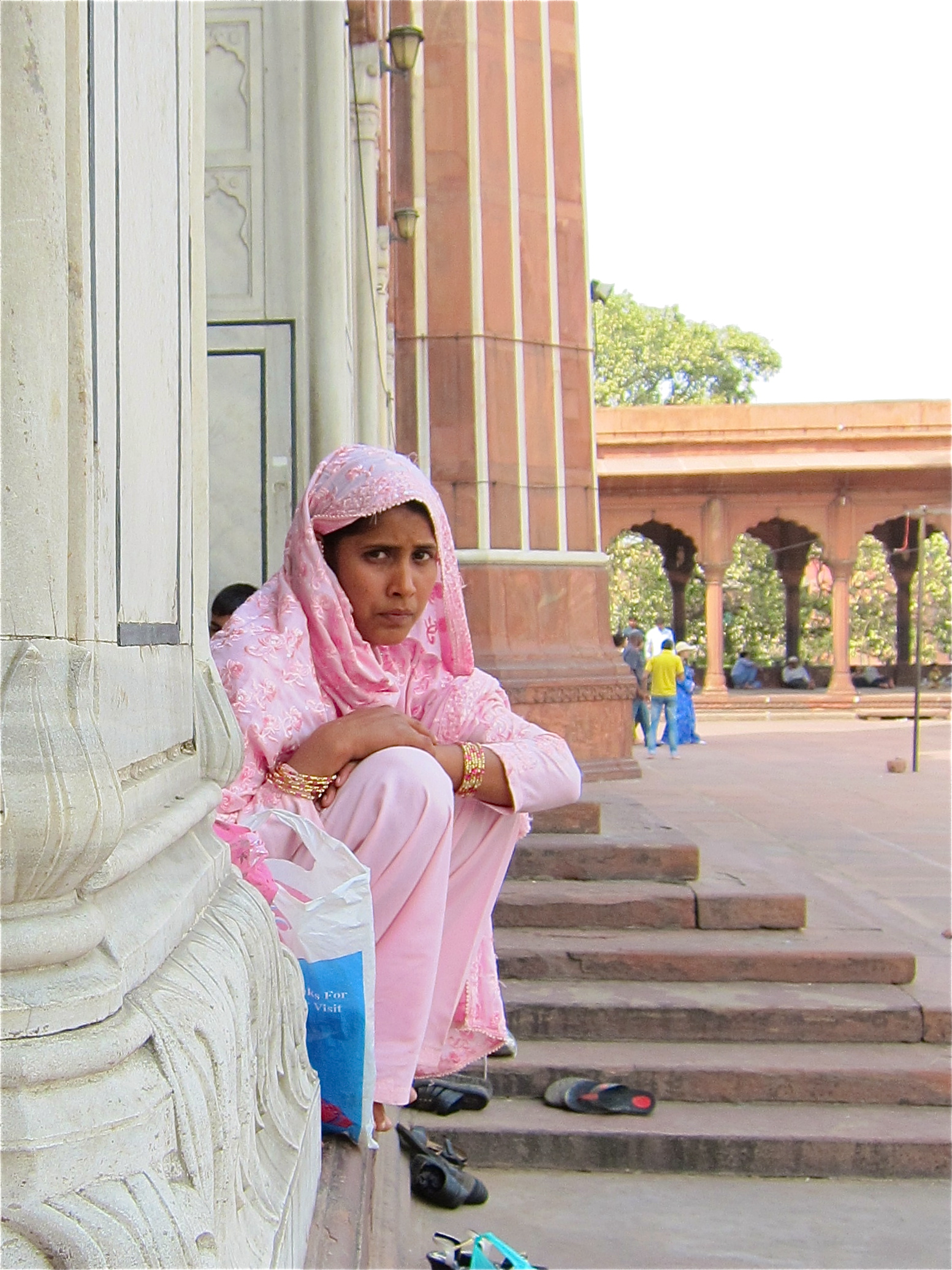
IMG_1261A woman at Jama Masjid

IMG_1268We entered Jama Masjid in between prayer calls, and inside, many people were performing the religious routines you’d expect to find in an Islamic temple: bowing in the direction of Mecca, reading their Quran propped on little bookrests, bathing in the pool in the center of the mosque.  Many were also eager to chat (“your country?”) and take their picture with us (something we’d soon get used to in India).

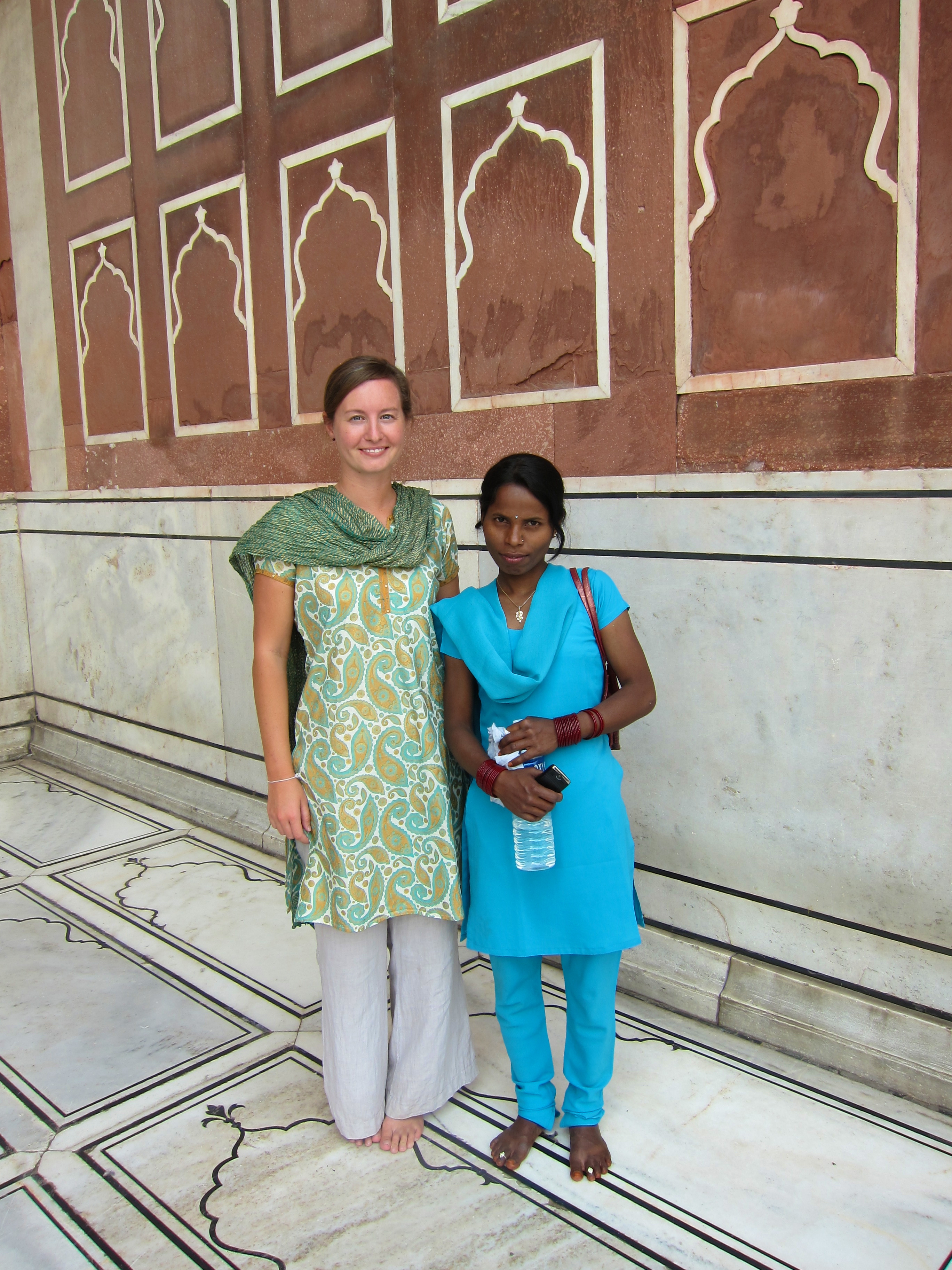
Steph saw this woman peeking at her several times before finally getting the courage to come up and ask for a picture with Steph.

IMG_1262http://www.flickr.com/photos/12339764@N00/6850459472/in/set-72157629618994675

…okay, we were the ones who asked for this picture:

IMG_1274Upon returning to New Delhi after a day in the Old, we’d seen enough that our eyes had begun to adjust. New Delhi began to look almost tame… almost. In the book Midnight’s Children, which takes place in India, Salman Rushdie calls it “city eyes”: this ability we all have to become accustomed to the filth, the begging, the suffering right in front of our eyes. It sounds cold, but without this ability, I’m afraid India would be completely overwhelming.

Delhi, India

Delhi, India

IMG_1217http://www.flickr.com/photos/12339764@N00/6996566599/in/set-72157629618994675

Delhi, India

Delhi, India

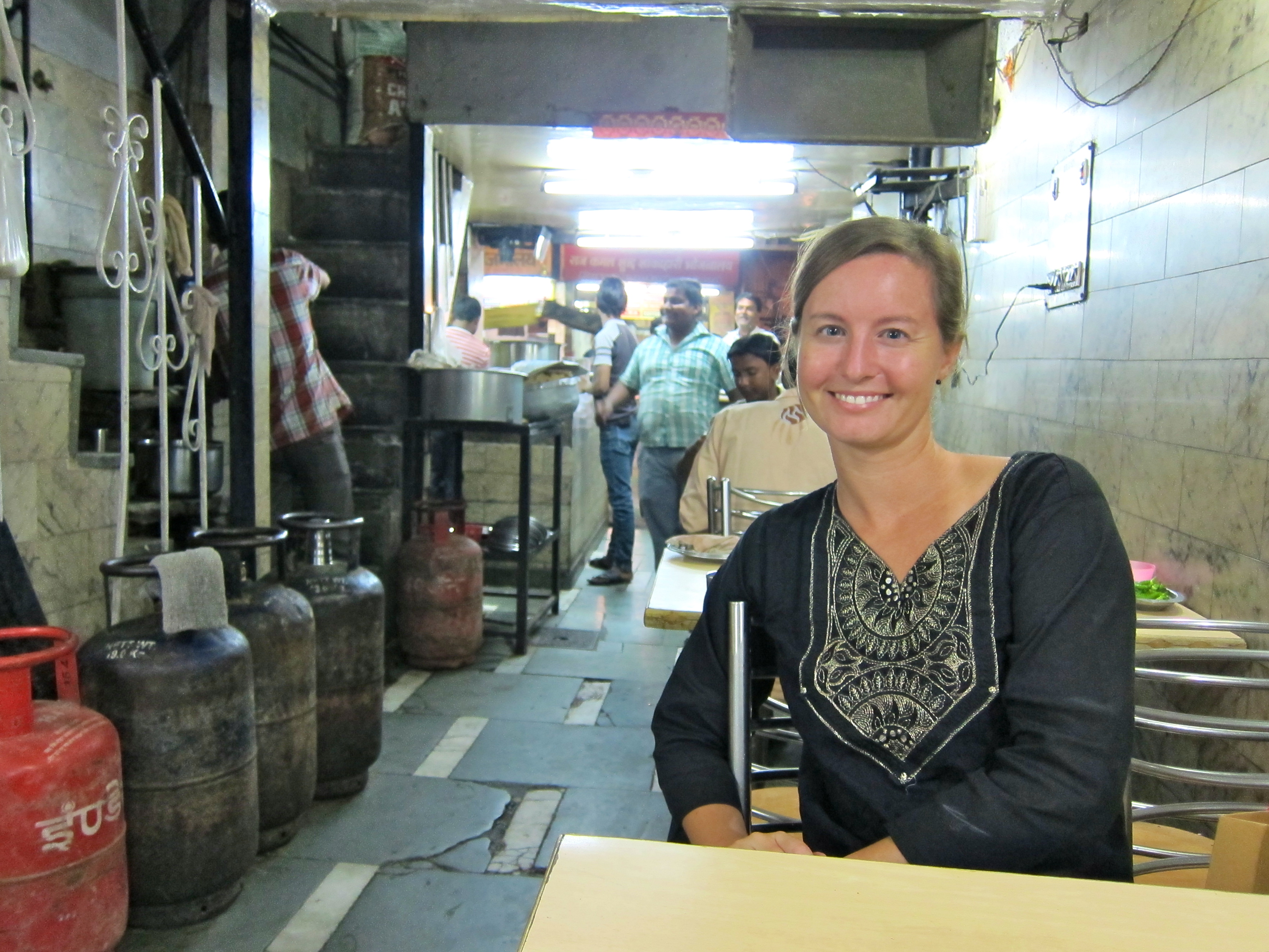
Steph out to dinner at a typical restaurant (Chana Masala and naan)

IMG_1244Gaining our city eyes would prove important in India, as it’s easy to dwell so much on that bad that you miss true beauty in between. India was already proving itself to us as a place unlike any we’d seen, and in our next stops, we were certain to see much more.

Delhi, India

Tangalle-d up in Sri Lanka’s coast

For our second and final week in Sri Lanka, we decided to head to the island’s south coast, where rumors of wild, beautiful beaches backed by lush green palms sounded too good to resist.

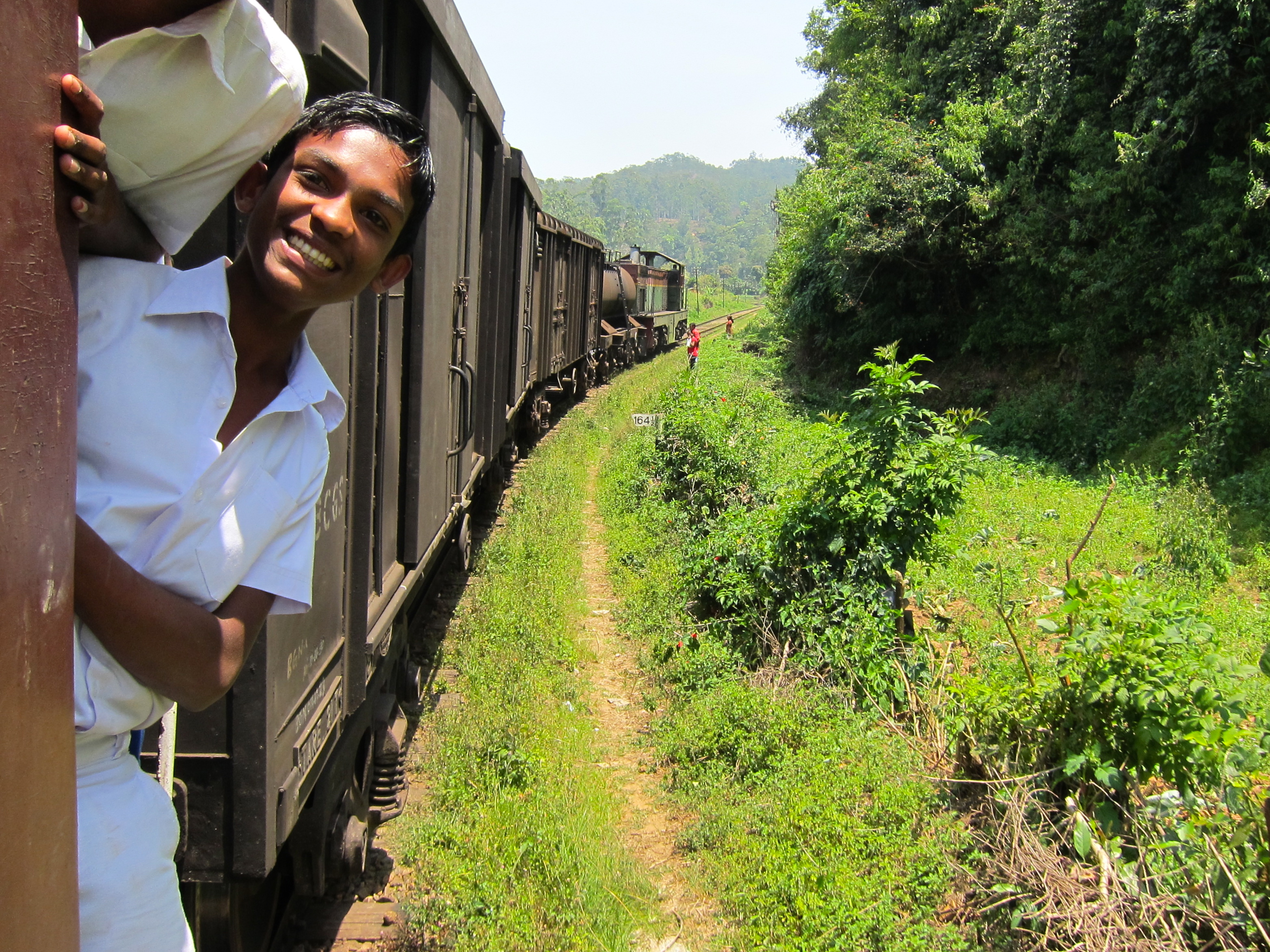
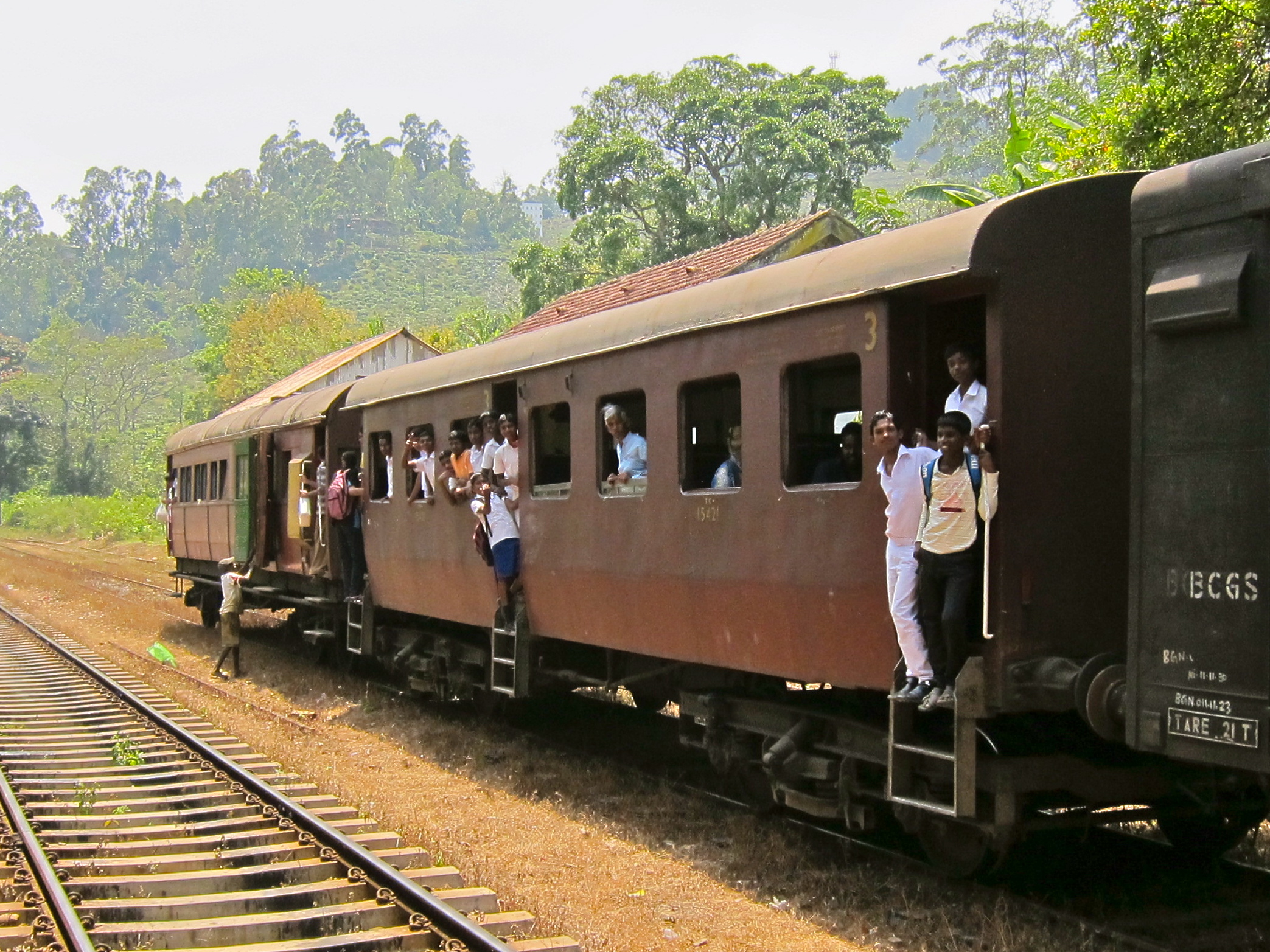
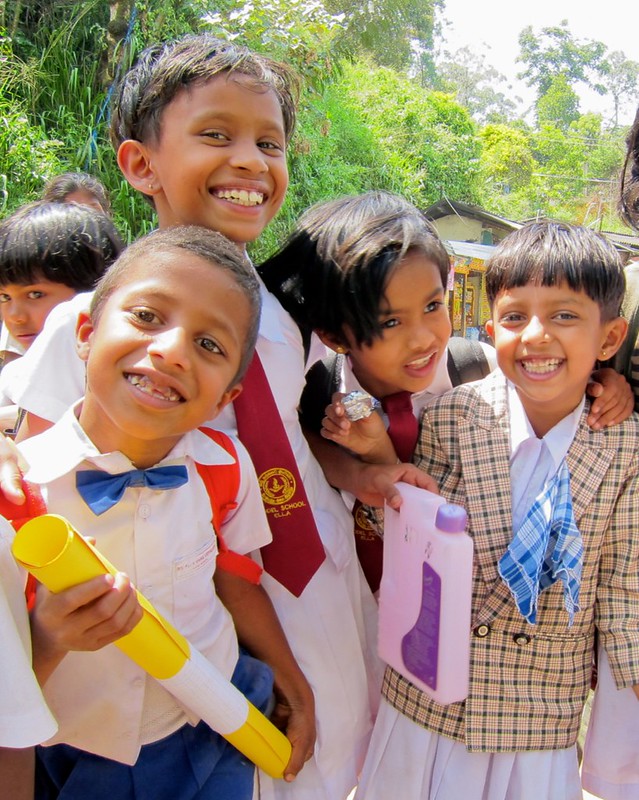
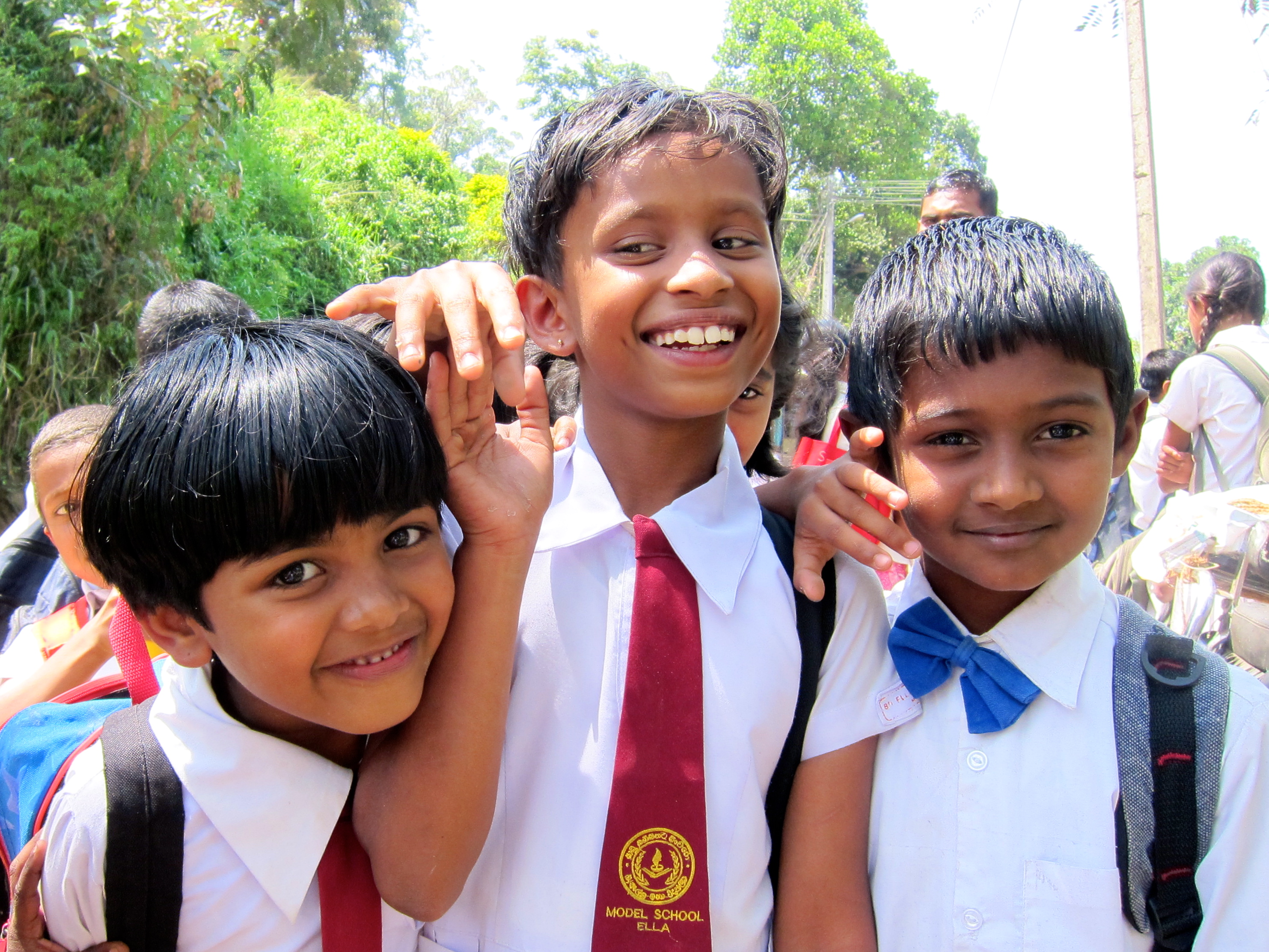
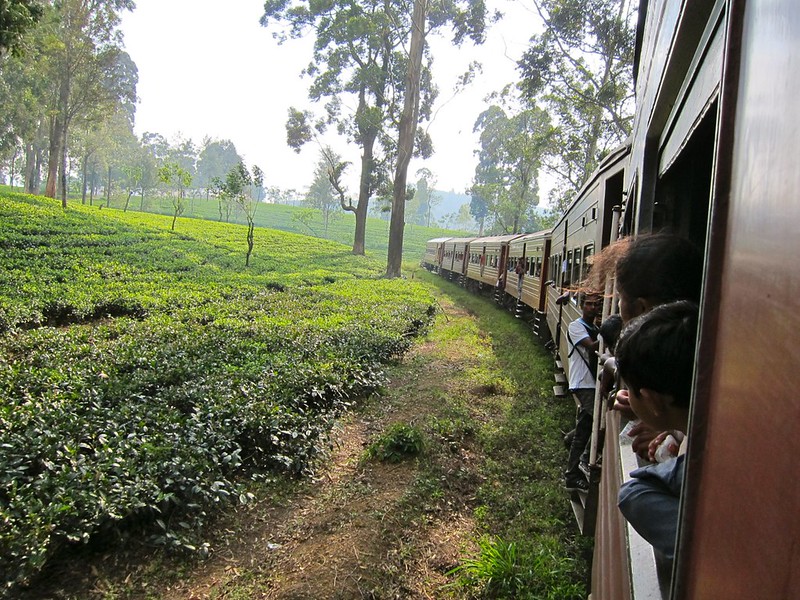
As if it were a sign of beautiful things to come, even the lazy, winding train ride there was bursting with gorgeous scenery and cute school kids on their way home from a cricket match (apparently, they even won first place).

IMG_1110IMG_1113

Train to Ella, Sri Lanka

IMG_1115Once on the south coast, we stopped in the town of Tangalle, home to a vast, beautiful beach where we caught our first ever glimpse of the Indian Ocean. It was night when we arrived, and the full moon over the turbulent waves made it all the more beautiful.

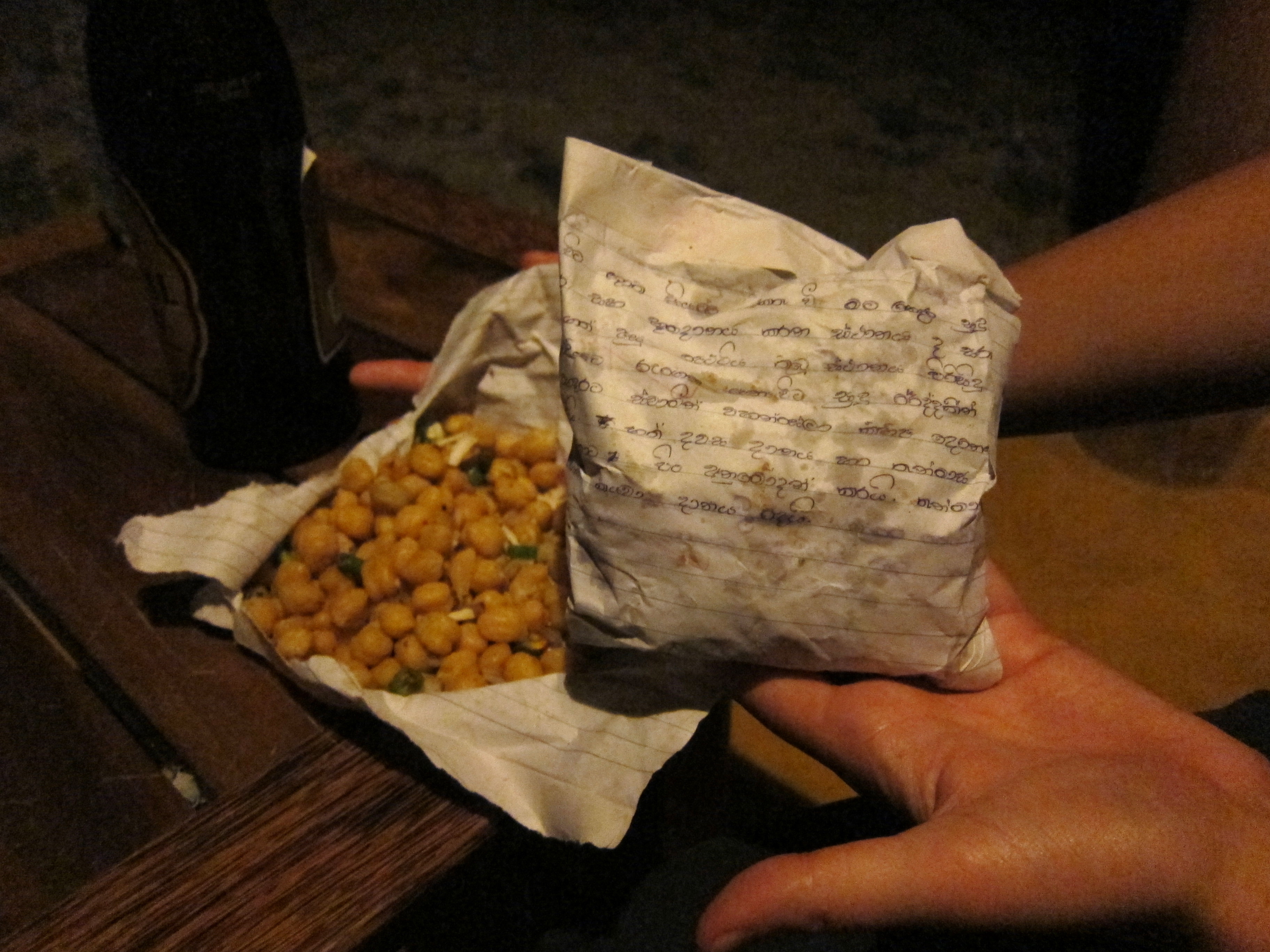
For dinner that night, we had brought with us a dinner of chickpeas, red onions, and chilies that we bought from a street vendor for 30 cents. Resourceful vendors in Sri Lanka take old homework or other used paper and fold it into little bags to hold the food – my dinner plate consisted of someone’s old medical lesson; Scott’s was written in Sinhalese– can anyone translate for us?

IMG_1122Dinner:

Tangalle, Sri Lanka

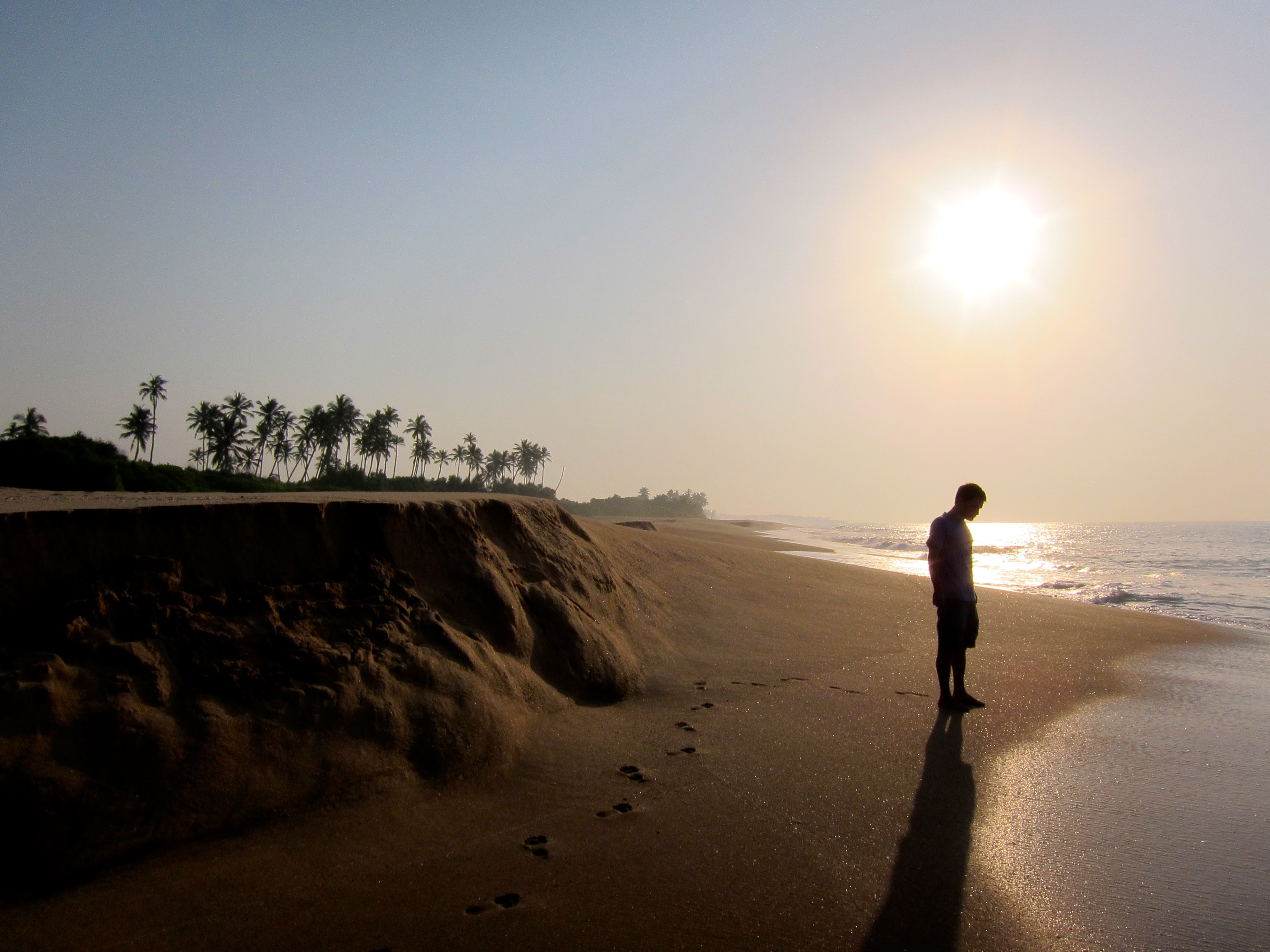
Tangalle beach at daybreak:

IMG_1128http://www.flickr.com/photos/12339764@N00/6996177647/in/set-72157629253364848/

“Tangalle”, or as I like to call it, “where seashell collectors go to die”:

The beach at Tangalle was far too dangerous to swim, due to monstrous waves and a steep shore break, so we spent just one night and moved on to the beach town of Mirissa.

Mirissa was a beautiful, tiny coastal village with not much to do other than surf, eat good curries, and relax on the beach. Unfortunately, our blog post about Mirissa got inadvertently deleted one day, so some pictures will have to suffice:

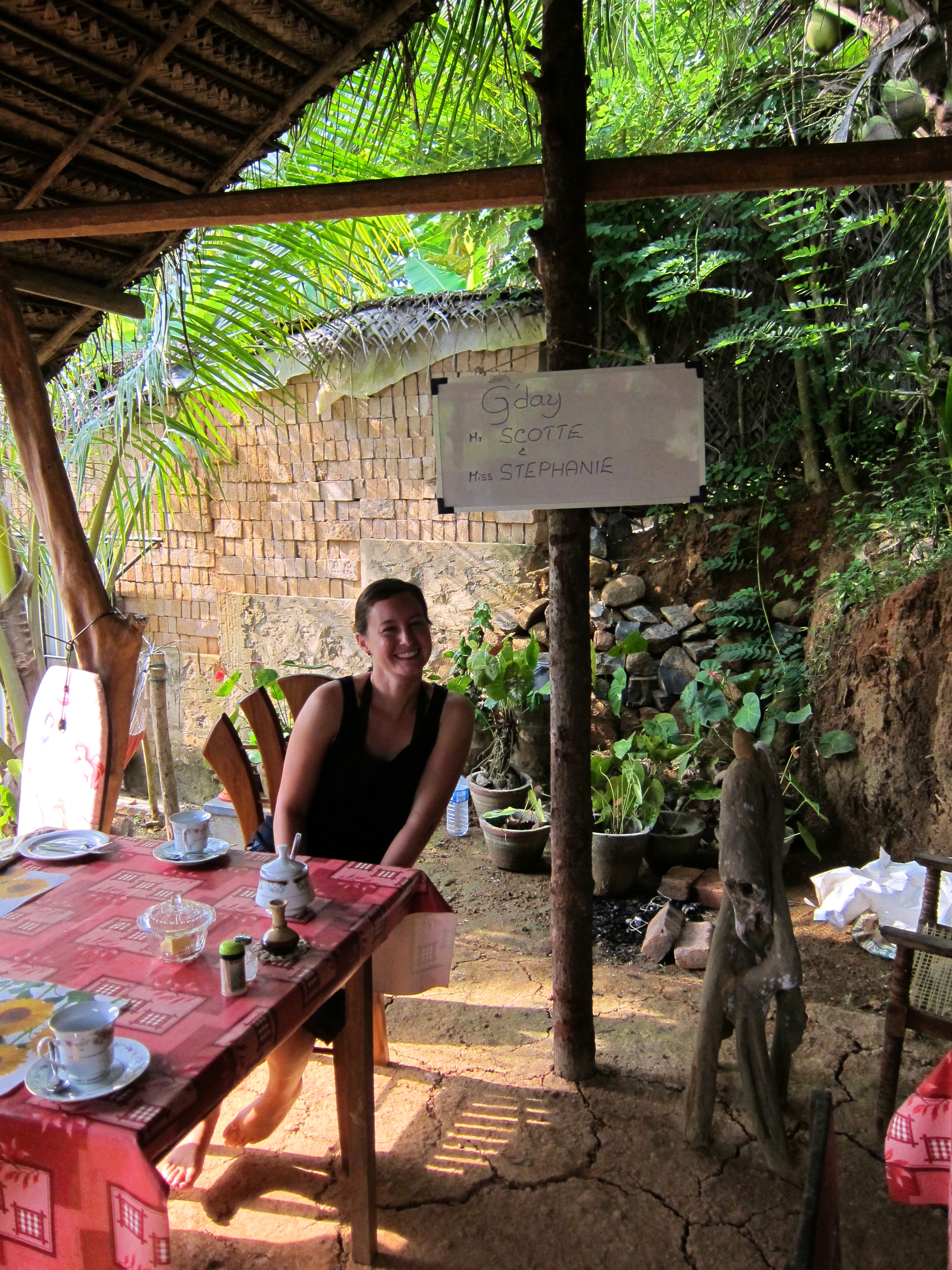
The homestay that we stayed at put out a sign one day to greet us with what they thought was an American saying. It read: G’day Mr. Scotte and Mrs. StephanieIMG_1153 IMG_1181 IMG_1177  IMG_1165

IMG_1142 IMG_1148 IMG_1144

Rolling in the Sri Lankan Hills

Pulling into the ground transport hub outside Colombo, Sri Lanka was a breath of exhausty, dusty, body-odorous air. We bumped our way through crowds of hawkers and honking tuk-tuks to find our way to the correct repurposed school bus and lumbered ourselves in, cramming – bags and all – into a one-and-a-half person wide seat to wait for the bus to load. There we sat in the stifling heat, unsure of when the driver would show, whether we were on the right bus, or even how soon the bus would depart.

Transport days… we’ve come to learn not to judge any place by its first appearances, and Sri Lanka was proving no different. Alas, the time had come for a change of scenery for us and it was thrilling to be out of our comfort zone again – back on the road and experiencing something new – just the reason we left home in the first place!

http://www.flickr.com/photos/12339764@N00/6817295456/in/set-72157629537384911/

The differences were all around, and helped to warm the mood.

The colors! Outside our window was a legitimate mess of activity, like a toddler’s plate at Thanksgiving. Women bustled around the station draped and tucked into vivid saris, the men in patterned lunghi kilts and linen collared shirts. Dahl curries stewed in the shop-fronts alongside towers of roti samosas filled with starchy veggies, yellow-orange turmeric, cumin. Replacing the motorcycle-pulled tuk-tuks we’d come to know well in Cambodia were sleek, egg-shaped “three-wheelers”, painted black, green, yellow, blue, sometimes tan.

http://www.flickr.com/photos/12339764@N00/6963417473/in/set-72157629537384911

IMG_0839Soon enough, our bus driver hopped up and started the engine. Off we were to Kandy, a historic and cultural hub of the country. Along the way, deep blue skies and banana trees blurred together out our window as everyone on the road, especially the bus drivers, treated the narrow rural roads like a race course and the traffic lanes like a naive suggestion. Before long, we were in bustling Kandy negotiating a fare with a 3-wheeler driver who would take us to our guesthouse, Sevana.

Sevana was a welcome and quiet retreat from the streets outside. We checked into our room, tossed our bags on the floor, and gazed out the screen window of our room… “Where the heck are we…?”

http://www.flickr.com/photos/12339764@N00/6817296046/in/set-72157629537384911/

Tea Plantations, Haputale, Sri Lanka

Throughout our time in Sri Lanka, that “where the…” feeling never really went away – it was quite a change from the scenes we’d grown used to in Southeast Asia.

We stayed long enough in Kandy just to get our Indian visas submitted, which was an adventure in and of itself– one frought with overly-picky Indian visa officials (there’s a shadow behind Steph’s ear in her application photo? Go get a new one!), multiple trips to the internet cafe next to the visa office, the discovery that the U.S. had made an error on Steph’s passport which the Indian officials kindly pointed out to her, our encounters with extreme gender inequality with security guards who only search/interrogate women, and a Muslim man who, upon learning we were American, asked us if we were afraid of his beard!

Feeling we’d been slung through the wringer at the visa office, we did little else in Kandy than wander the city for an afternoon or two, and try some delicous new foods, such as the rotis and curries at Kandy Muslim Hotel (which like most “hotels” in Sri Lanka, aren’t hotels at all, but restaurants).

http://www.flickr.com/photos/12339764@N00/6817297574/in/set-72157629537384911

Nearing the end of our lunch at Kandy Muslim Hotel, we were encouraged to eat faster, faster, then as-fast-as-possible and (as kindly as possible) GET OUT!– they were closing the entire restaurant, as they do every day at 12:30, for their afternoon call to prayer. The patrons filed out, the metal security door was pulled down tight, and twenty minutes later, they were open for business again.

http://www.flickr.com/photos/12339764@N00/6817297742/in/set-72157629537384911

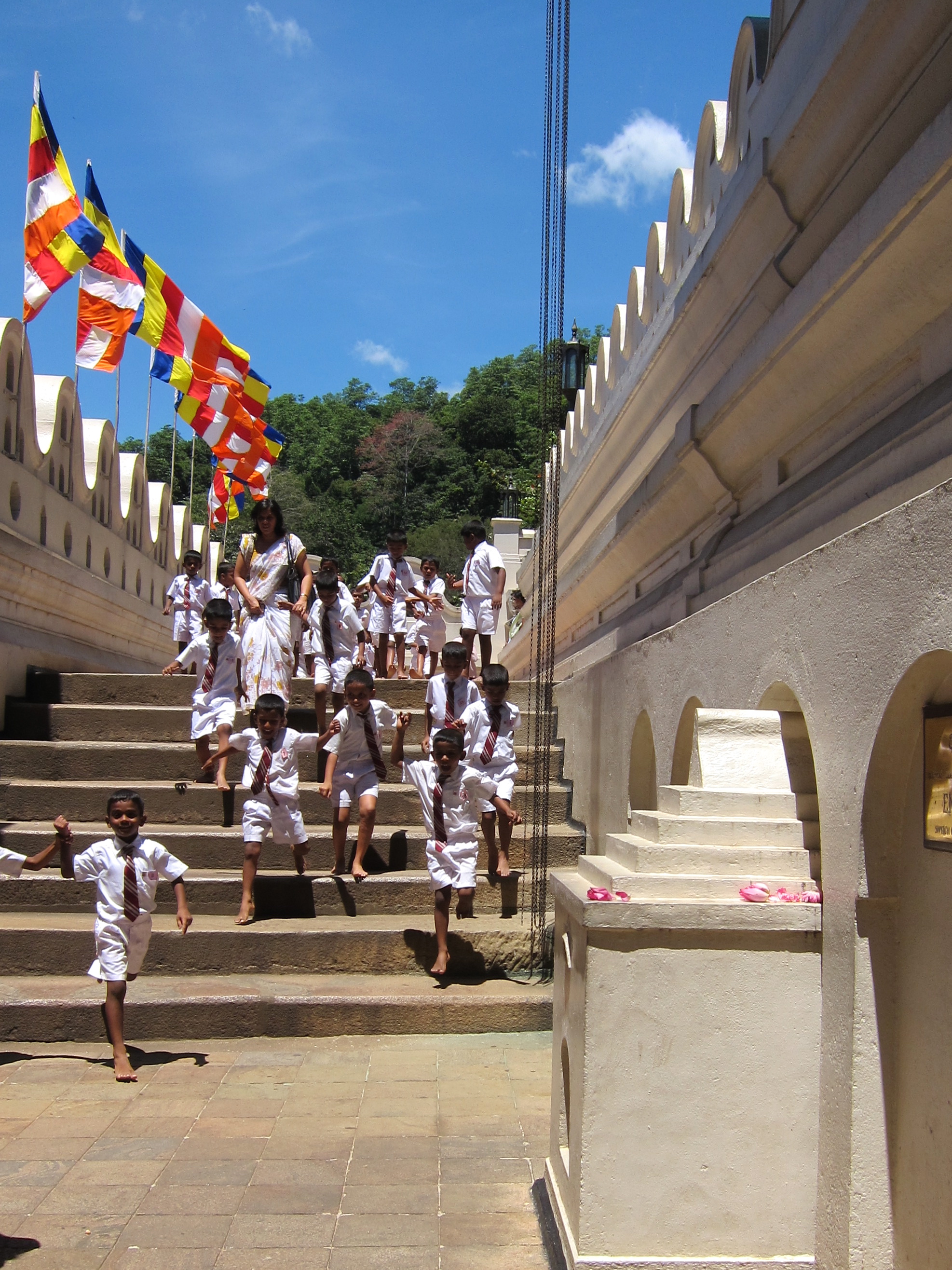
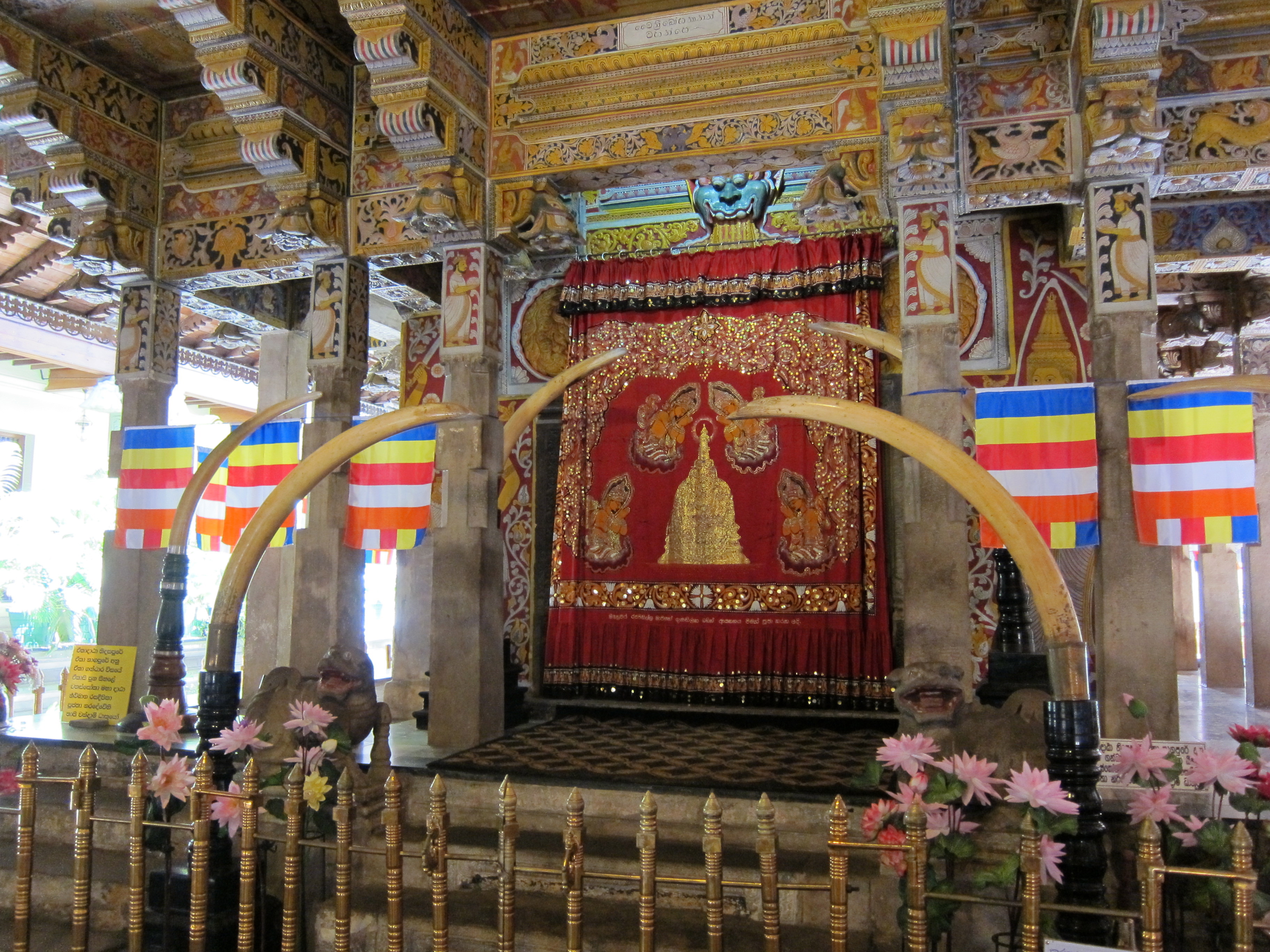
While in Kandy we also toured the Temple of the Sacred Tooth, which holds one of the teeth of the Buddha, apparently plucked/stolen from his cremation pyre and passed down through generations.

IMG_0815Visitors to the temple aren’t able to see the actual tooth itself (it sits inside the smallest of 5 gold boxes, with each smaller box fitting inside the next like a Russian doll), but we did walk by its holding shrine to find hundreds of devotees that had made the pilgrimage to worship before it.

IMG_0820…and gawk at the uninvited patrons in the trees outside:

http://www.flickr.com/photos/12339764@N00/6963421825/in/set-72157629537384911

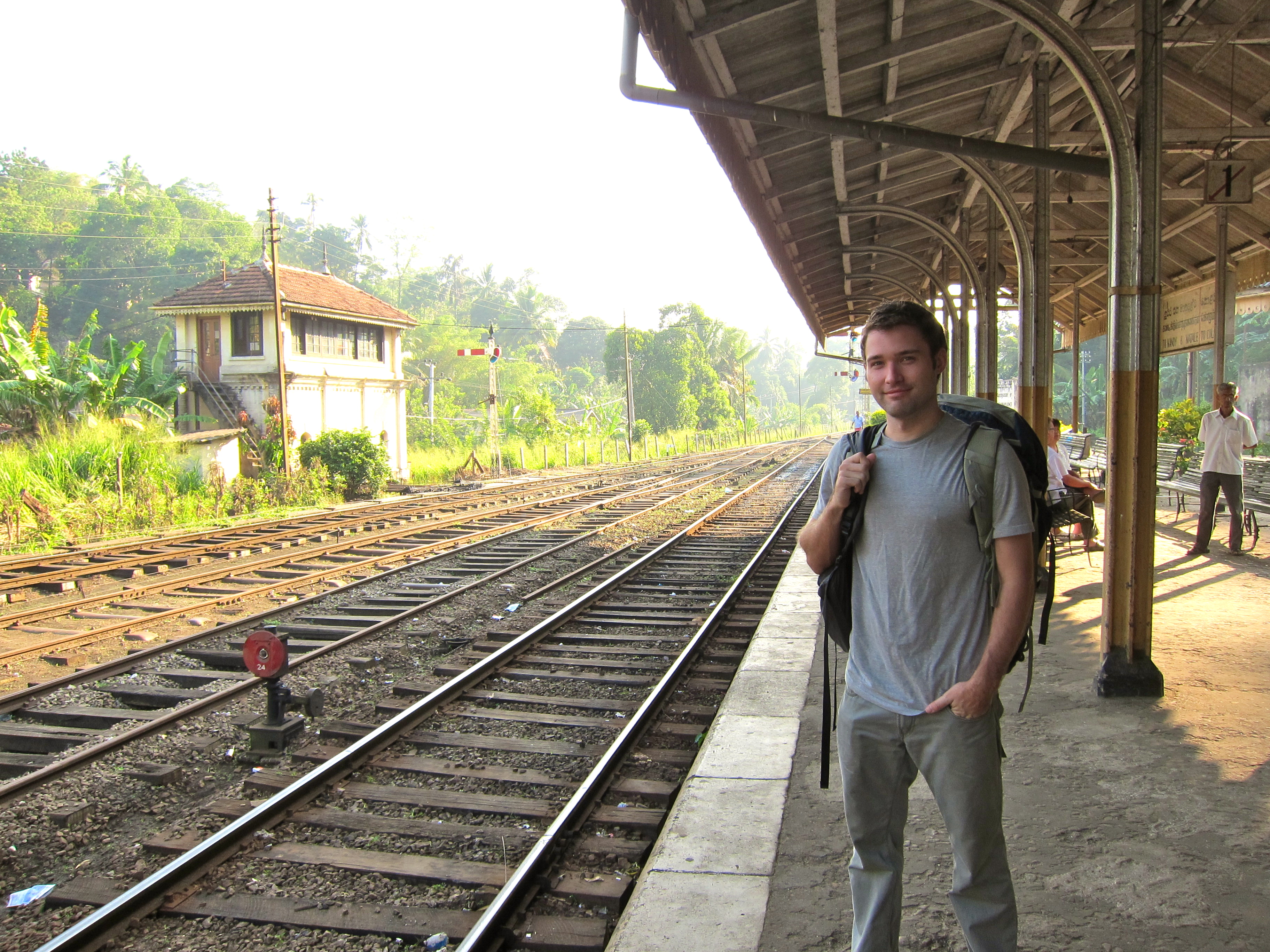
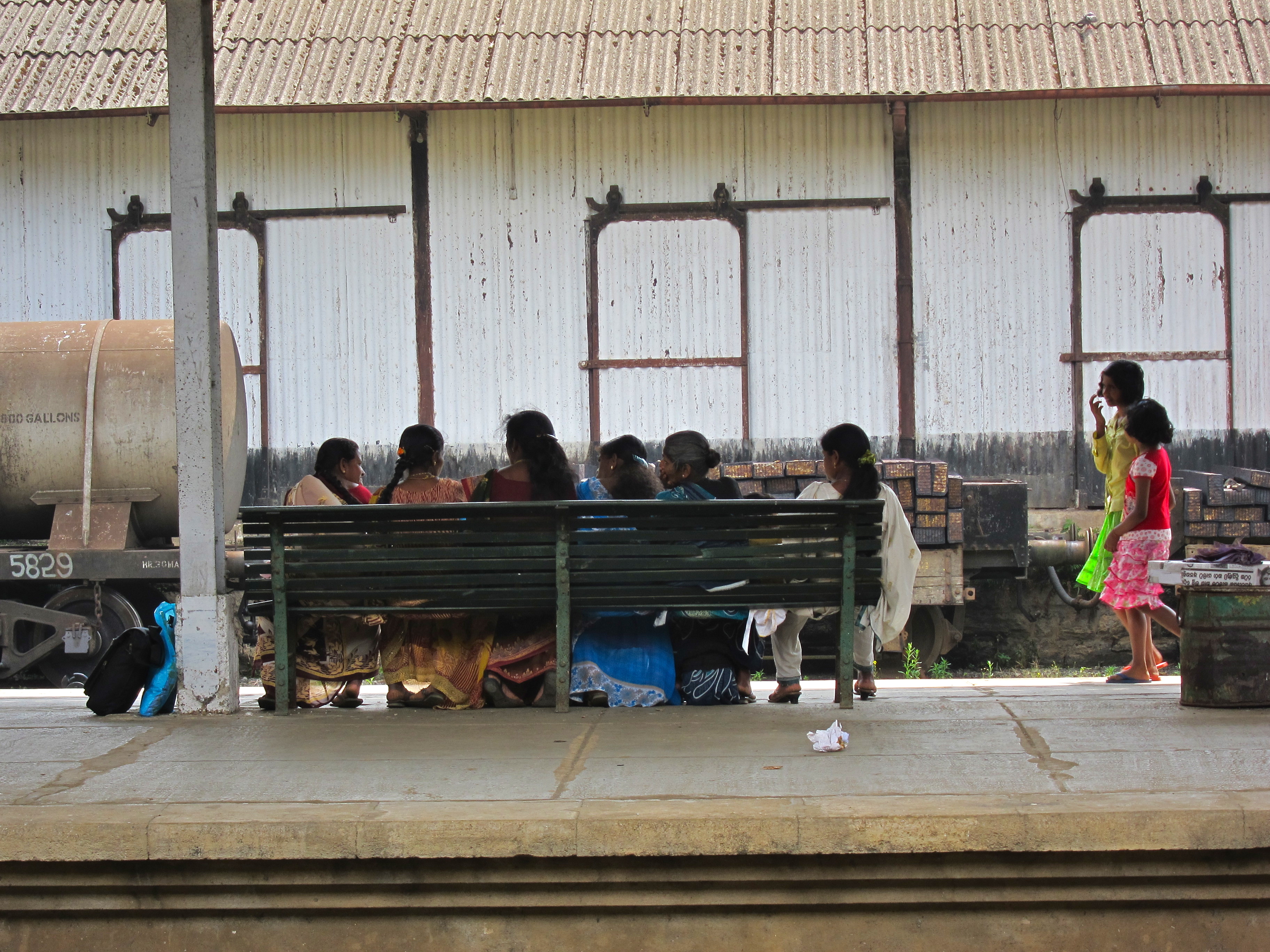
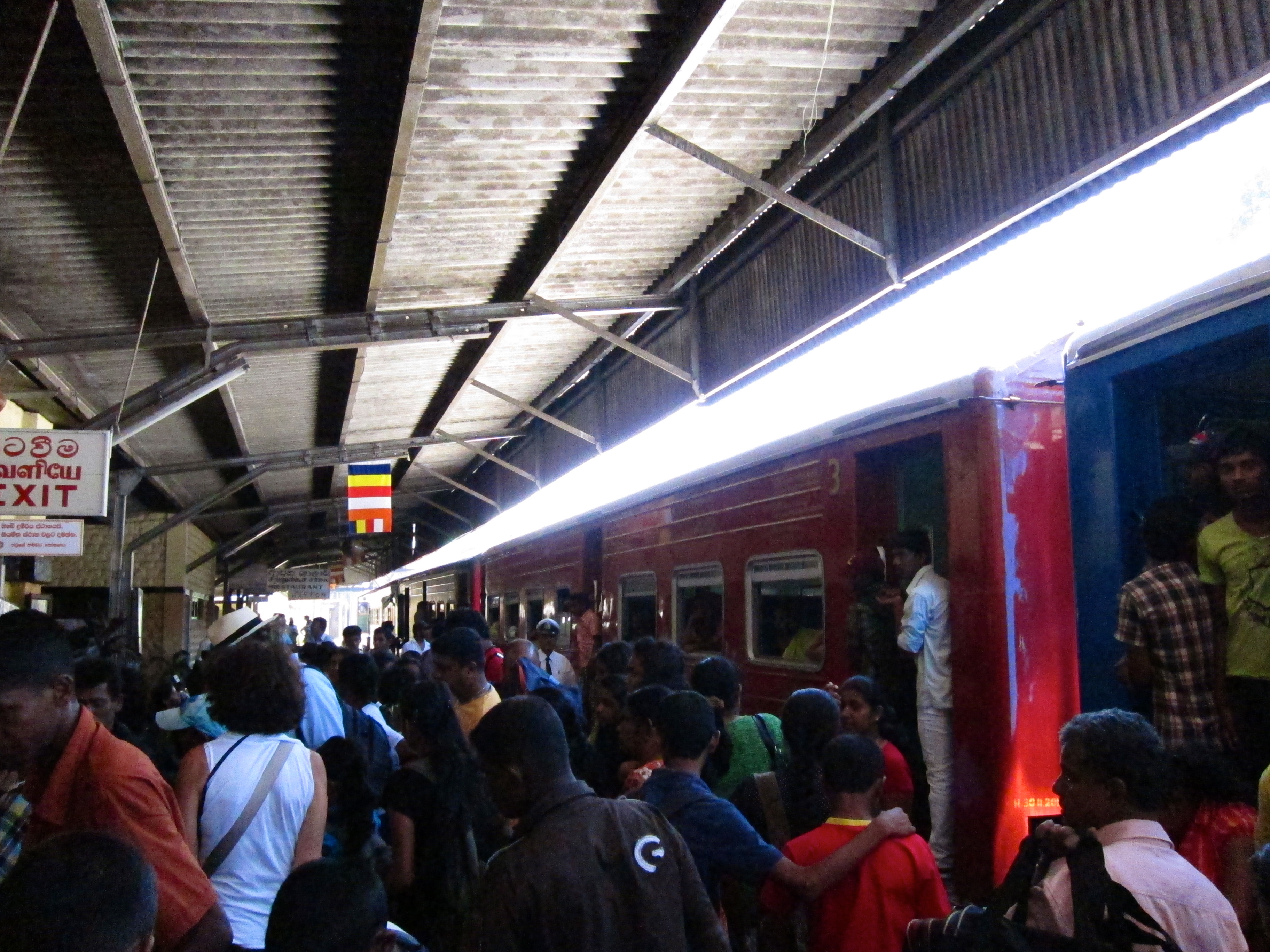
Before long, we were rumbling out of Kandy and into the mountains aboard what quickly became one of our favorite traits of Sri Lanka: the railways. Trains in Sri Lanka felt like more of a forum for social gathering than a mere means of transportation: families laugh and toy with each other, young kids hang out the windows and scream when the train passes through a tunnel, vendors hawk wadi-wadi and cups of chai to travelers, all while crossing through and towering over the most awe-inspiring scenery.

IMG_0856http://www.flickr.com/photos/12339764@N00/6817305290/in/set-72157629537407847

[Women in saris, waiting for a train…]

IMG_0979The only downside it seems is that the trains can get crowded– very crowded.

[fighting to get into the 2nd class train..]

http://www.flickr.com/photos/12339764@N00/6817305436/in/set-72157629537407847

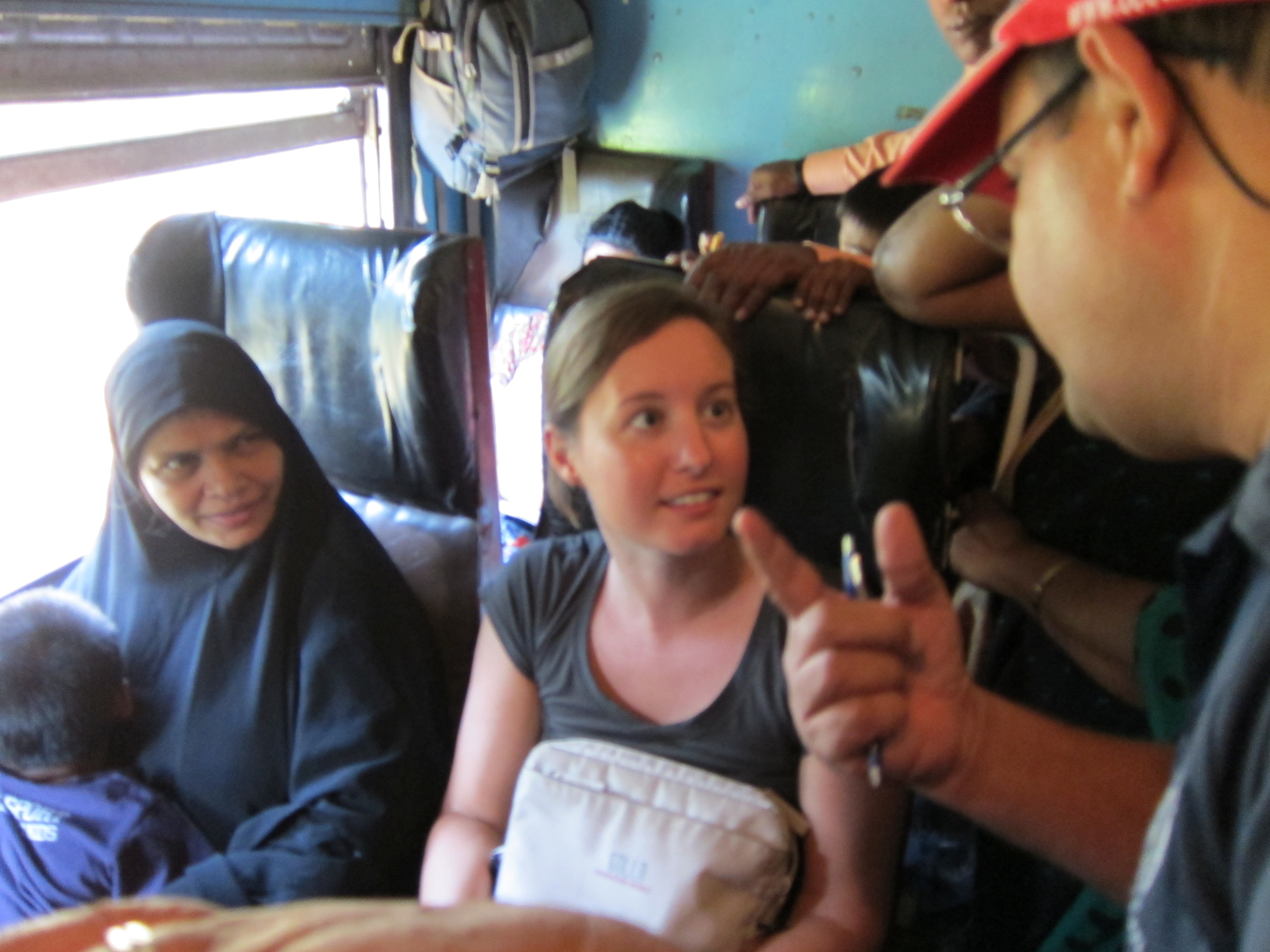
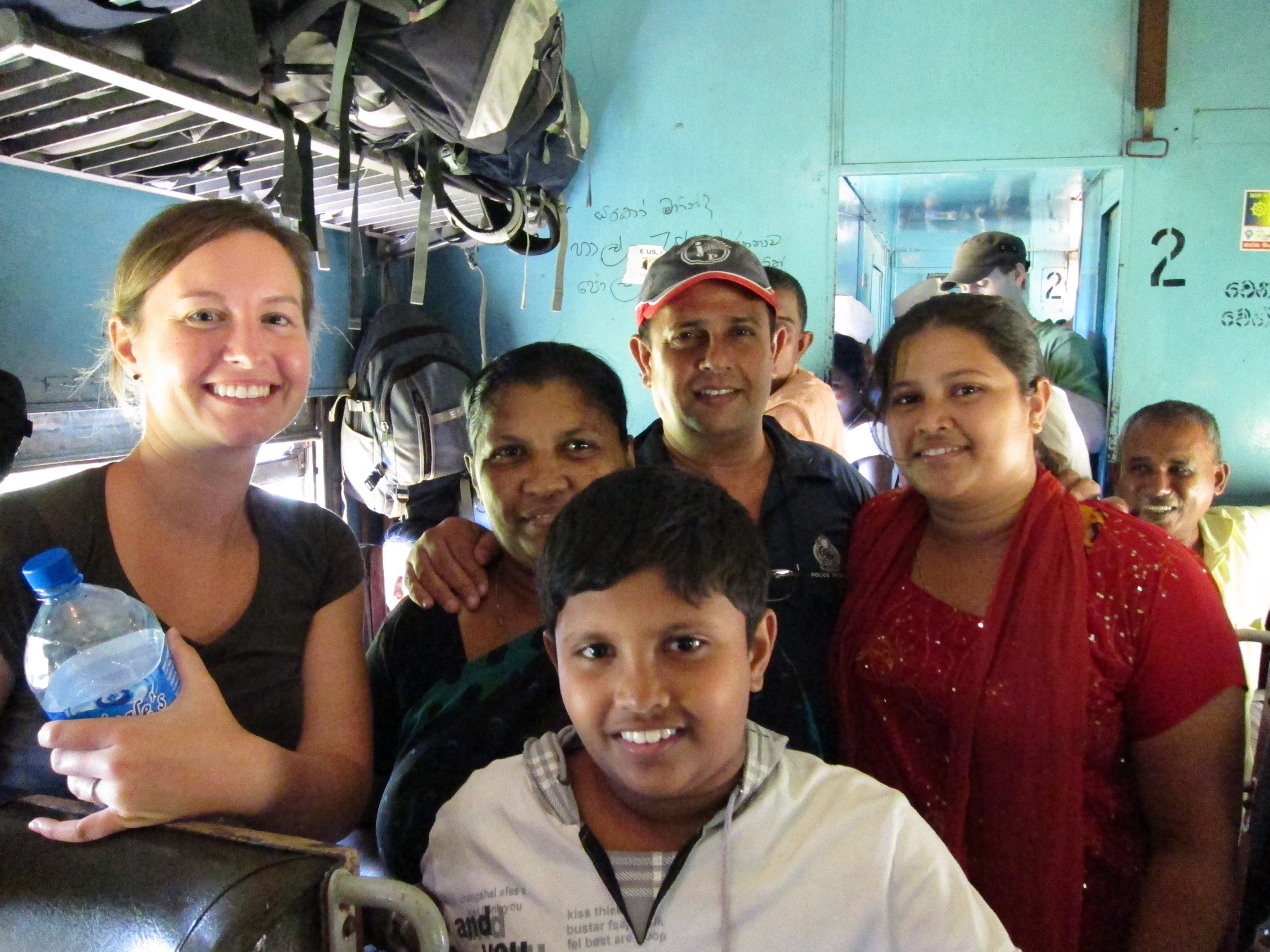
IMG_0877That first train into the Hill Country arrived packed to the gills – we grabbed our bags, held our breaths, and pushed our way into the packed car. But we had only been standing in the train car for about 30 seconds when a woman offered Steph her seat. Steph was eventually forced to sit despite repeated polite refusals, and before long we were part of her family (complete with little kids crawling all over Steph’s lap and all of us sharing a bag of chili-spiced olives). The dad took pleasure in my request for him to teach us some Sinhalese, perhaps too much… We didn’t know how to ask how much something costs, but we could say “you are beautiful”, “what is your telephone number?”, and “I love you; do you love me?”  Hmm.

IMG_0864IMG_0875

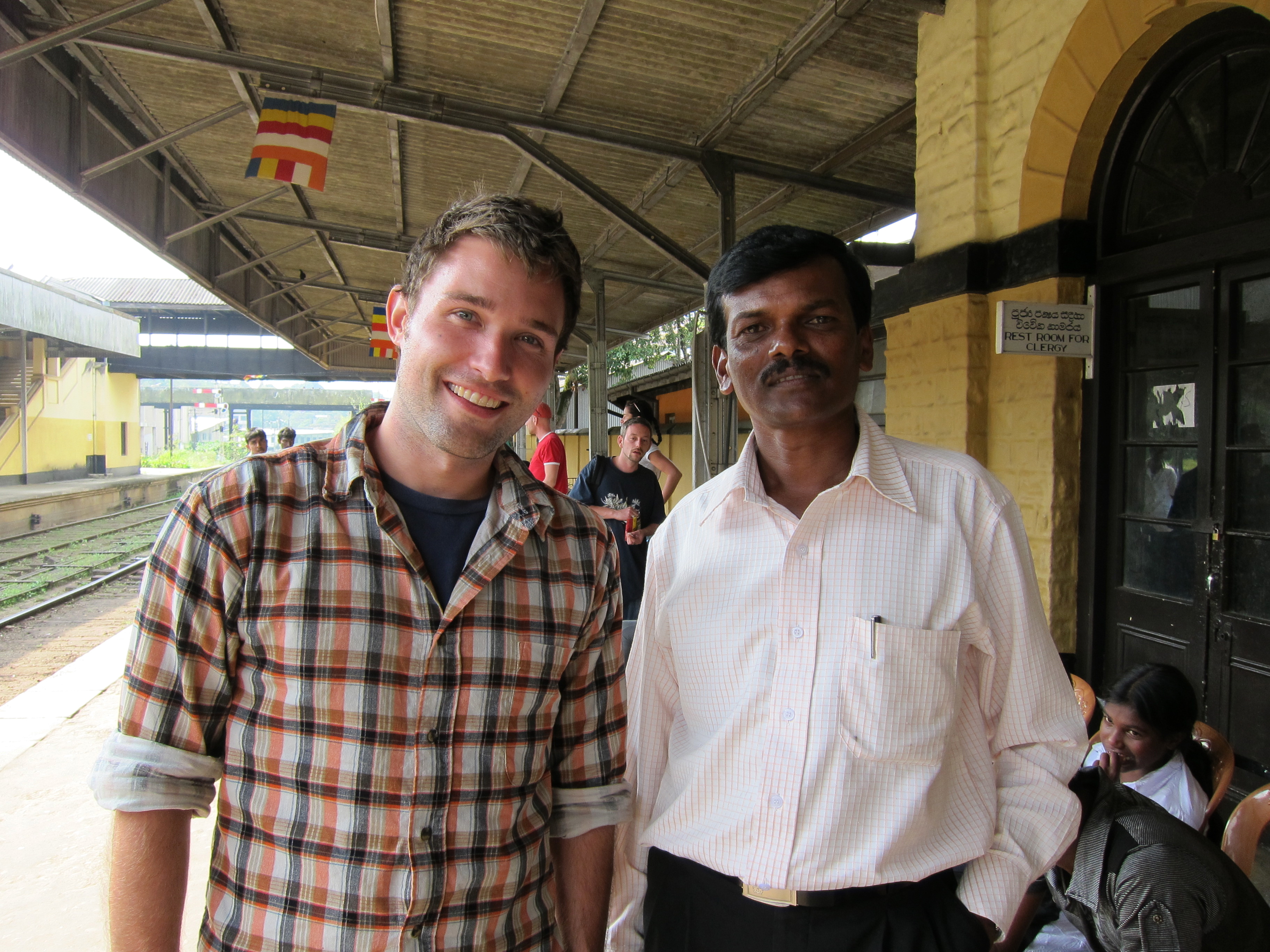
That train dropped us in Hatten. Our friends from the train helped us off, and in an early show of Sri Lankan hospitality, were the first of many to give us their phone number, even offering to pick us up from the train station if we ever needed a lift! In Hatten, we made a short and memorable stop for a dawn hike up Sri Pada. From there, we took another train, where we met a man named K.I., a school principal who was on his way back home after visiting a friend. We spent the afternoon chatting with him at the train station and later on the train itself, pointing out for us various natural landmarks and waterfalls of his beautiful part of the country.

Haputale, Sri Lanka

Just before the train reached K.I.’s stop, he bought us all a round of banana bubble gum from the train vendor, gave us his telephone number, and promised to check in with us later.

IMG_0986Several stops past K.I.’s house, we reached Haputale and settled into our guesthouse – just in time to catch a call from K.I., making sure we had made it. From that day, we received a call from K.I. every day until we left Sri Lanka. Given the language barrier, our conversations were pretty rudimentary, and nearly identical from day to day, but they somehow left us laughing every time he called and looking forward to hearing from him again.

In Haputale we stayed at a small family-run guesthouse where we were brought in as one their own – indeed, the father’s belief in tough love applied to us as much as it applied to his kids and we were politely scolded if we showed up to dinner a little late… which we never were again… after the first time.

[The view from our room:]

Haputale, Sri Lanka

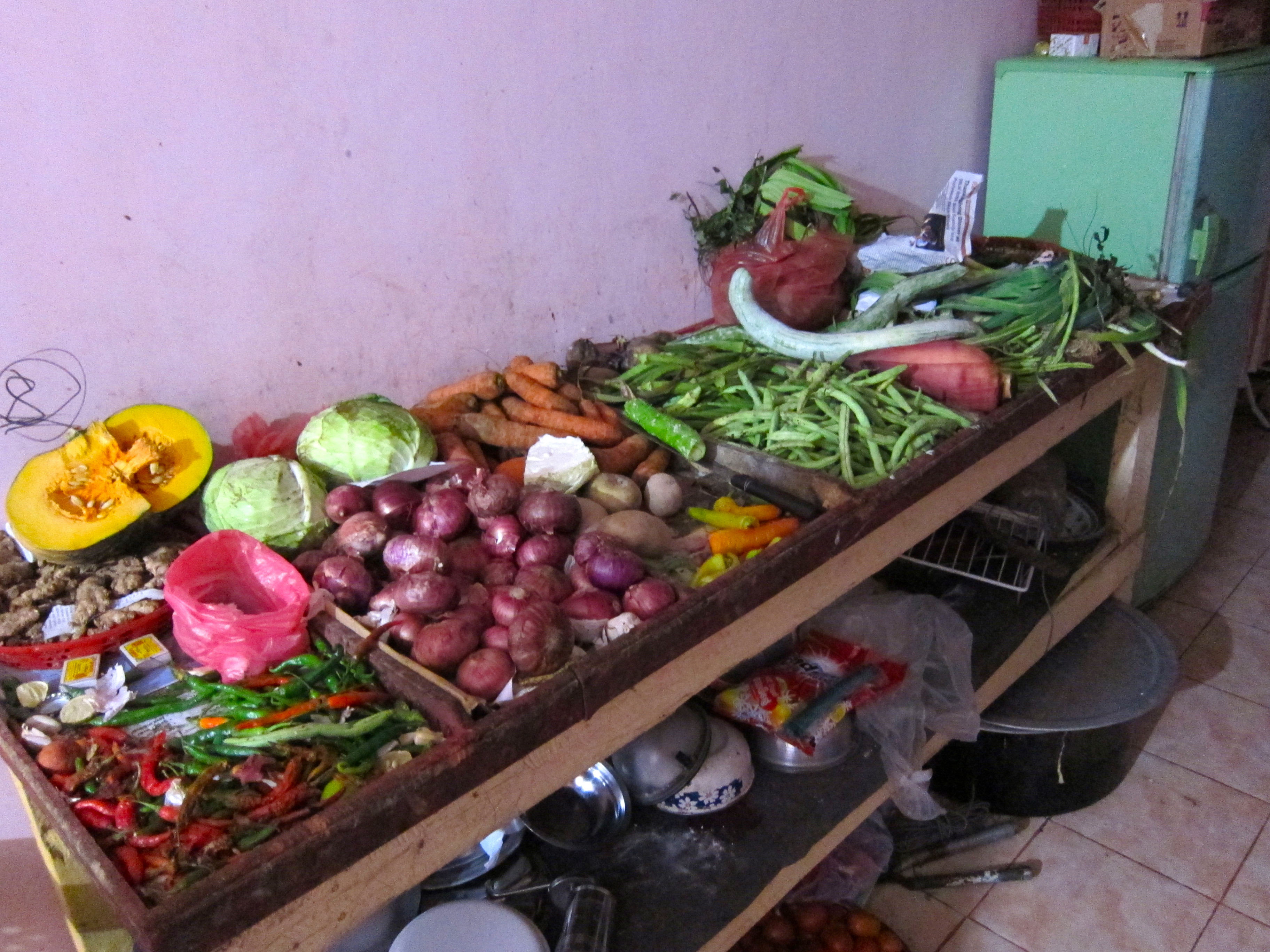
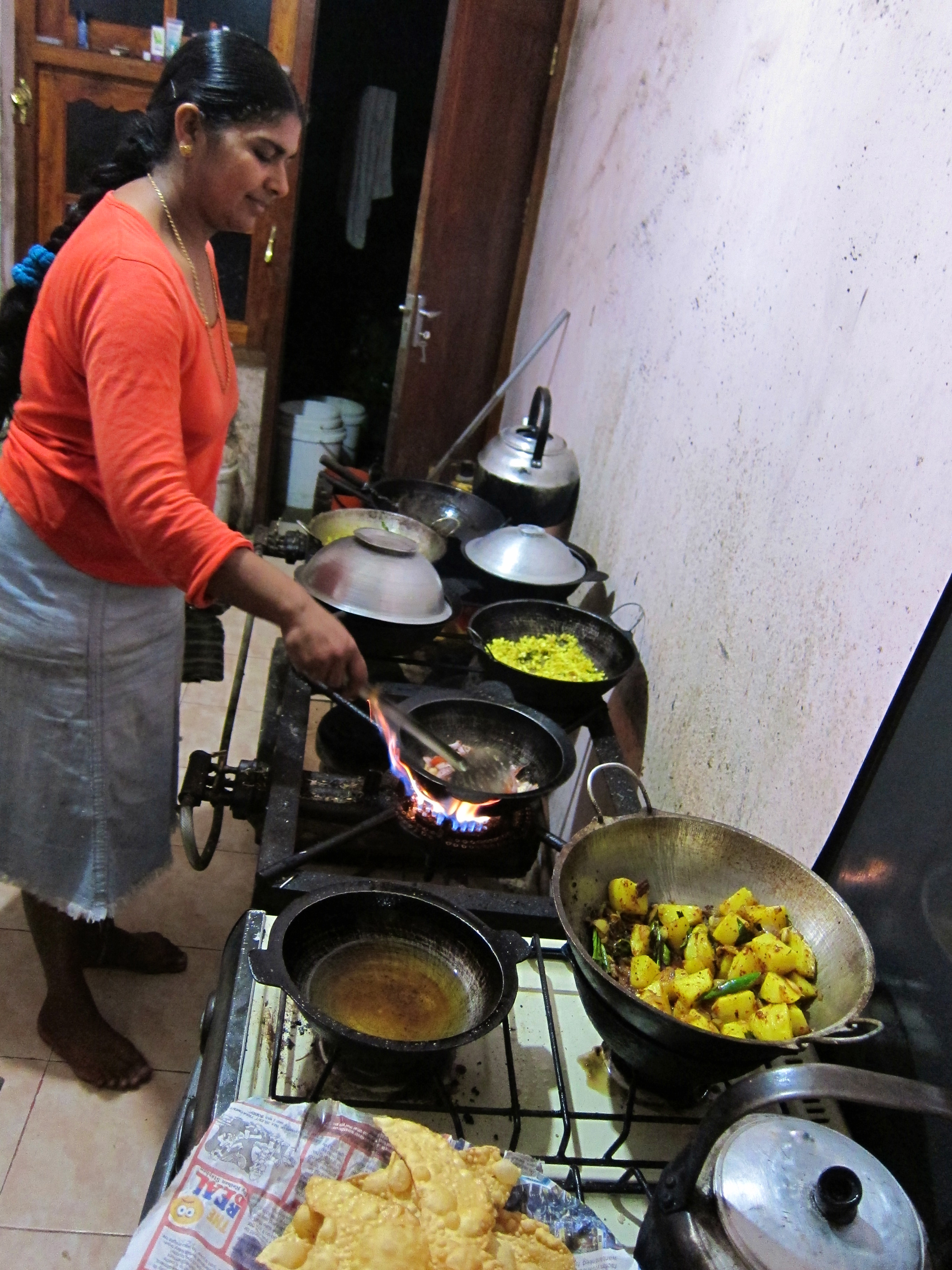
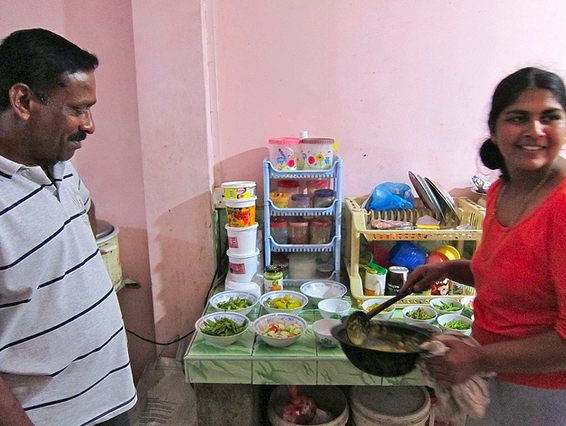
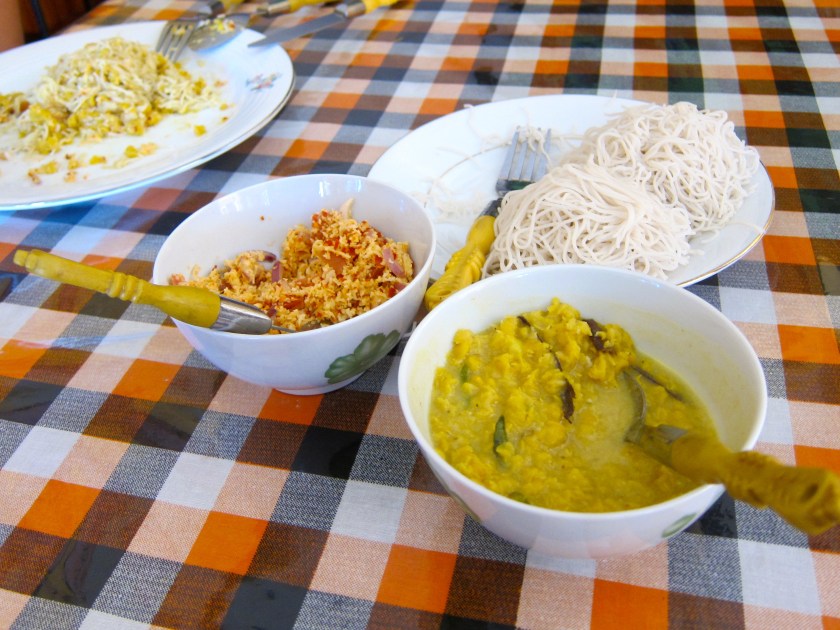
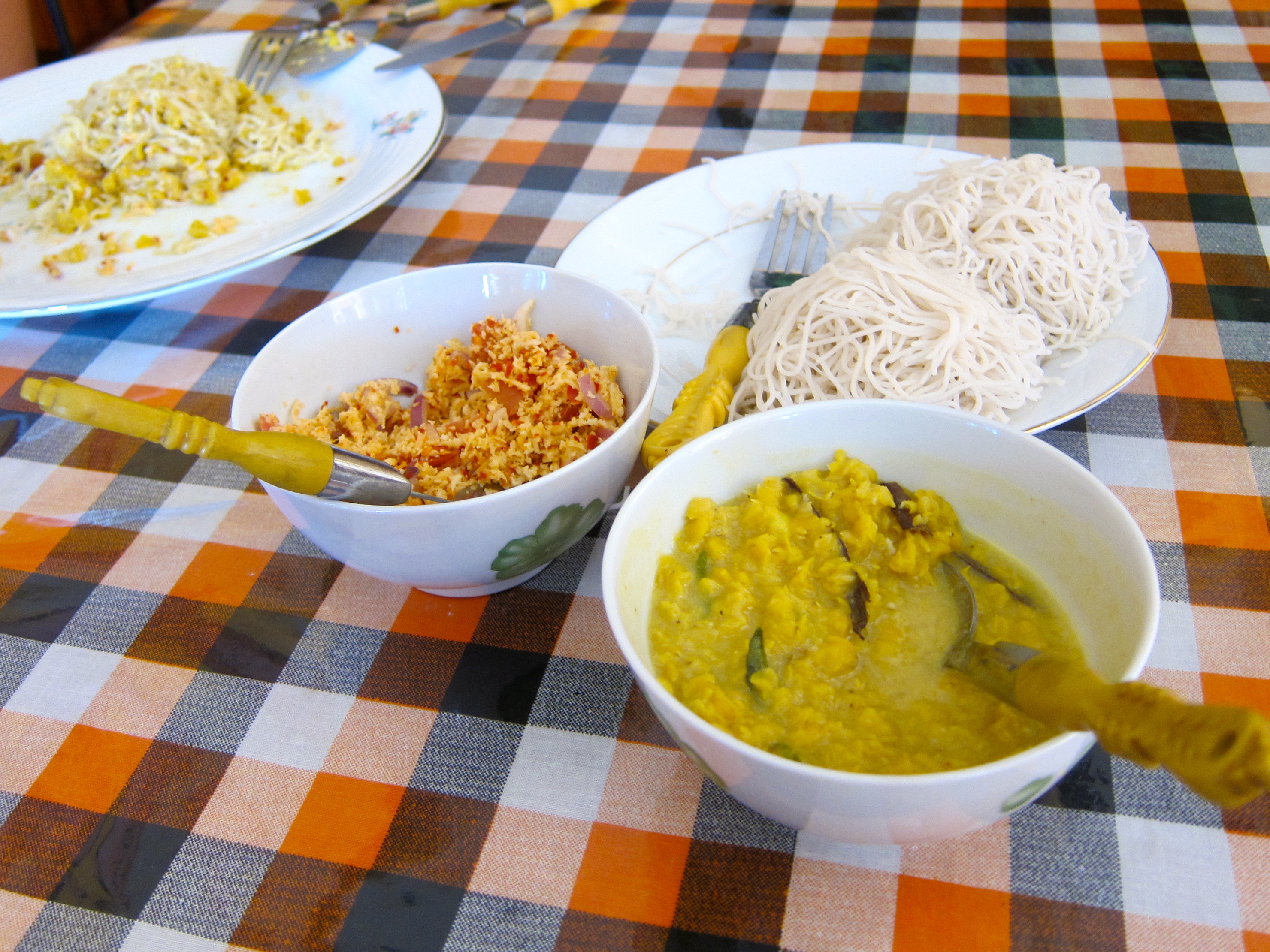
IMG_1069His wife was an amazing cook, and every night she would let us join her in her kitchen as she prepared our dinner, where she taught us to cook homemade coconut sambal, dal curry, string hoppers, Sri Lankan-style okra, deviled potatoes, squash curry….

IMG_1070IMG_1076

Impromptu cooking class in Haputale

Screen Shot 2014-12-17 at 3.56.17 PMIMG_1062IMG_1096

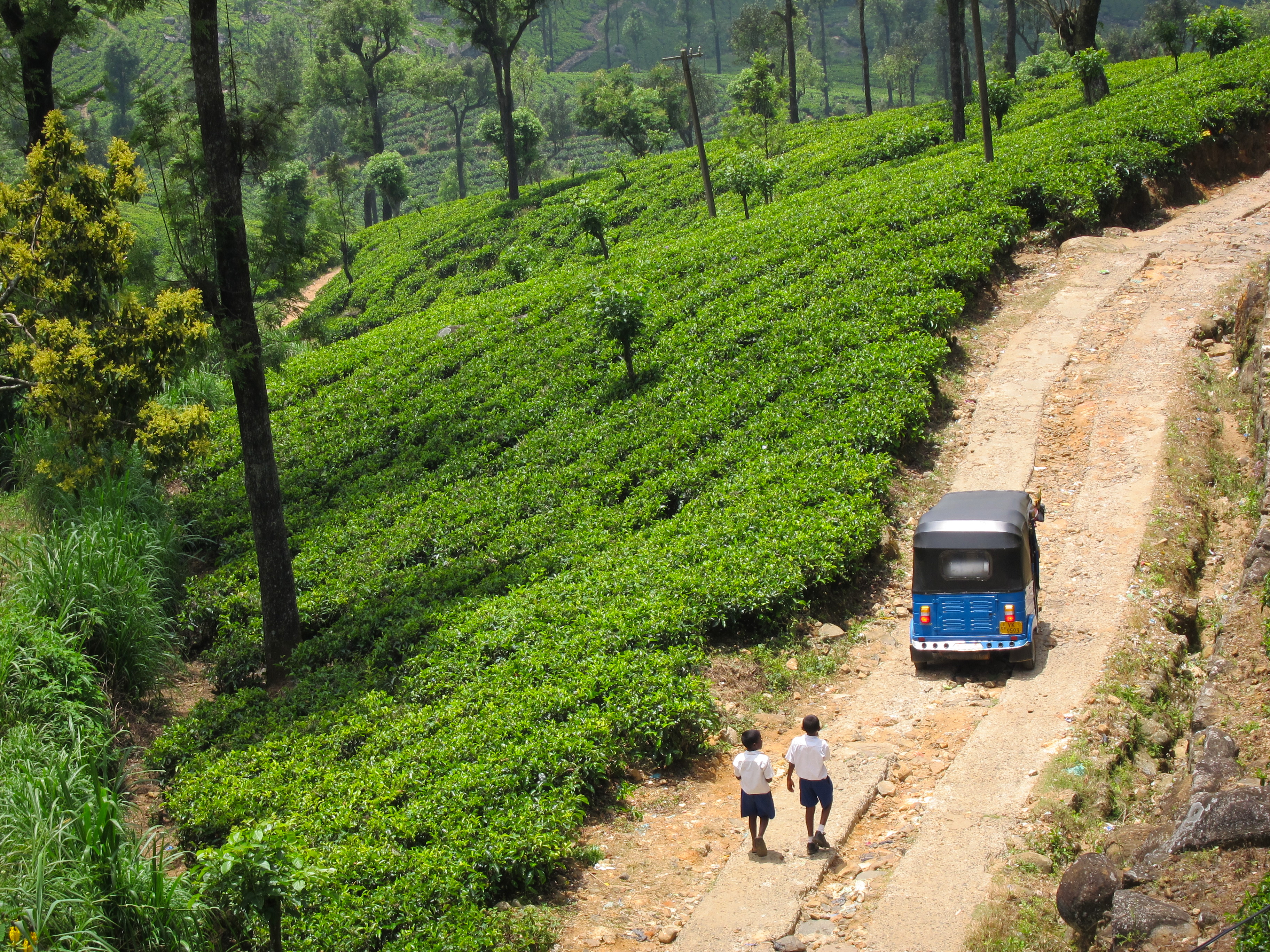
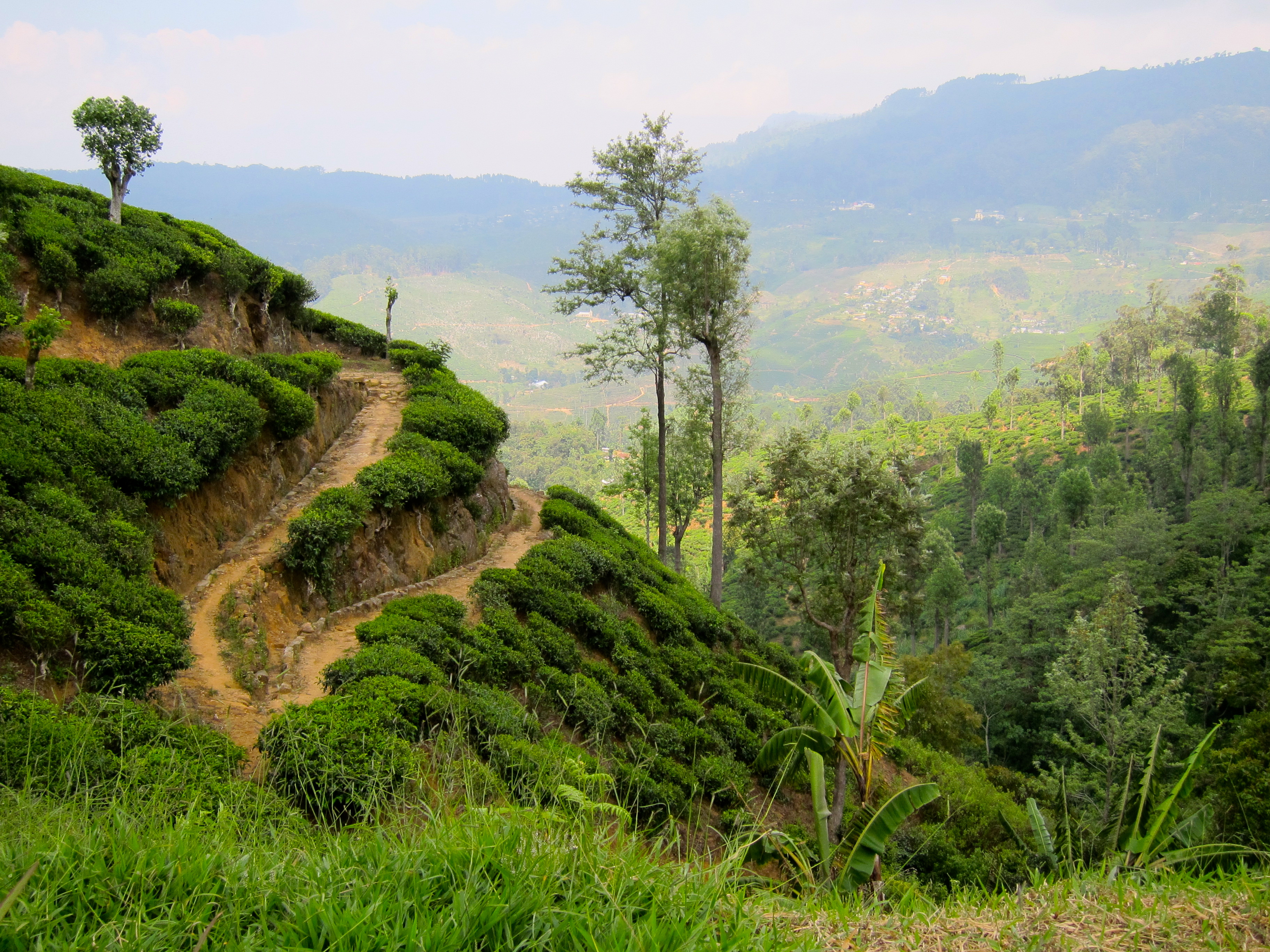
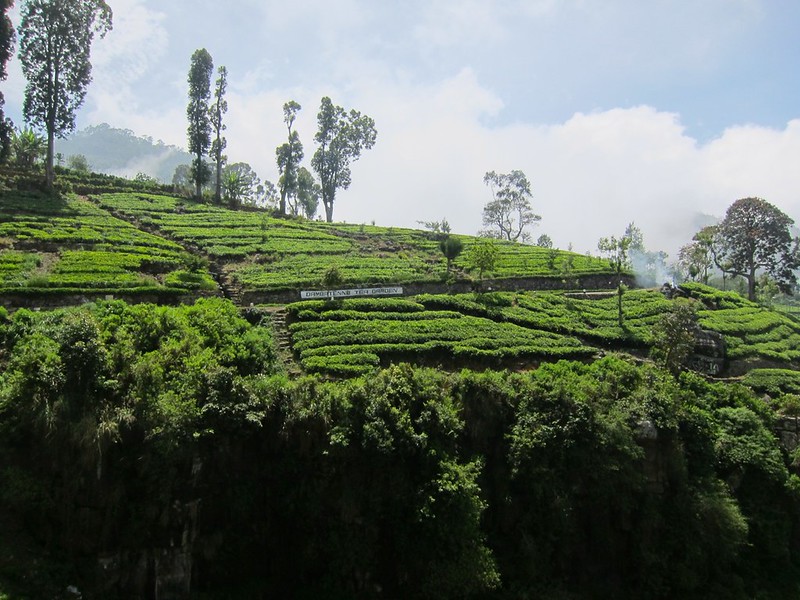
Setting out to explore Haputale the next day, we learned that the town is home to one of many British tea plantations that still thrive here and churn out Sri Lanka’s #1 export. We spent 5 days in Haputale, aimlessly walking the hills of the tea plantations, occasionally joining the locals on their walks home down the lonely train tracks.

IMG_1042IMG_1037

Haputale, Sri Lanka

Tea Plantations, Haputale, Sri Lanka

Haputale, Sri Lanka

Tea Plantations, Haputale, Sri Lanka

It would be fair to say we did little more than go on long walks during our 5 days in Haputale – but it wasn’t for lack of trying – on our first day we walked 3 miles to explore an old Benedictine monastery in the area, just to find that it was closed. We were later told that it is only open to visitors on national holidays, and lucky for us there would be such a holiday coming up in just 2 days. By the time the national holiday arrived, we’d decided to forgo the monastery altogether and visit one of the tea factories instead, so we hopped on a rickety old bus that felt like it would shake itself apart any second and traveled 30 minutes to the tea factory, and what do you know?

Haputale, Sri Lanka

Closed! Apparently, the tea factory is open every day of the year except on national holidays.

Our last day in Haputale, we decided that we really had to “do” at least one activity in our time there, given that everything else had been closed: we would visit Diyaluma waterfall. Being the second tallest waterfall in Sri Lanka at almost 600 feet tall, we agreed to take a bus over an hour and a half each way just to check it out. I can’t exactly say it was “closed”, but let’s just say that its faucet wasn’t exactly “open” all the way at this time of year. It was pretty, but not the kind of thing worth spending all day trying to visit.

Haputale, Sri Lanka

Before we could leave the town, Haputale had one more trick up its sleeve for us it seemed. While walking the train tracks one day, we decided that we wanted to try to smash a coin on the train tracks– something Steph had never done! Since trains are very infrequent, we were surprised to see a train heading our way halfway through our walk. Quickly, we put the coin on the track, giggling like 5 year olds, and stepped back to watch the magic unfold…

Once again, Haputale had other plans for us…

It was time to move on, but suffice it to say, we really enjoyed Haputale, in particular, the lush rolling hills that surrounded the dusty town itself.

Tea Plantations, Haputale, Sri Lanka

Haputale, Sri Lanka

Haputale, Sri Lanka

A pilgrimage to Sri Pada, Sri Lanka

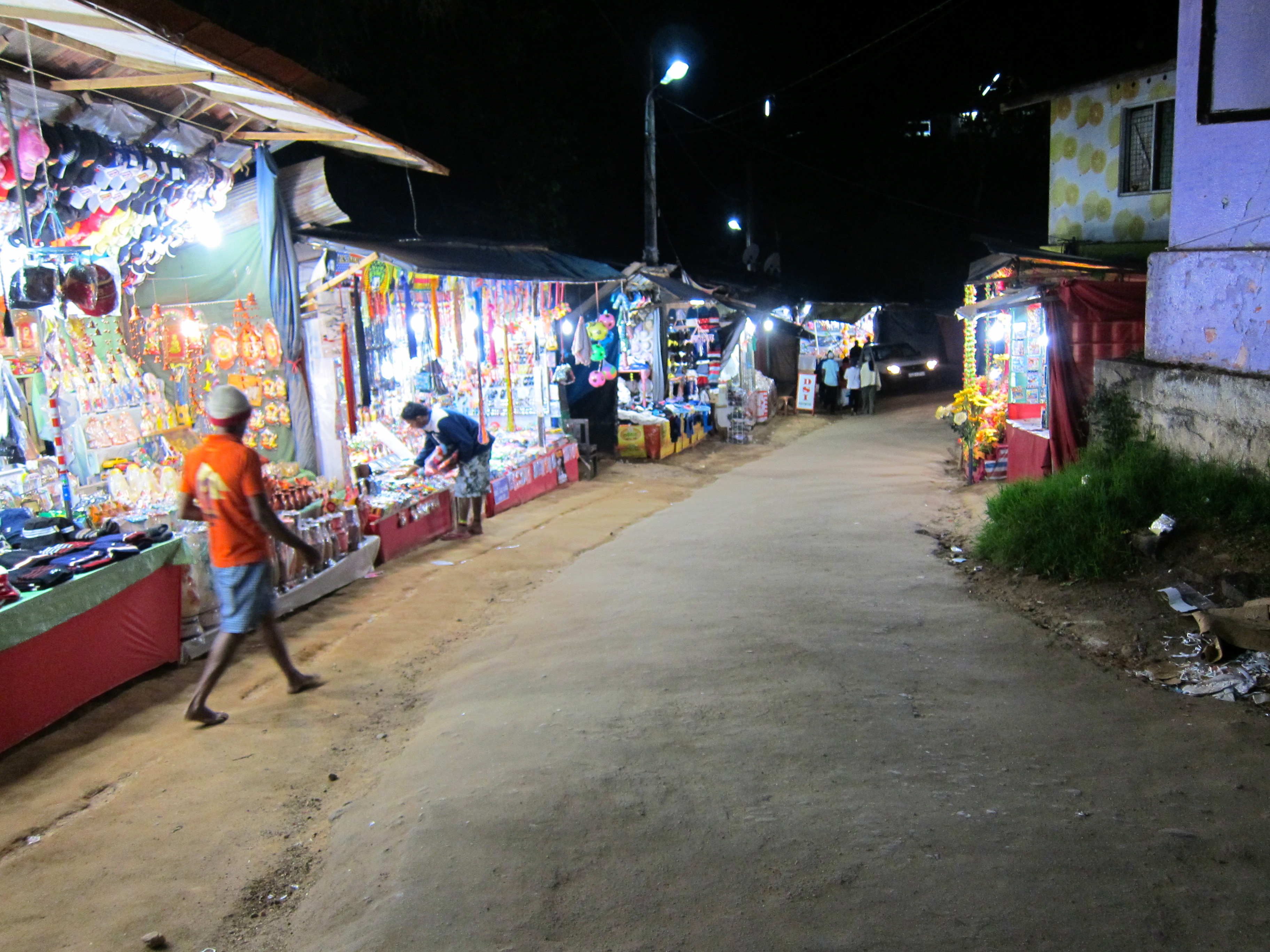
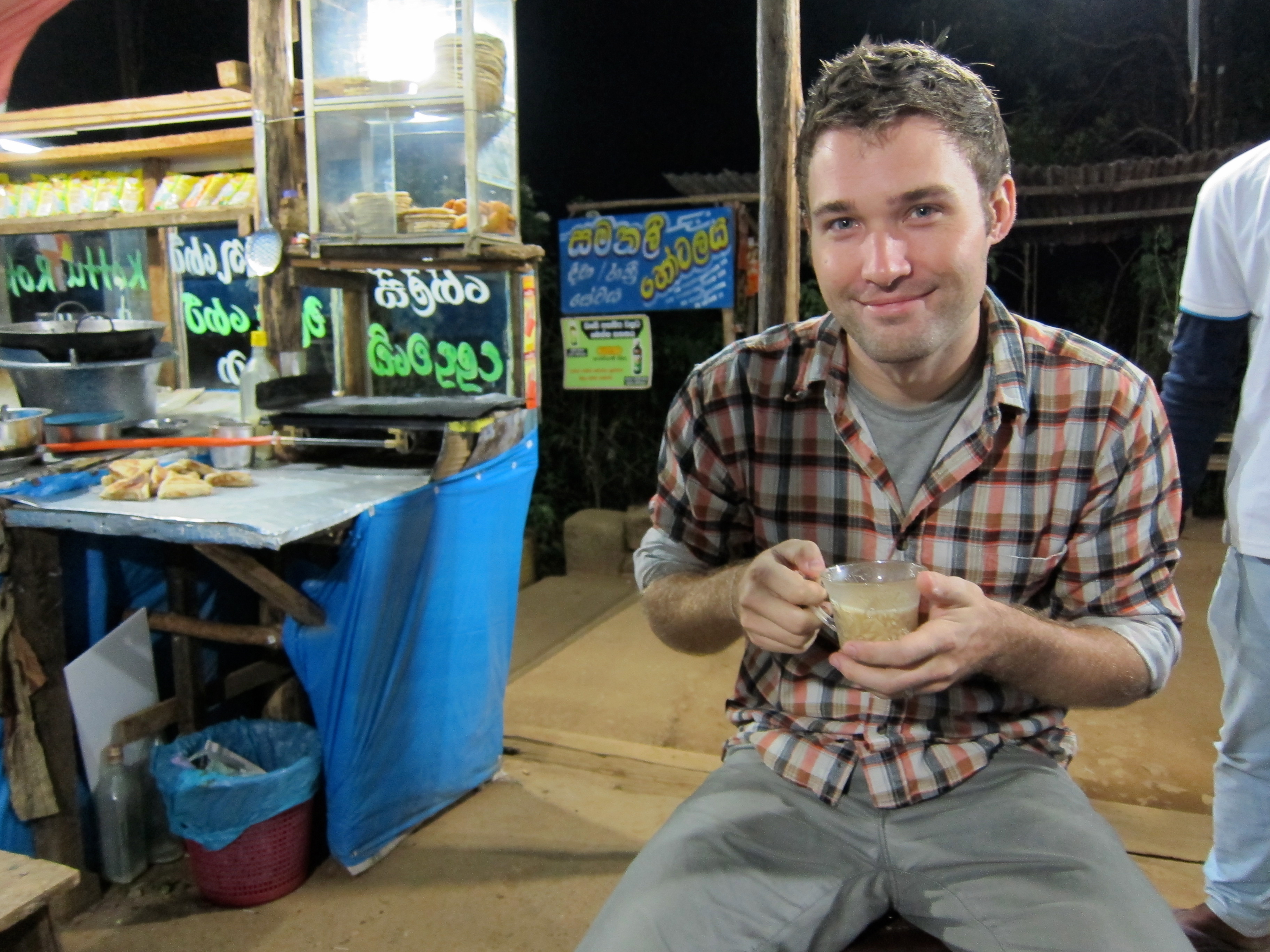
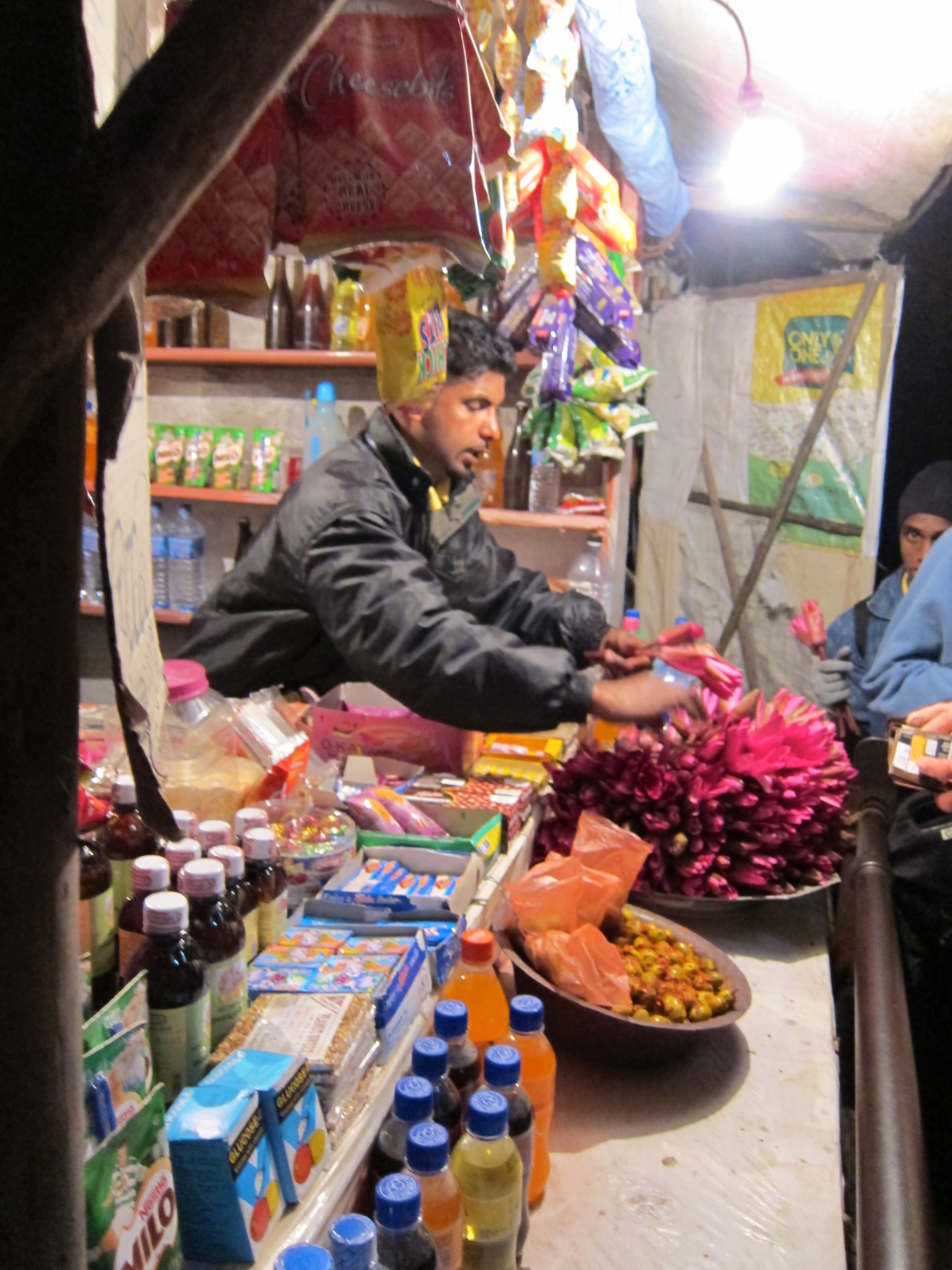
It’s a few minutes after midnight, and the shopkeepers are busying themselves arranging winter coats and hats; frying up samosas, chapatis, pakoras; readying their wares for the stream of pilgrims who are preparing for the long, cold journey ahead.

In the dark, we buy some provisions ourselves and take a minute to chat with the young shopkeeper. “Have you ever climbed Sri Pada?” Scott asks, motioning to the black peak looming behind us in the distance. He laughs, “No…it looks very hard, too high,” and we set off chuckling and unfazed by his warning, nibbling away at our much-needed fuel.

IMG_0889We’re here to climb the mountain known as Sri Pada (translating directly to “Sacred Footprint”) or “Adam’s Peak,” as it’s more commonly known in English. Sri Pada, being one of few pilgrimage sites that is revered by 4 major religions worldwide, is said to be one of the most sacred places on earth. Looming over 7,000 feet above the Sri Lankan jungle, Sri Pada’s lofty heights appear to reach up toward the heavens, its sides being nearly vertical in places. On its summit, a large “footprint” (over 5 feet long) imprinted on a boulder marks the reason for Sri Pada’s sacredness: Buddhists say it is the footprint of Lord Buddha himself, left during his third visit to Sri Lanka over 2500 years ago; Hindus say the footprint is that of Lord Shiva; Muslims and Christians claim that it is that of Adam, formed when he was sent to earth and placed in Sri Lanka, or “Eden”. (Those who are more agnostically-inclined might be interested to know that Sri Pada is also known as the place that “butterflies go to die,” meaning that, really, one of the above categories should cover just about everyone except for the very hardest of hearts…:)) Whatever the reason people have had for visiting the mountain, pilgrims from around the world have been climbing to its summit for over a thousand years, ever since the footprint was discovered in 851 AD. Since then, its fame has been carried around the planet, its summit being tackled by such famous characters as Marco Polo and Alexander The Great. Today, we’re here to do the same.

[Sri Pada in the distance:]

http://www.flickr.com/photos/12339764@N00/6963428549/in/set-72157629537407847/

[Aerial shot of Sri Pada at daytime, borrowed from Wikipedia:]

We’re here in the middle of Sri Pada climbing season, and everyone packed onto our train (and later, bus) on the long journey to the town of Hatton was on their way to make the arduous climb. Everyone was laughing, singing, drumming on the doors, happy to be making another pilgrimage up the sacred mountain. Although all Sri Lankans are expected to climb the mountain at least once in his or her lifetime, there is merit gained for each individual time a pilgrim reaches the summit. A man we met on the train told us that he has climbed Sri Pada three times before, but for many of the older people, it was their 10, 15, even 20th time.

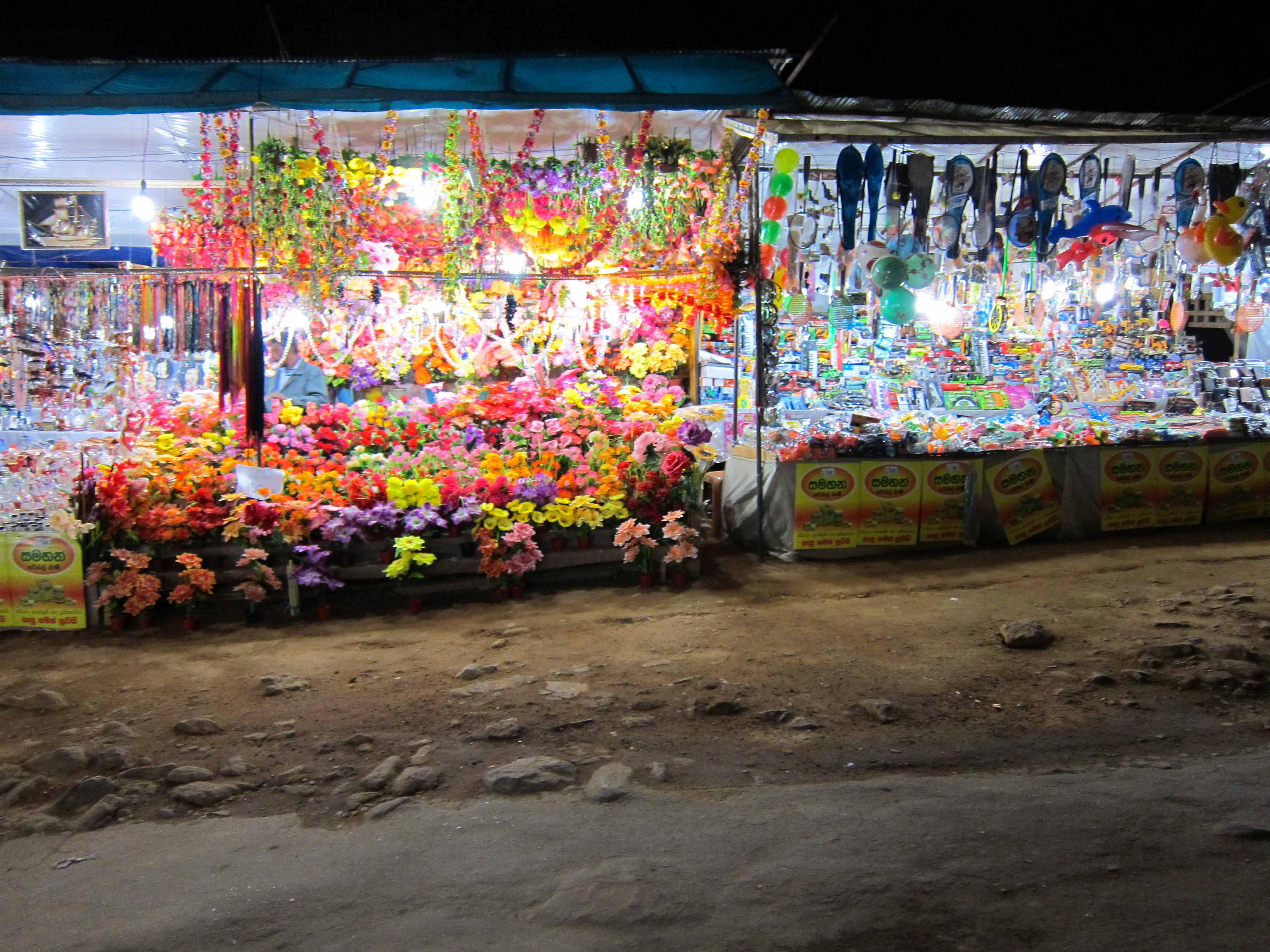
After thanking the shop owner for the snacks, we begin to wind our way out of town, walking past countless brightly-lit storefronts selling everything from fake flower offerings to stuffed animals (?) to high-energy sweets and hand-sewn Santa hats (?).

IMG_0893IMG_0894

At the true start of the climb, nestled at the base of the mountain, we reach a bell tower that pilgrims must ring once for each time they have made the pilgrimage to climb Sri Pada. Scott and I each ring the bell once, and we’re joined by a Buddhist monk who whispers a prayer of safety and good luck for each of us, before tying a white string around our wrists in blessing.

http://www.flickr.com/photos/12339764@N00/6963430403/in/set-72157629537407847/

The climb up the mountain is gradual at first, and lights have been strung up along the trail to light our way. We pass various “pilgrim’s rest” stops, which are nothing more than a cement floor with a tin roof overhead, where hundreds of people lie on newspapers or wrapped in blankets, catching some sleep before (or after) the long climb. Others kneel in prayer in front of enormous Buddha statues or Hindu temples, asking for a safe and rewarding journey.

http://www.flickr.com/photos/12339764@N00/6817308636/in/set-72157629537407847/

The trail seems abandoned and lonely at first, but we’re gradually joined by more and more people, as we are all trying to reach the summit before sunrise– a solid 6 hours away. To hike the mountain after the sun rises is far too hot, and to reach the top too early before sunrise is too cold, when the lofty summit feels close to freezing.

The trail begins to climb, higher, higher, and we can occasionally steal glances at the fully-lit trail winding its way up the mountain.

IMG_0902Countless resting places line the trail all the way to the summit, selling much-needed vegetable rotis and a hot cups of milk tea to weary travelers.

IMG_0909http://www.flickr.com/photos/12339764@N00/6963431263/in/set-72157629537407847/

After several hours of continuous stair-climbing, the path narrows and steepens, and each new step takes tremendous energy. We’re joined by entire families walking hand-in-hand up the sacred mountain, by young couples carrying their babies to the top for its first pilgrimage, by very old men and women who must have climbed the peak countless times before. Many of the older pilgrims are dressed in all white and are barefoot, there being that much more merit gained for making the arduous climb this way. At one point, we find ourselves in the middle of a group of young men whose beautiful call-and-response chanting –”Devindu, api enava” (“God, we are coming”)– helps propel us along to the top.

http://www.flickr.com/photos/12339764@N00/6996103643/in/set-72157629537407847

Eventually we reach Idikatu Pana, the steepest, most difficult point in the climb, where the stairs are nearly vertical. We pass by an old woman, folded in half at the waist, pulling herself up and up each step by the metal handrail; she still has a long way to go. Another woman is draped across the handrail in exhaustion, clinging to it to remain standing, as her family encourages her to take just one more step, one more step. Countless others are sitting and resting on the steps, their heads buried in their knees as they catch a few minutes sleep.

We eventually decide to pull over for a few minutes rest, not so much out of exhaustion but out of apprehension about making it to the freezing summit too long before sunrise. Seeing me resting on the side of the trail, an old woman in a white sarong with long gray hair grabs my hand, pulls me to my feet, and literally drags me up the mountain for a few hundred feet, saying, “Come, come, let’s go. Sri Pada, we climb. Come, come.”

http://www.flickr.com/photos/12339764@N00/6963431361/in/set-72157629537407847

[Last shop selling flower offerings before the top:]

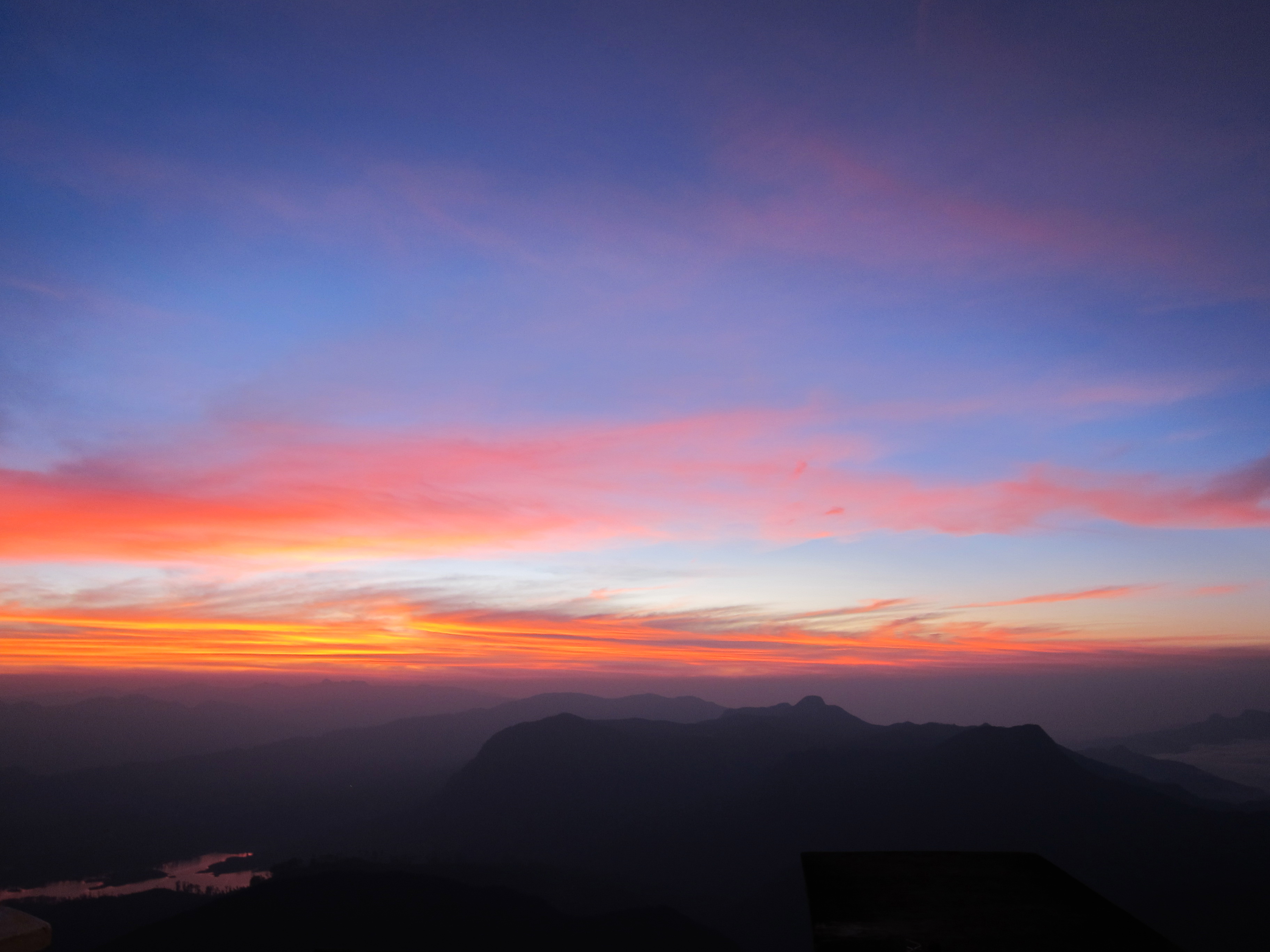
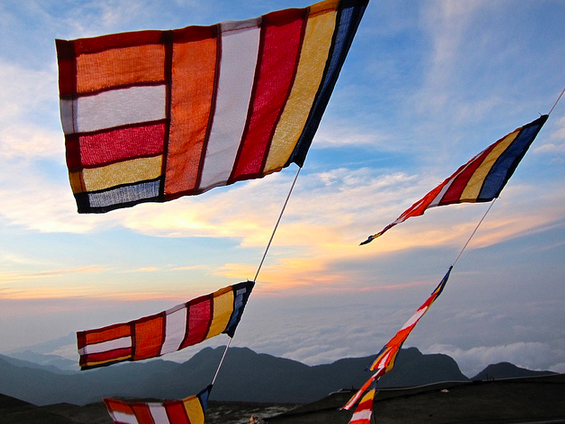
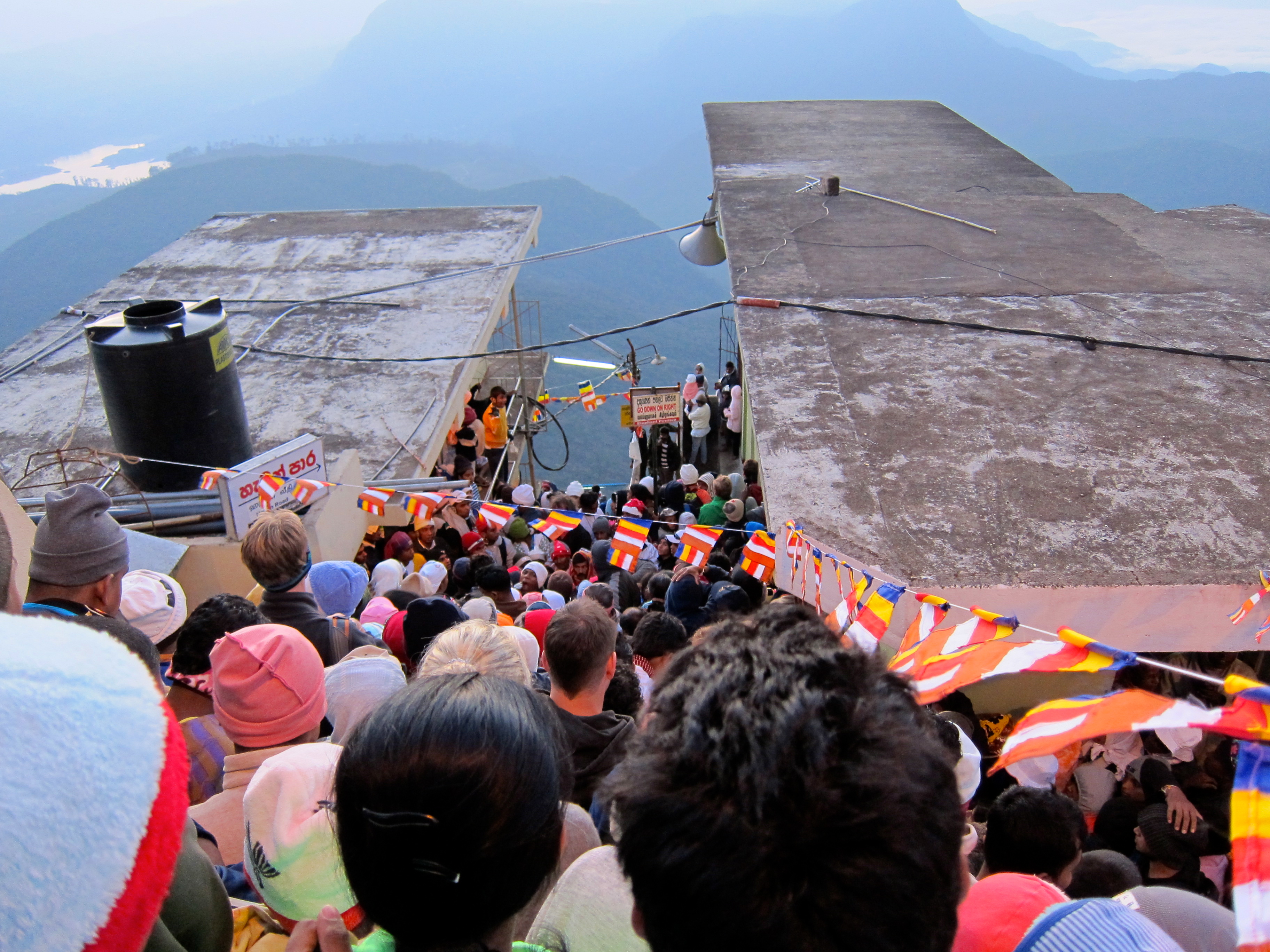
IMG_0933As we near the top, some 6 hours of near-vertical climbing later, the crowd becomes very dense. Cold and gridlocked on the side of the mountain, we worry we won’t reach the summit before sunrise, and it takes nearly an hour to cover the last 30 feet of the climb. We finally reach the vertigo-inducing summit a mere 2-3 minutes before the sun breaks through the cloud layer far, far below us. The bulging crowd, all clinging for space at the top, becomes silent, and all that can be heard is the violent flapping of the Buddhist prayer flags strung out above us.

http://www.flickr.com/photos/12339764@N00/6963436099/in/set-72157629537407847/

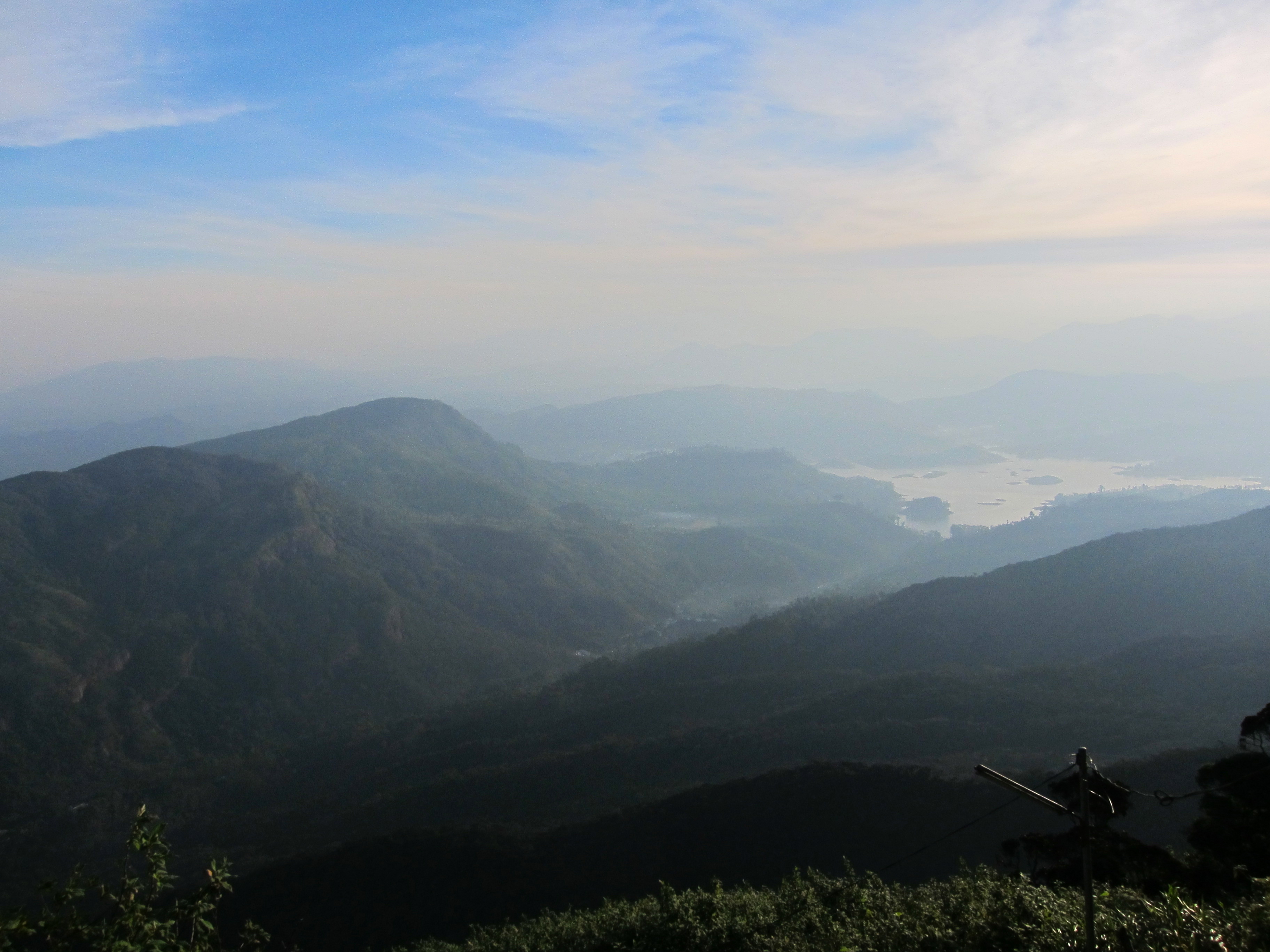
IMG_0949Behind us, Buddhists pay silent respects to the holy footprint, as the Hindus carry out a ceremony of their own only a few yards away. Together, we become witness to a spectacle of colors seemingly tossed across the infinite sky before us, and I know why each group has claimed this scared site as their own.
Screen Shot 2014-12-17 at 3.34.45 PM

IMG_0952http://www.flickr.com/photos/12339764@N00/6817318742/in/set-72157629537407847/

The climb down the mountain is dramatically more crowded and difficult than the climb up, and my legs take on a jerky, uncontrollable motion for the long journey downwards. We pass a very elderly man being helped down each step by his wife, who holds his elbow in support; he is crying in pain with each step that he takes. In stark contrast, porters wearing sarongs and turbans run up and down the mountain now that daylight has broken, carrying full tanks of gas hoisted on their shoulders to the rest stops that are now far above us. I fall somewhere in the middle– not yet crying but also certainly not running.

We manage to reach the town again by 9:30 in the morning– a full 9 hours since we first set out last night. The odd little 9 year old who apparently runs our guesthouse literally pushes us out of our room before our 10am check-out, screaming “The new guests are coming! The guests, they are coming!!” Tired and discombobulated, we grab our bags, hobble on to the next bus out of town, and fall fast asleep.

IMG_0964—-

We were sore for at least the next 5 days, with going down stairs not just being difficult, but damn-near impossible– I had to go down backwards anytime we reached a staircase (which was oddly quite often) and hold my body weight up by my arms, using the railing. Whenever I caught a funny glance from someone as I hobbled down a set of stairs backwards, one foot at a time, I had nothing more to do than simply pat my thighs and call out “Sri Pada!”, when their expression would change from bemusement to surprise to finally, respect.

In our short time at the top of Sri Pada, I saw neither the famed sacred footprint nor the perfect triangle of Sri Pada’s shadow that is supposedly cast by the mountain shortly after sunrise (it was far too crowded to move around). But as I turned my back on the light show taking place before us and faced into the crowd, I did see something spectacular: the smiling faces of Buddhists, Hindus, Christians, Muslims, Jews, (and perhaps some butterfly collectors?) all upturned as one, offering collective praise to the heavens splashed out across the beautiful blue sky before us.

http://www.flickr.com/photos/12339764@N00/6963436799/in/set-72157629537407847/

Kuala Lumpur Food Tour

When we started planning this trip last summer, we had two major regions of the world that we really wanted to reach: Southeast Asia and India. Not requiring any pre-arrival visas or pre-departure planning (..things we’re not very good at), the countries of Southeast Asia would be an easier first stop. Getting into India, however, would be more difficult… We couldn’t apply for the Indian visa while in the U.S. because we didn’t have a verifiable permanent address (with utility bills) after selling our Boston apartment; we knew we’d have to get the visa in person through another country’s embassy along our way. So moving on from Cambodia, we decided to head to Sri Lanka, as it is known to be a reliable place to apply for an Indian visa – not to mention an interesting place to visit in its own right!

In order to get to Sri Lanka, we had to change planes in Malaysia. So we tacked on a few extra days of sight-seeing and eating in the country’s capital, Kuala Lumpur.

http://www.flickr.com/photos/12339764@N00/6963409675/in/set-72157629537380171

http://www.flickr.com/photos/12339764@N00/6963409873/in/set-72157629537380171

Kuala Lumpur is said to be somewhat of a “foodie” paradise, so before leaving Cambodia, we compiled an eating itinerary of various Malaysian goodies we should try while we were there. To fill out our itinerary, I solicited feedback on Twitter and received quite a few responses for food and locations we’d never have known to try on our own.

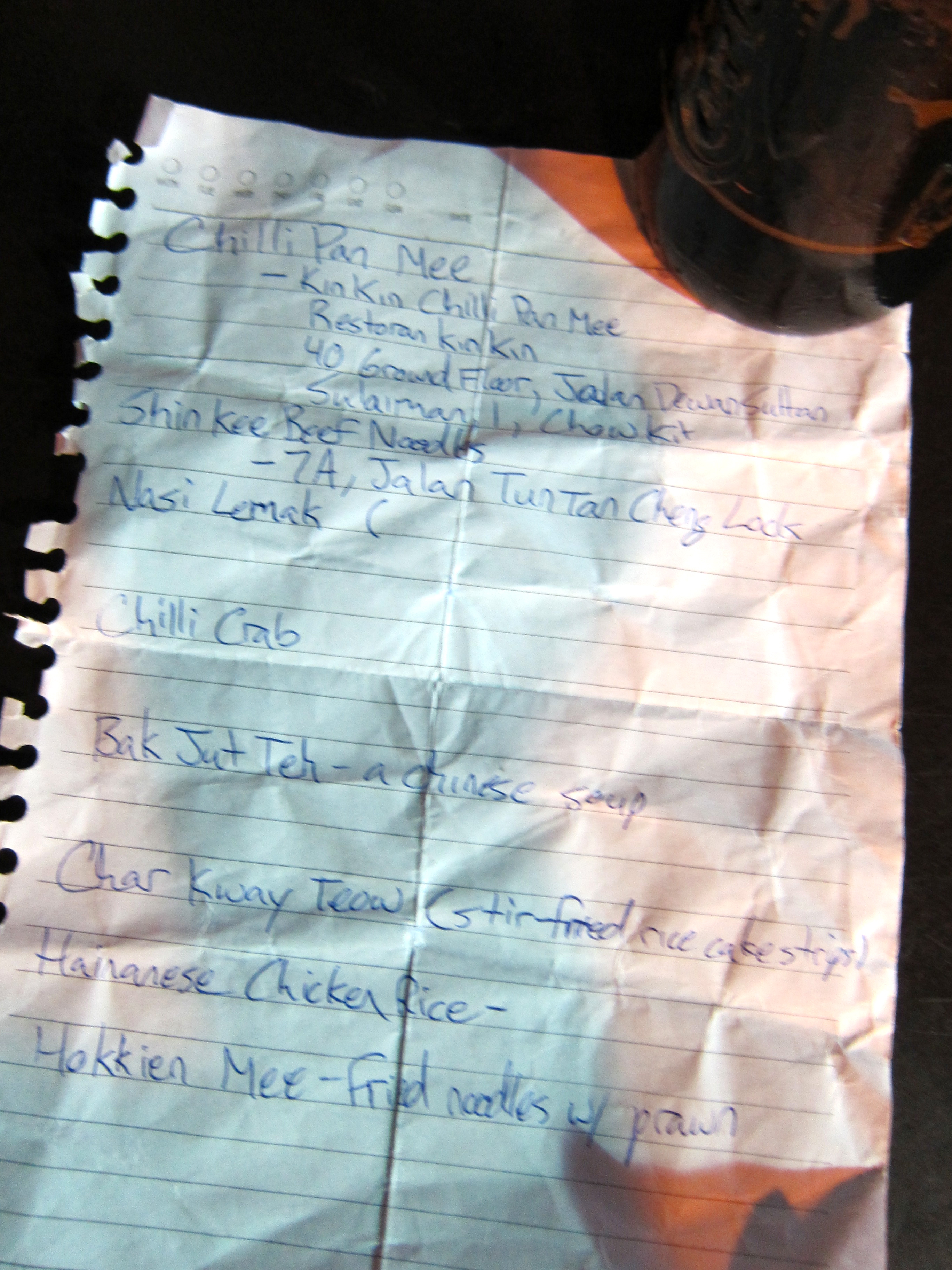
With that, we assembled a checklist:

IMG_0781Upon arrival in Kuala Lumpur, we got straight to work. We’d read that 10 or so of the best street food vendors in K.L. were invited to set up shop in an upscale food court inside one of the malls. (In Asia, mall food courts are very different than the U.S. – often some of the best, authentic food in the city can be found in them). We set out for that particular food court and began checking off our list.

At the very first counter we approached, we found “beef noodles”, which were high on our to-do list – it wasn’t the “Shin Kee Restaurant” recommended on Twitter, but we figured we should try them in case we didn’t make it over that way. It was a great dish – sort of a caramelized soy sauce taste over thick noodles and very finely ground beef.

http://www.flickr.com/photos/12339764@N00/6963411921/in/set-72157629537380171/

http://www.flickr.com/photos/12339764@N00/6963412081/in/set-72157629537380171/

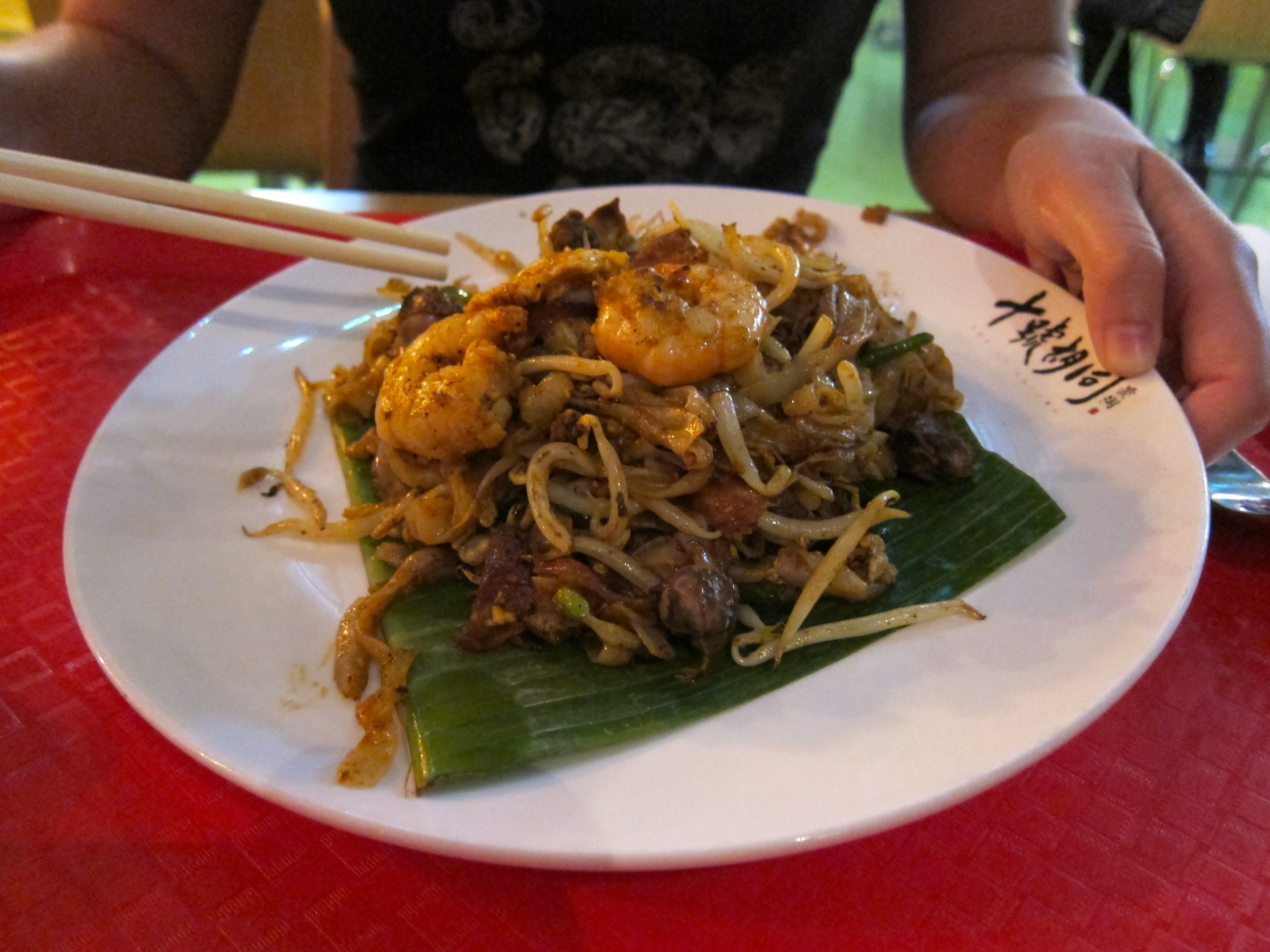
The very next counter had yet another item on our list: Char Kway Teow. This Penang specialty is made up of very soft rice-cake noodles, smothered in bacon, cockles, chives, sprouts, hot chili, shrimp, and soy sauce – all stir fried over high heat in bacon fat! Delicious and filling. But not light on calories.

http://www.flickr.com/photos/12339764@N00/6817290534/in/set-72157629537380171/

IMG_0729At that point, we needed to locate a cafe so Steph could read up on the next leg of our trip while I got some work done with the folks back in Boston. Walking around looking for a cafe, we couldn’t help but notice that the diversity in K.L. was far beyond any place we’d ever been. Just walking down a random street, we’d see people representing just about any race and cultural group we’d ever known existed (and even some we didn’t), intermingling and outwardly friendly towards one another –  perhaps K.L. has an edge on other parts of the world in that regard– who knows.

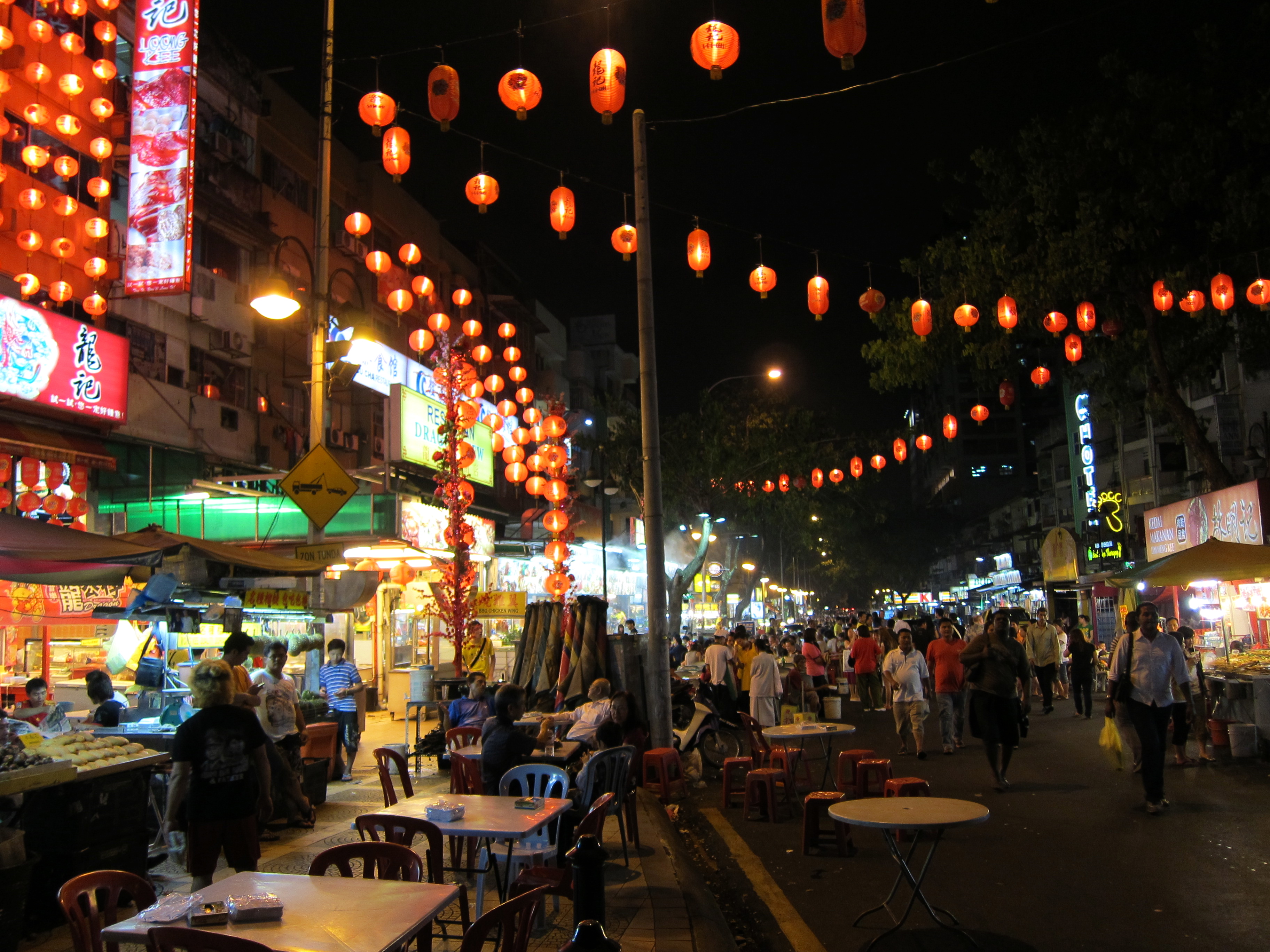
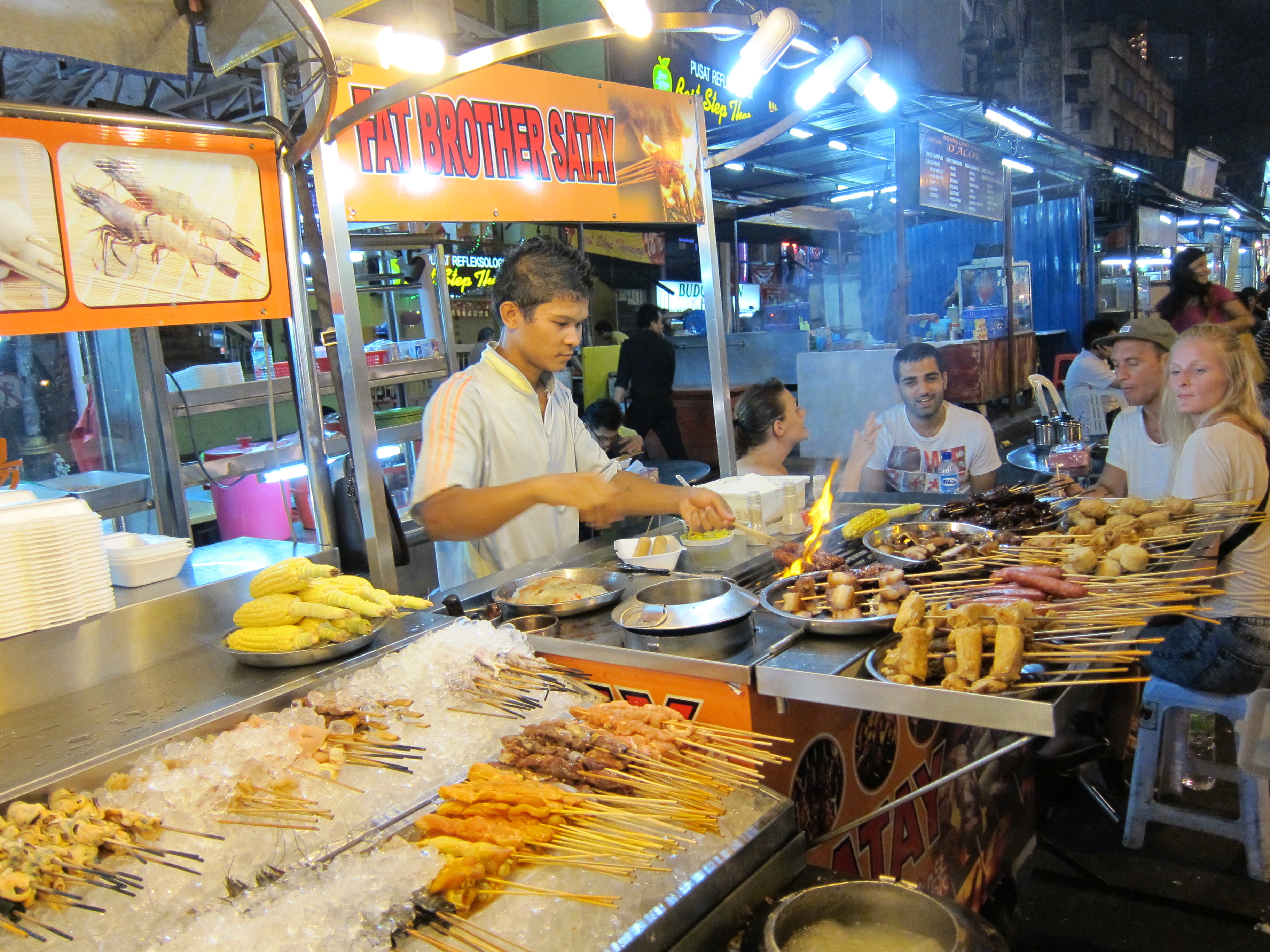
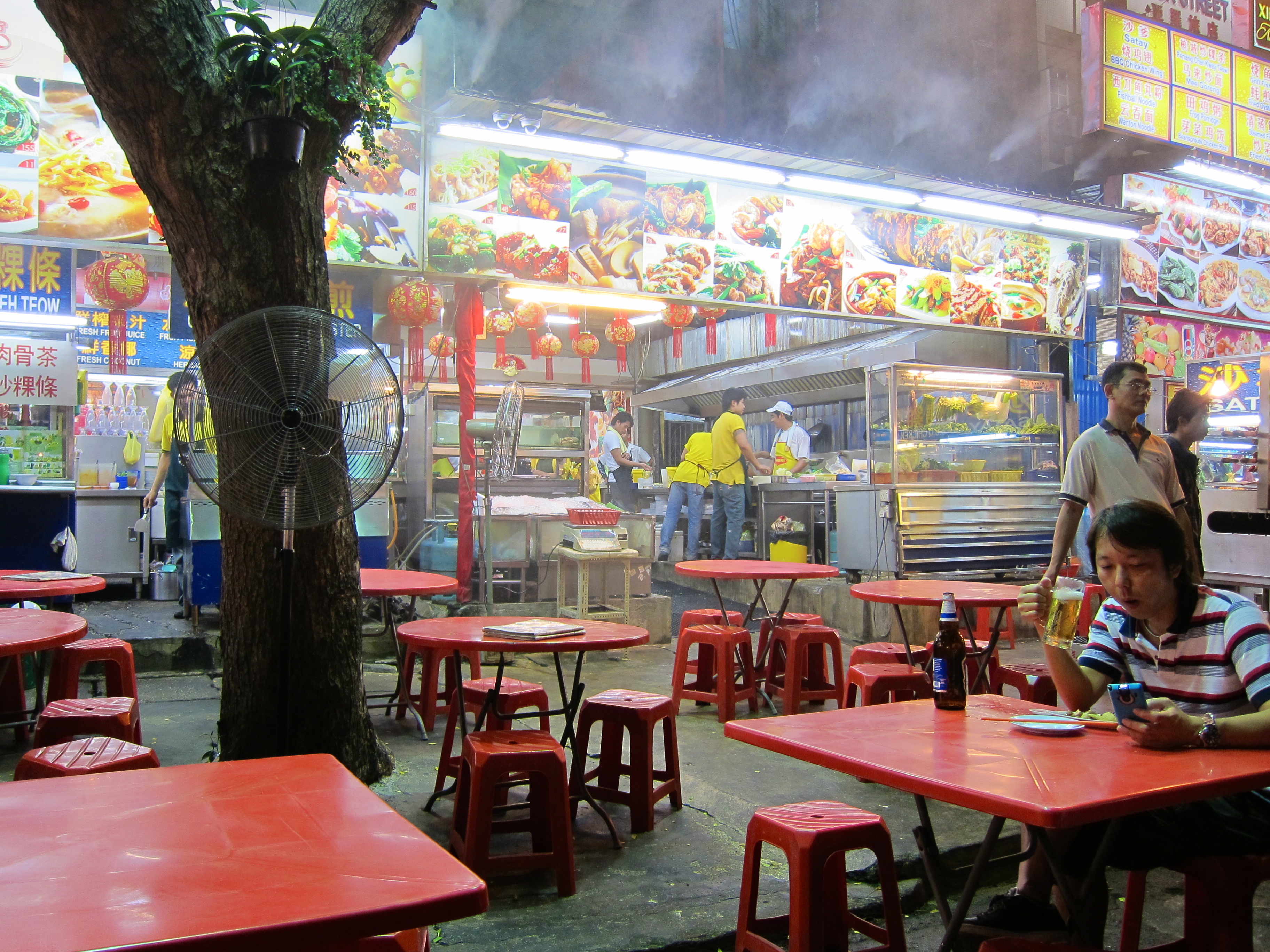
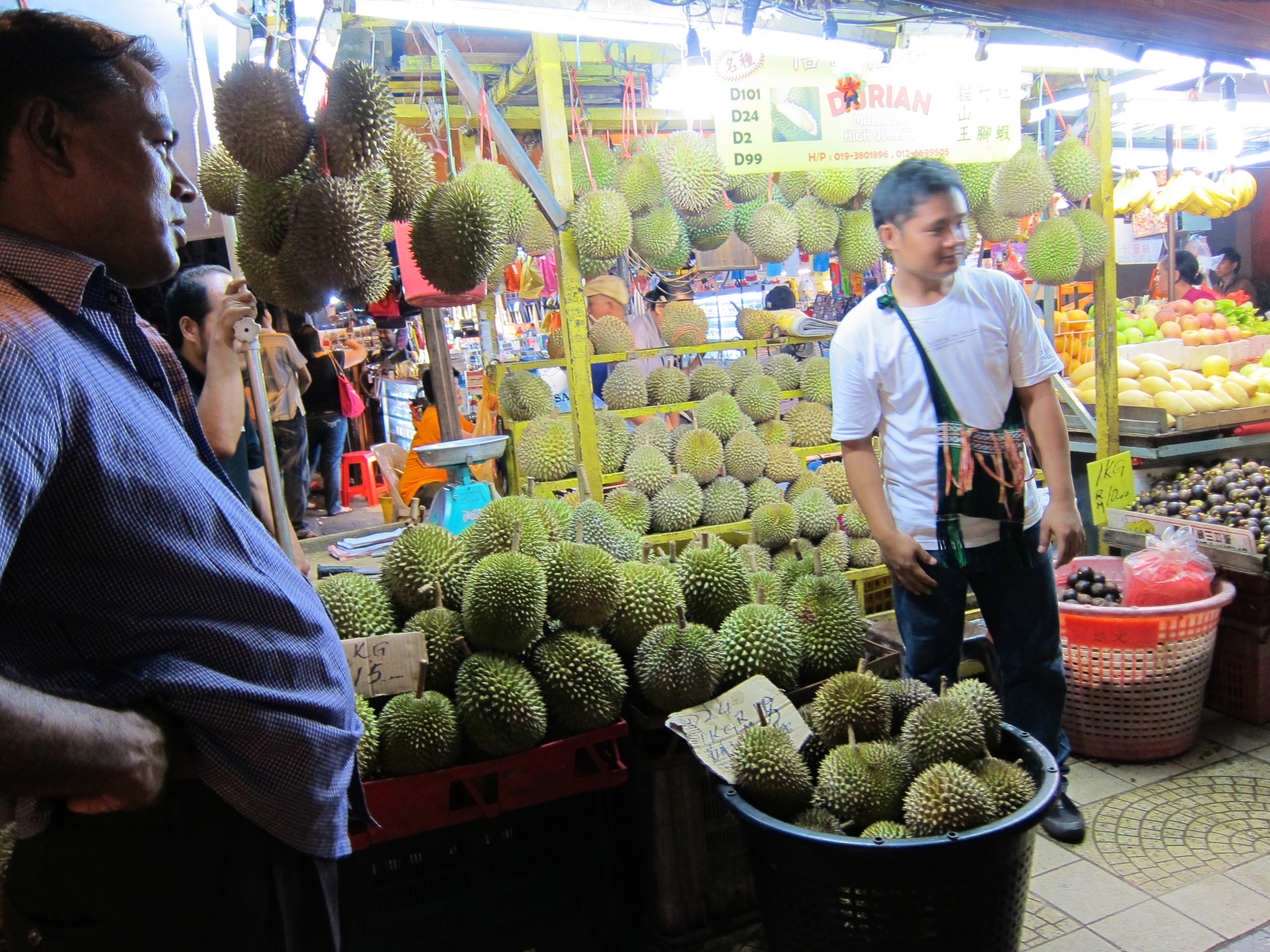
Late that night after the food and work had settled, we were back on the prowl. We headed over to a busy downtown district known for its street vendors and restaurants.

IMG_0737IMG_0738

IMG_0741http://www.flickr.com/photos/12339764@N00/6817291794/in/set-72157629537380171

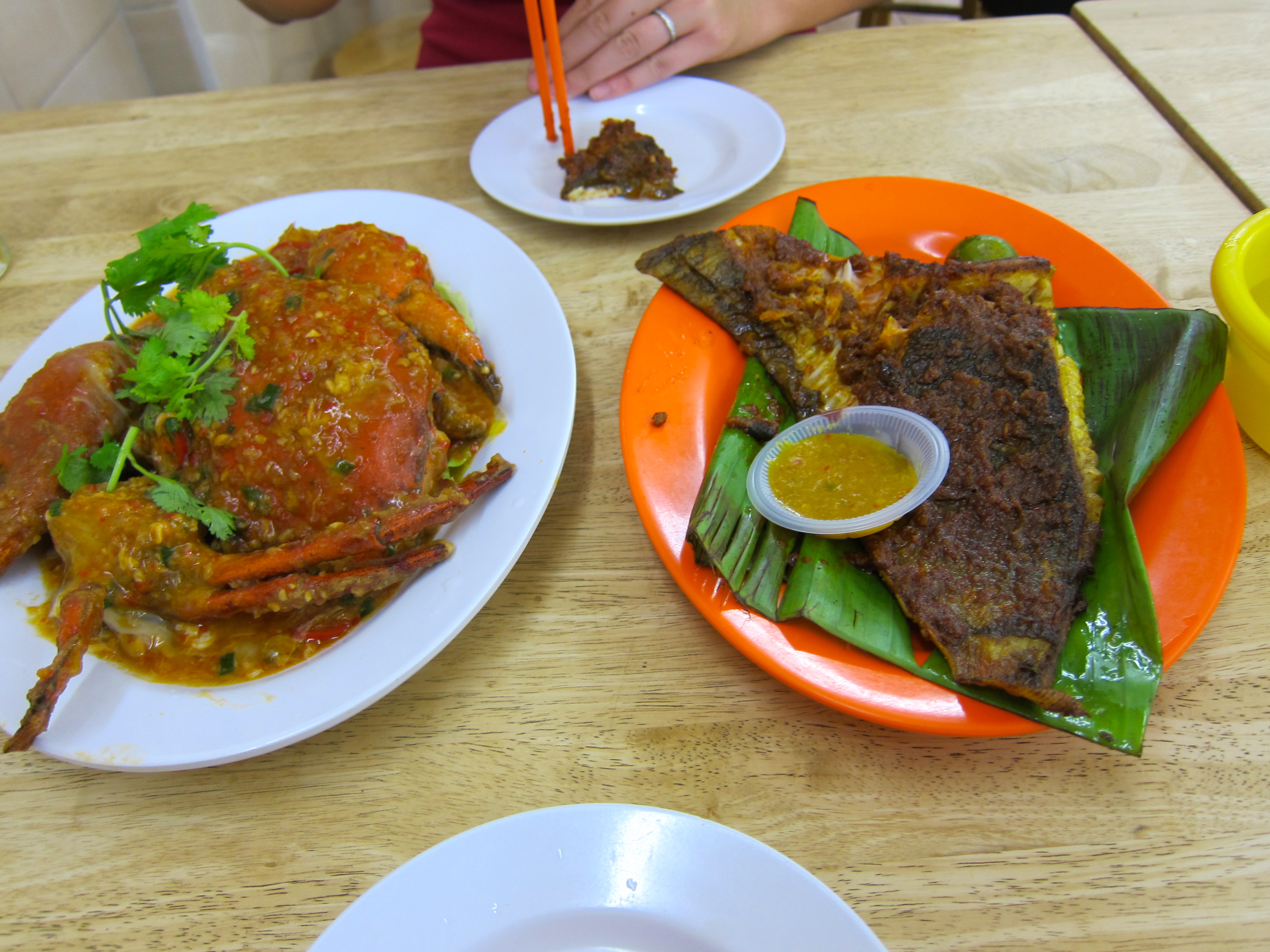
IMG_0751For all the variety on display, it was impossible to choose where to go, so we ended up parking at a restaurant that had a couple of items from our list: namely, chili crab and stingray! Of the two, the crab was okay, but kind of bland– but we chalk that up to the restaurant itself, not the dish. The stingray was very tasty – a nice tender cut of white fish with sweet chili sauce.

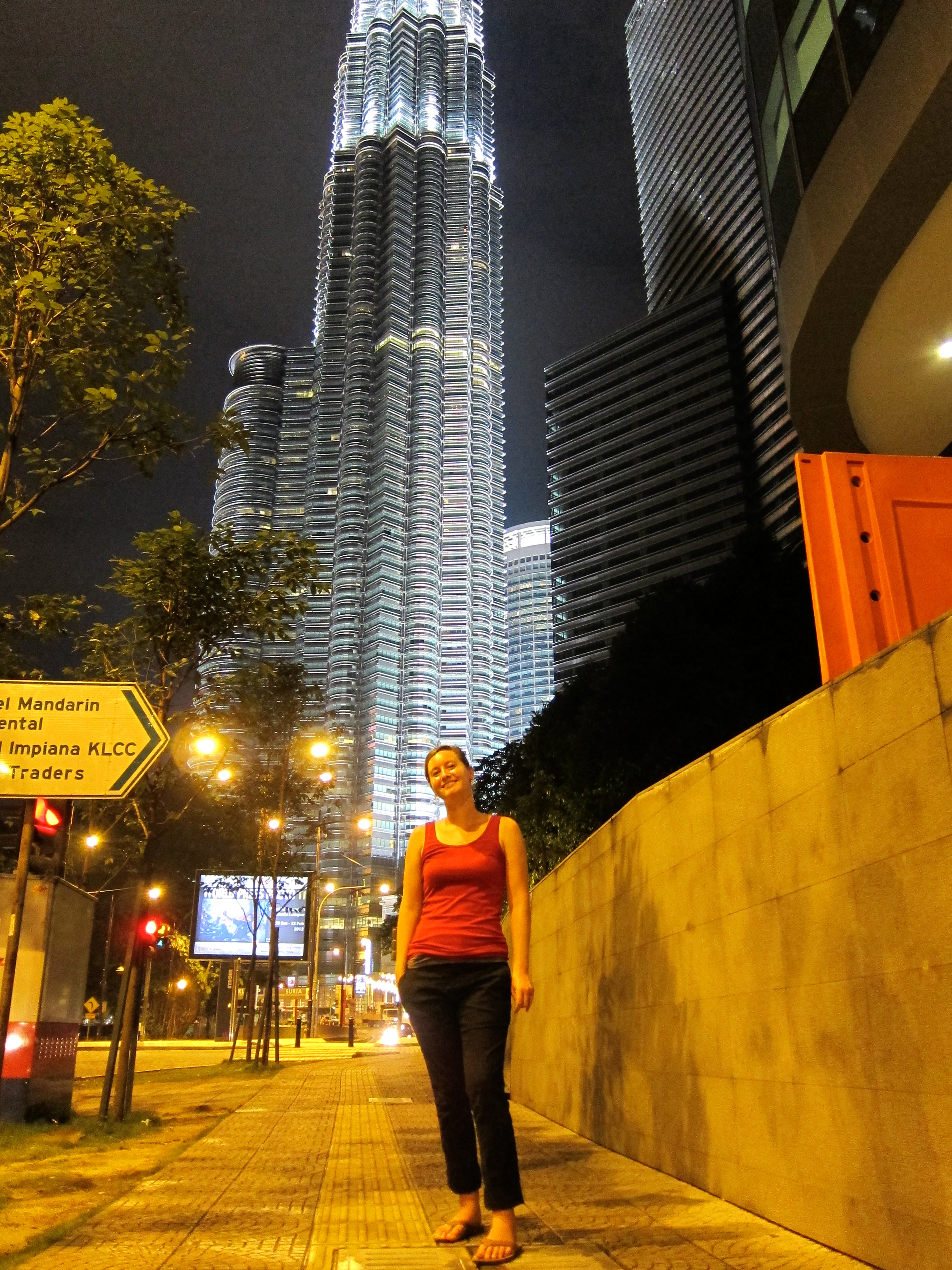
IMG_0750On our way home, in front of the famed twin towers:

IMG_0757http://www.flickr.com/photos/12339764@N00/6817292462/in/set-72157629537380171

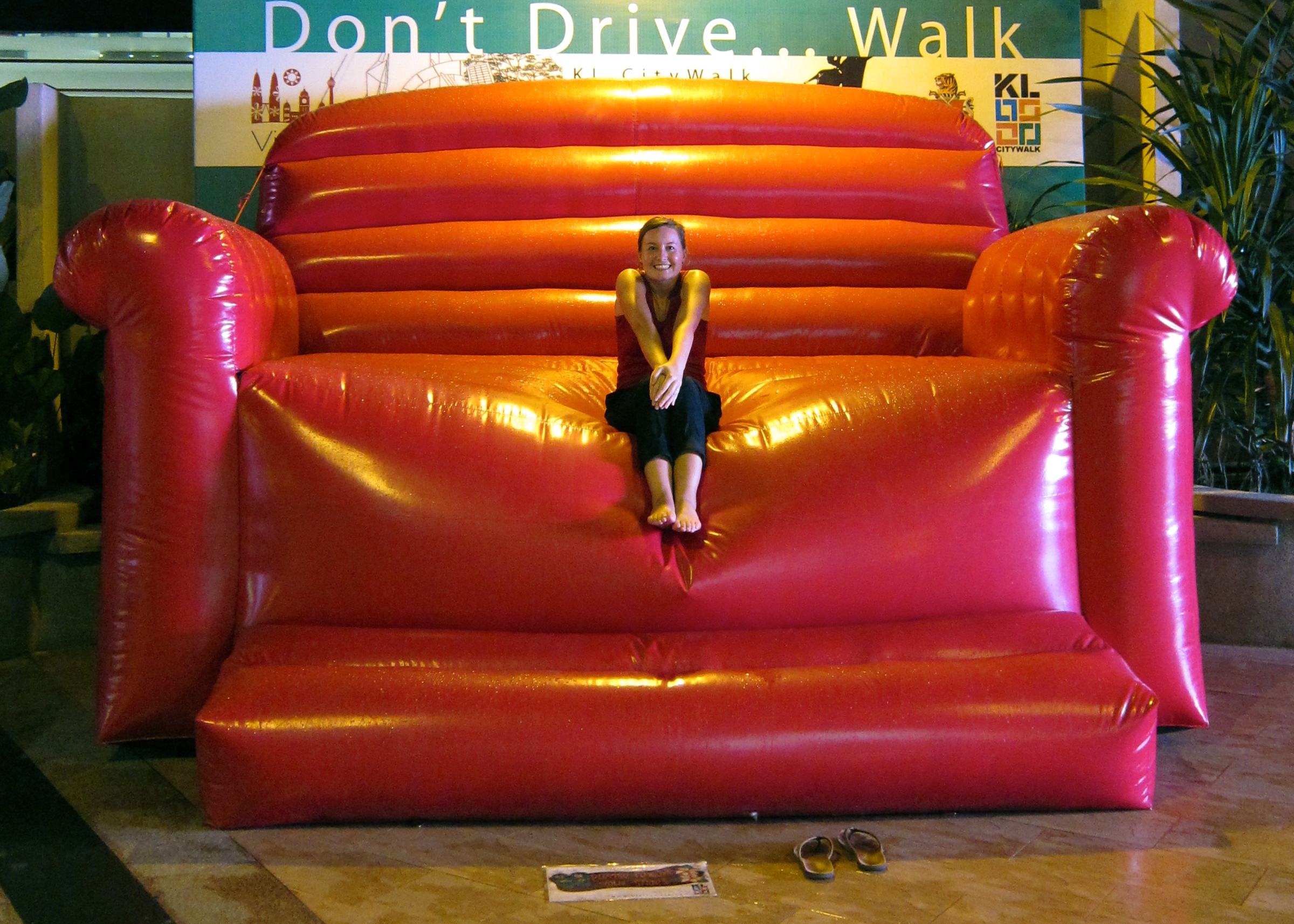
Steph finding a comfortable spot to wind down after the long day:

IMG_0758The next day, we headed over to Chinatown, where many very old Chinese temples and tea shops are still preserved and in use.

http://www.flickr.com/photos/12339764@N00/6963414961/in/set-72157629537380171

On Petaling Street, the main artery through Chinatown, we stopped in to have dim sum for breakfast. Below is Steph picking from the Dim Sum tray… we ended up with BBQ pork buns, some shrimp shumai, and some coffee and tea: all delicious.

http://www.flickr.com/photos/12339764@N00/6817293288/in/set-72157629537380171

http://www.flickr.com/photos/12339764@N00/6817293470/in/set-72157629537380171

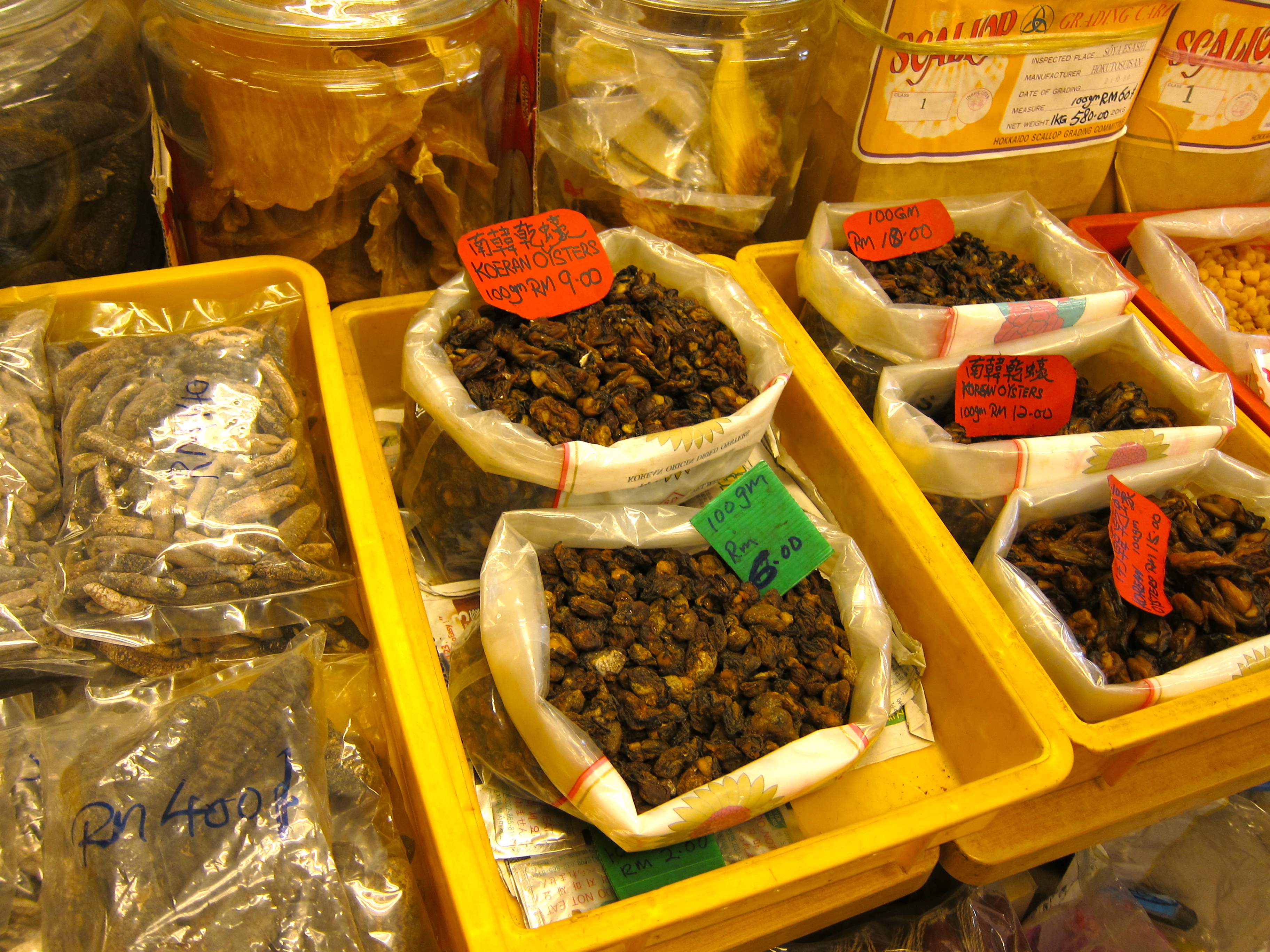
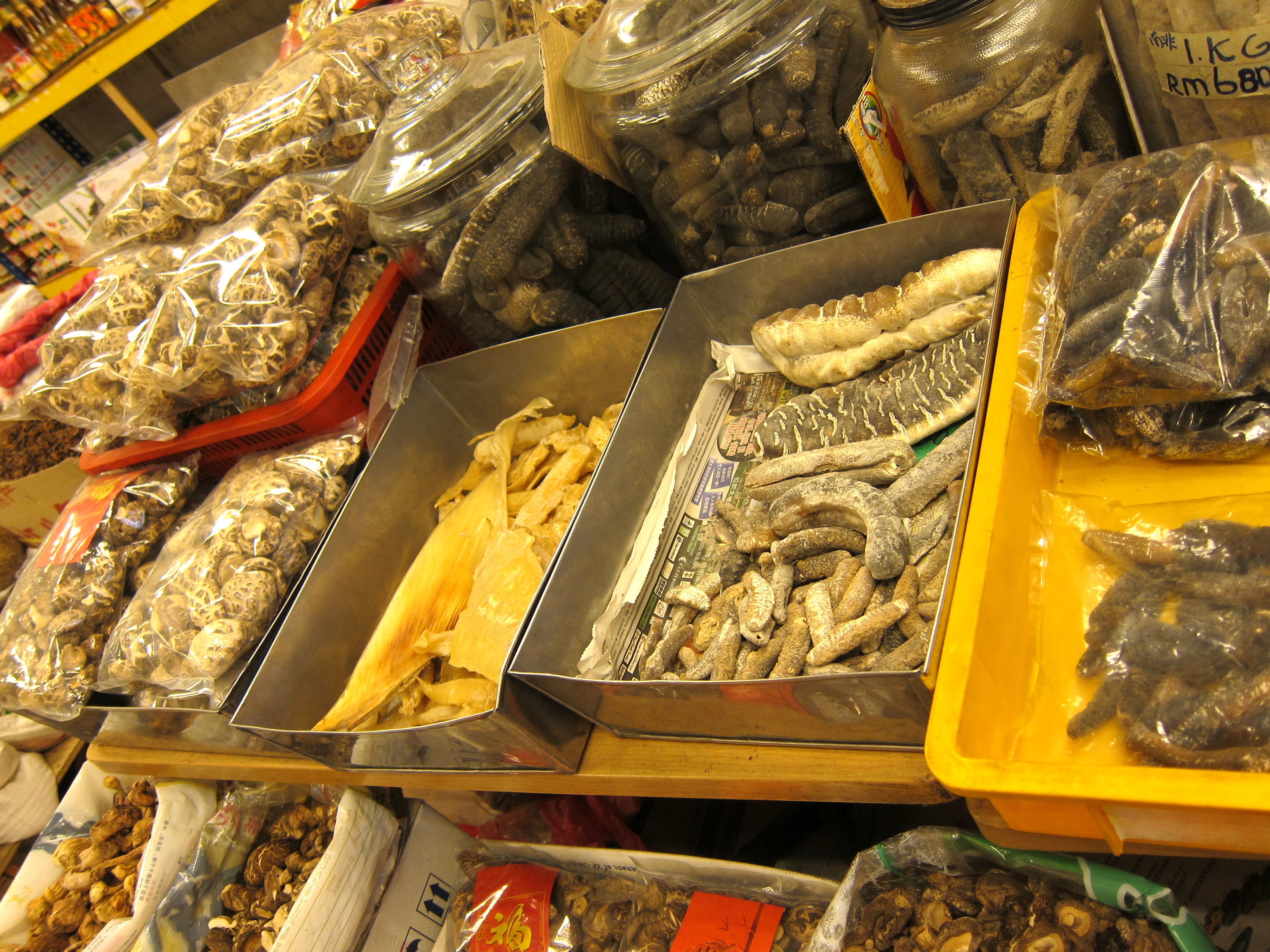
Wandering further down Petaling, we found all sorts of unusual dried foods for sale.

Oysters:IMG_0766Geoduck (or “Gooey Duck”?):

IMG_0767Star anise:

http://www.flickr.com/photos/12339764@N00/6817294042/in/set-72157629537380171/

Oranges:
http://www.flickr.com/photos/12339764@N00/6963416135/in/set-72157629537380171/

We’d intended to make our way to “Shin Kee” for lunch, as it was a restaurant that was recommend to us to check out. Unfortunately, it was closed (pictured), and we weren’t sure if it would open that day or not. That item would remain unchecked….

http://www.flickr.com/photos/12339764@N00/6963416299/in/set-72157629537380171

Further wandering the city, we attempted to finish off our checklist, sampling the random odd thing along the way.

Steph with some bubble tea (milk tea with gummy-bear like tapioca balls inside).

http://www.flickr.com/photos/12339764@N00/6963416485/in/set-72157629537380171

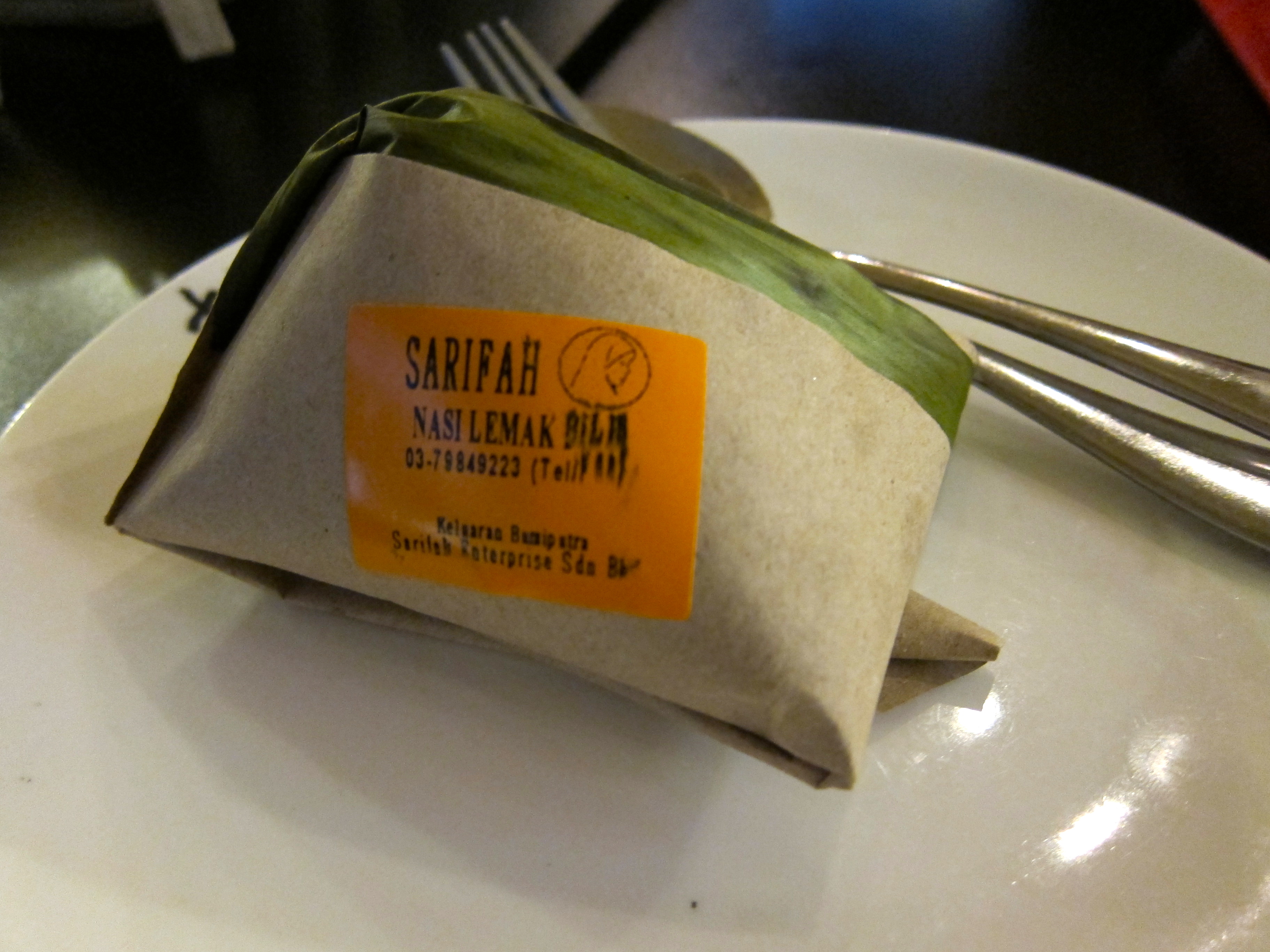
Nasi Lemak to go: rice soaked and steamed in coconut cream, a fried egg, chillies, and peanuts wrapped in a banana leaf.

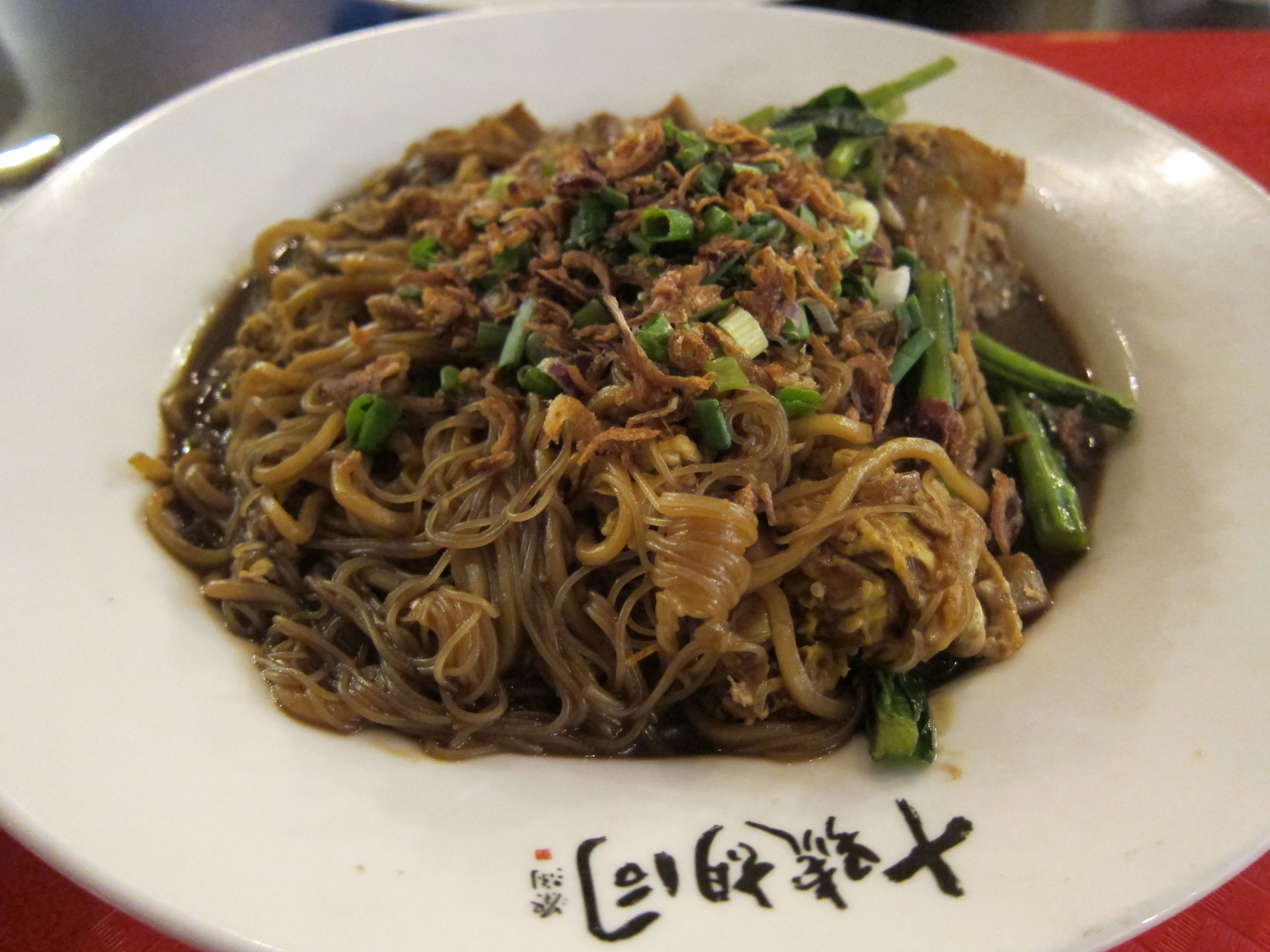
IMG_0773Hokkien Mee: fried noodles with prawns, which tasted similar to the Char Kway Teow.

Chilli Pan Mee: noodles with minced pork, anchovies, and chilli sauce– possibly the best thing we had in K.L.

IMG_0774———————-

After all that,  it was once again time to head back to the room and ready ourselves for a 4am taxi to the airport. In the end, we crossed-out all but one or two items on our list – not too bad!

More importantly, we definitely felt we could have spent a long time in K.L. – in just two days, it left a lasting, tasty impression.

Next stop: Sri Lanka!

Goodbye, Southeast Asia!!

[A quick note to avoid any confusion… we are a little behind on the blog posts… We left Cambodia a few weeks ago but have been having too much fun to get around to posting until now!]

———————————————————

Last night we turned in our keys, said our goodbyes, and concluded our 5-month tour around Southeast Asia. We could have easily stayed a few more months, even another year, but it was time to move on.

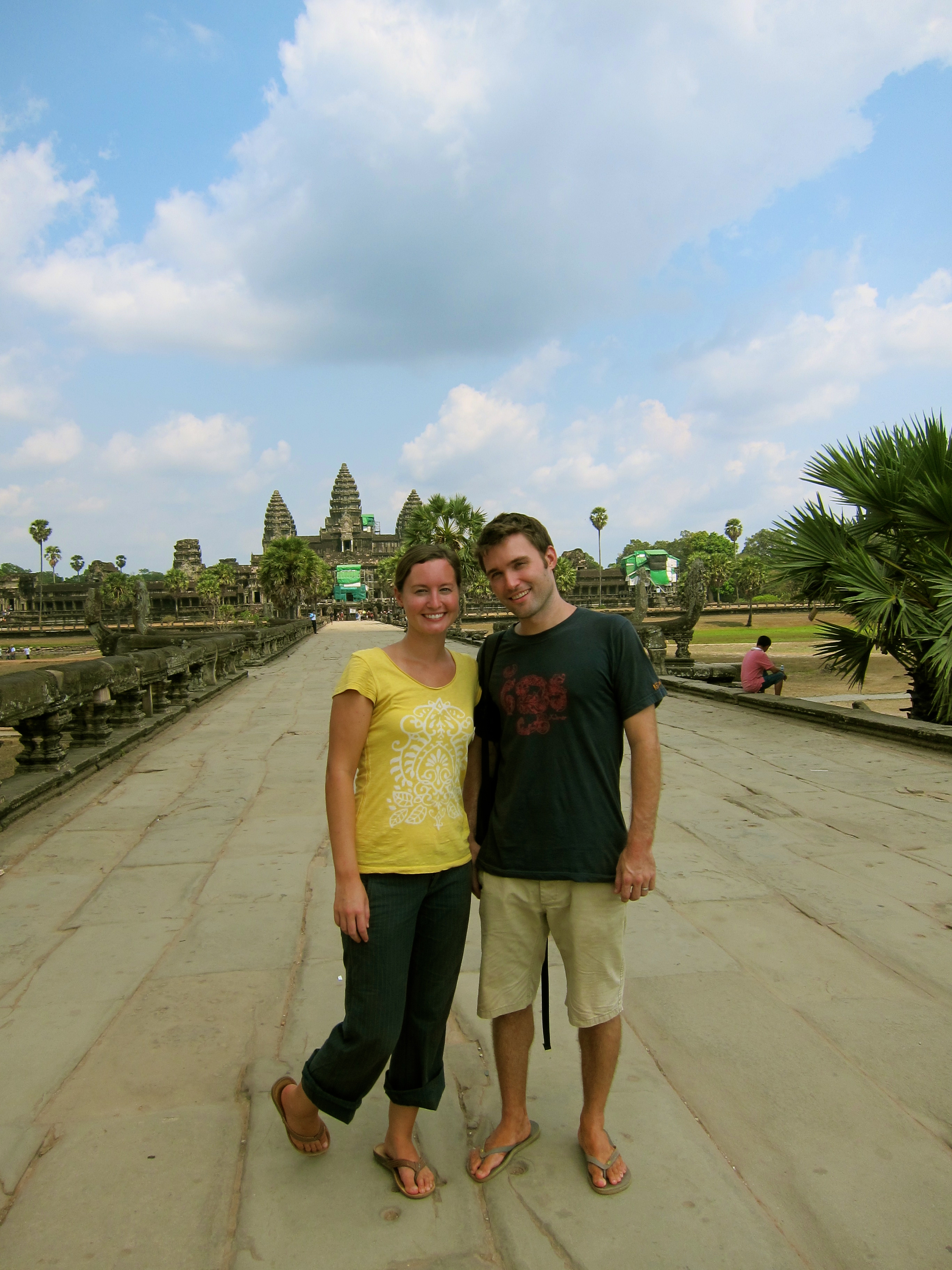
To send a proper farewell to the region, we jumped on the back of a motorscooter  this past weekend with our friend Bon and headed out into the countryside to see the Angkor temples one last time.

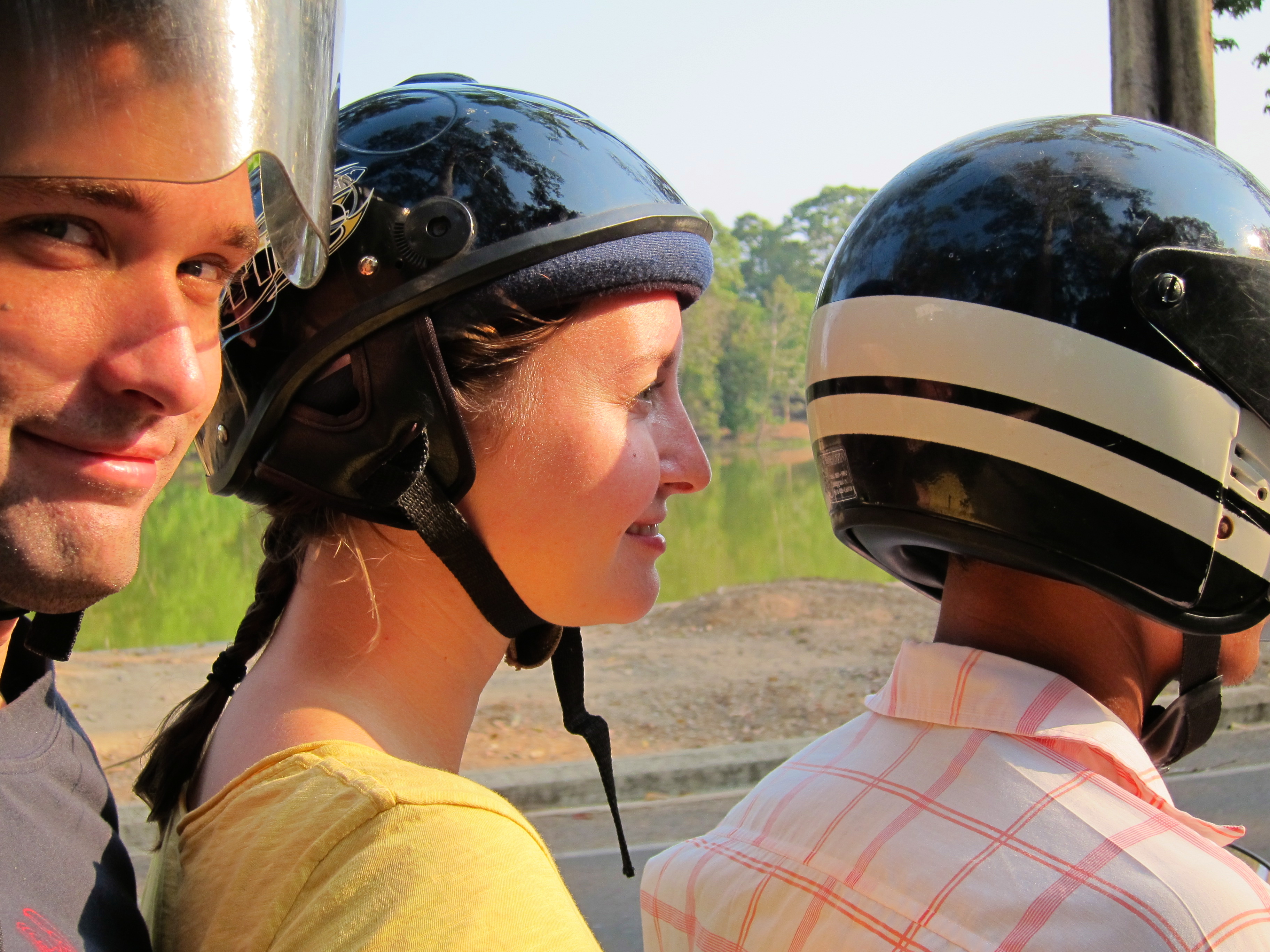
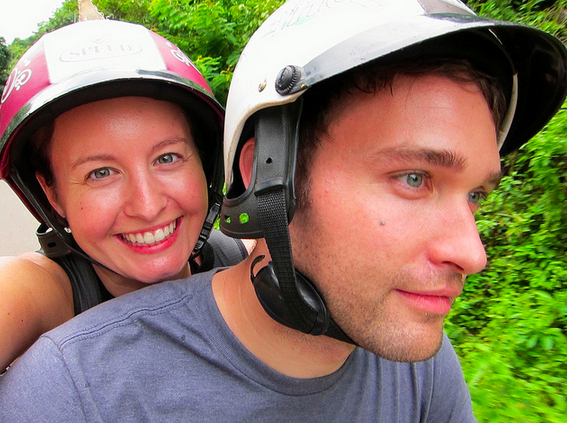
We left our itinerary for the day entirely in Bon’s hands, who took us on a 50 kilometer ride out of town to his favorite temple, Bantey Srei. True to local-style, we rode 3-deep on his motorscooter for the hour that it took us to reach the temple…

http://www.flickr.com/photos/12339764@N00/6817267914/in/set-72157629253597145

IMG_0575http://www.flickr.com/photos/12339764@N00/6812906576/in/set-72157629253597145

IMG_0581http://www.flickr.com/photos/12339764@N00/6959018339/in/set-72157629253597145

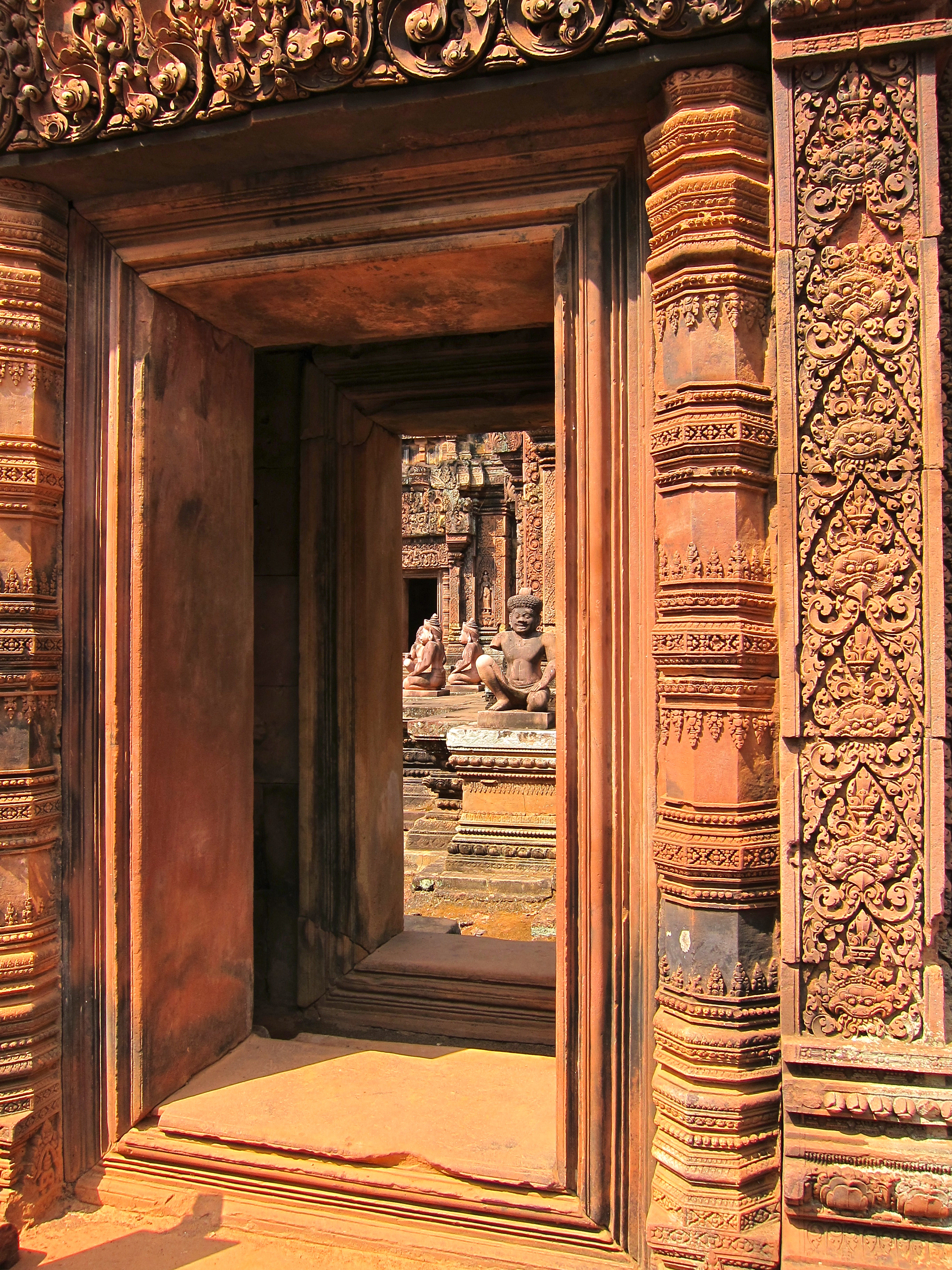
IMG_0582We could see why it was his favorite. Its scale was miniature compared to other Angkor sites– like a dollhouse more than a grand temple, where we had to duck to reach the inner sanctums– and its bas relief carvings depicting scenes from ancient scripture were deeper and more ornate than any we’d seen before.

http://www.flickr.com/photos/12339764@N00/6812910044/in/set-72157629253597145

IMG_0613http://www.flickr.com/photos/12339764@N00/6812908000/in/set-72157629253597145

Then we hopped back on the moto and zoomed off to visit the one and only Angkor Wat, one last time…

IMG_0670IMG_0668

As we started back toward town at the end of the day, a moment of hilarity ensued as I jumped on the back of the moto and Bon took off– not realizing we had left Scott standing in the dust 15 feet back. That got us all laughing and giddy for the long ride home, and from then, on nothing we said, no matter how serious, got off without a snicker or cracked joke.

http://www.flickr.com/photos/12339764@N00/6812915076/in/set-72157629253597145

IMG_0645http://www.flickr.com/photos/12339764@N00/6812912808/in/set-72157629253597145

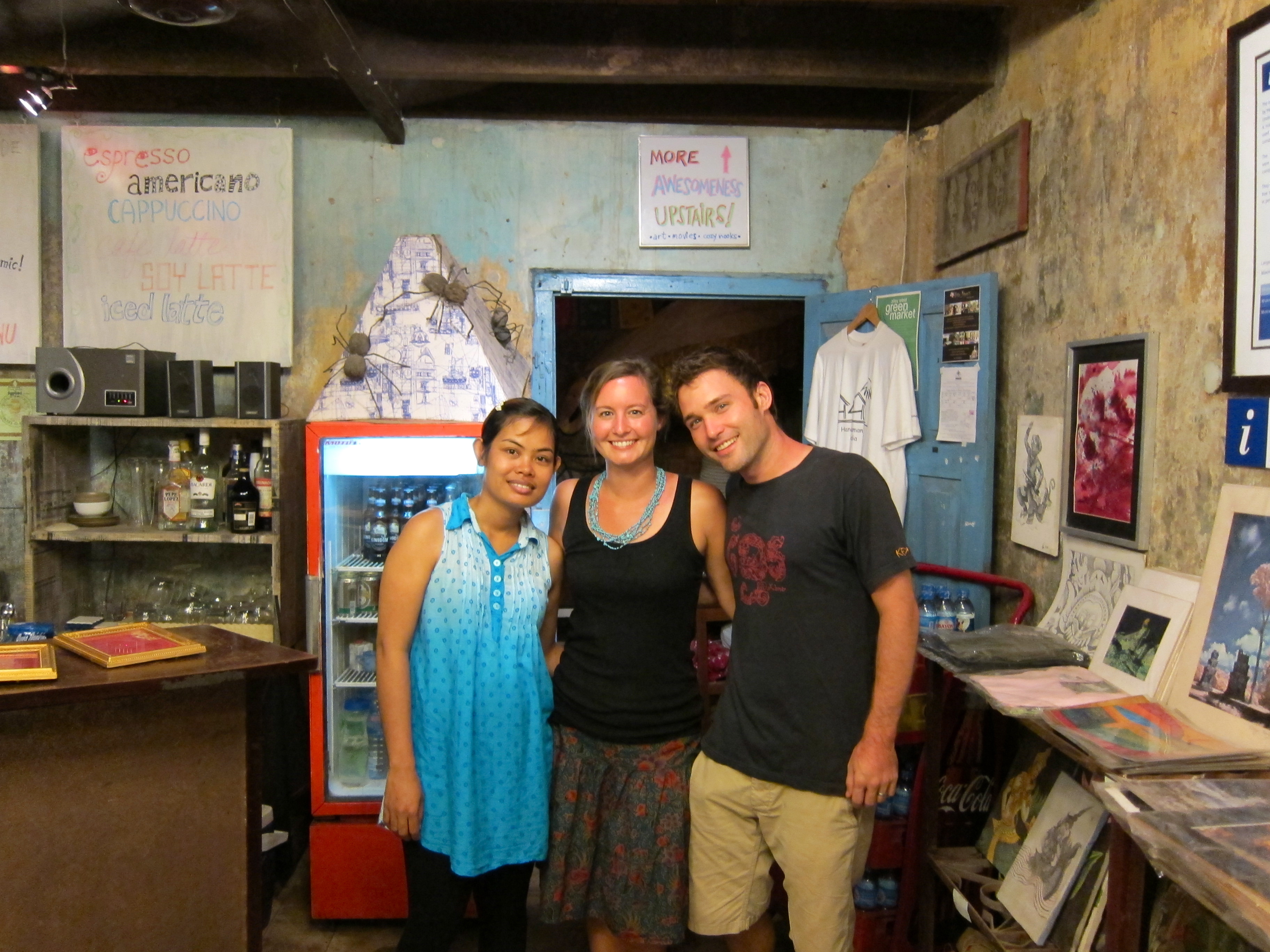
We said goodbye to Bon, then strolled over to Art Deli where we told our favorite barista that we we wouldn’t be coming into the shop anymore – not for a long while, anyway.

IMG_0685That night, we ate at one of our favorite local restaurants, Chamka, and a young backpacker who had just flown into town asked us why we were so clearly enamored by Cambodia. It’s a question that always seems to catch me off-guard– mostly because it’s one I have been trying to answer for myself.

I knew the answer teetered around one simple realization– it’s simply impossible to spend time in Cambodia and remain an outside observer– it’s the kind of place that pulls you in and doesn’t let go easily. It’s the wedding (or funeral!) that takes place in the middle of the street for everyone to see… it’s the sounds of the neighbors that penetrate your every windowpane, every crack in the floorboards… it’s the stories of the people that you may know for only a brief moment in time that somehow manage to leave an indelible mark.

For me, it was the people that I worked with every day–

IMG_0492IMG_0496

http://www.flickr.com/photos/12339764@N00/6959011659/in/set-72157629253597145

–the people whose stories fascinated me and humbled me–

IMG_0659IMG_0396

–people who I barley knew, like the young HIV patients I met in the countryside, and the patients whose stories were told to me only through the lens of the microscope.

IMG_0658Thinking back to our conversation at the restaurant, I realized what my true reasons were– but they were reasons that couldn’t have been easily conveyed to anyone –they were reasons that she would have to discover for herself.

So goodbye, Cambodia and Southeast Asia! Thank you for an incredible 5 months – we will miss you, and we will be back!!

IMG_0641Screen Shot 2014-12-17 at 1.37.48 PM

Daily Life in Cambodia

Most of our posts highlight specific places or stories that we want to remember; here’s a run-down of the minuscule, everyday things that make traveling and living in Cambodia fun, interesting, difficult, and sometimes just plain weird.

(Just a warning – this is a really long post, and it is mostly written for our own future recollection… feel free to skip over the boring sections.. :))

Living Arrangements
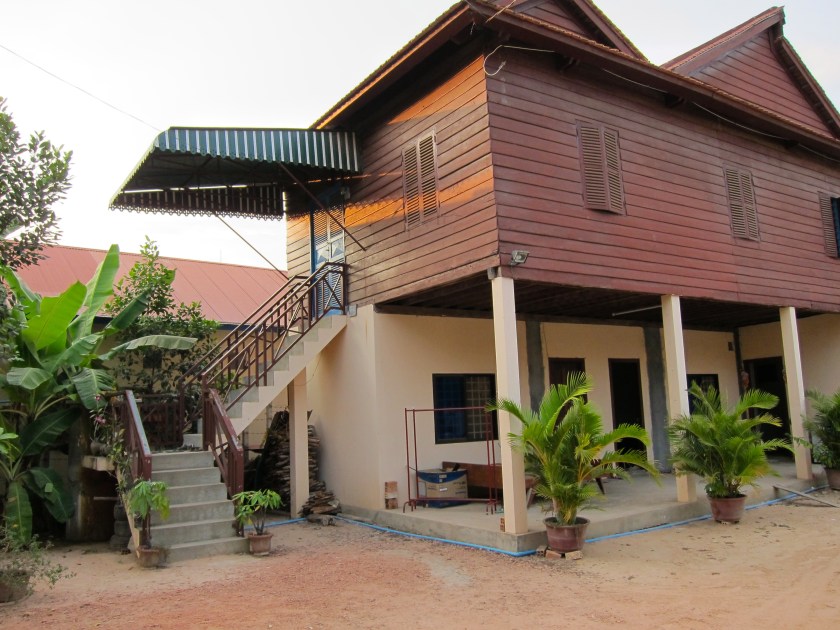
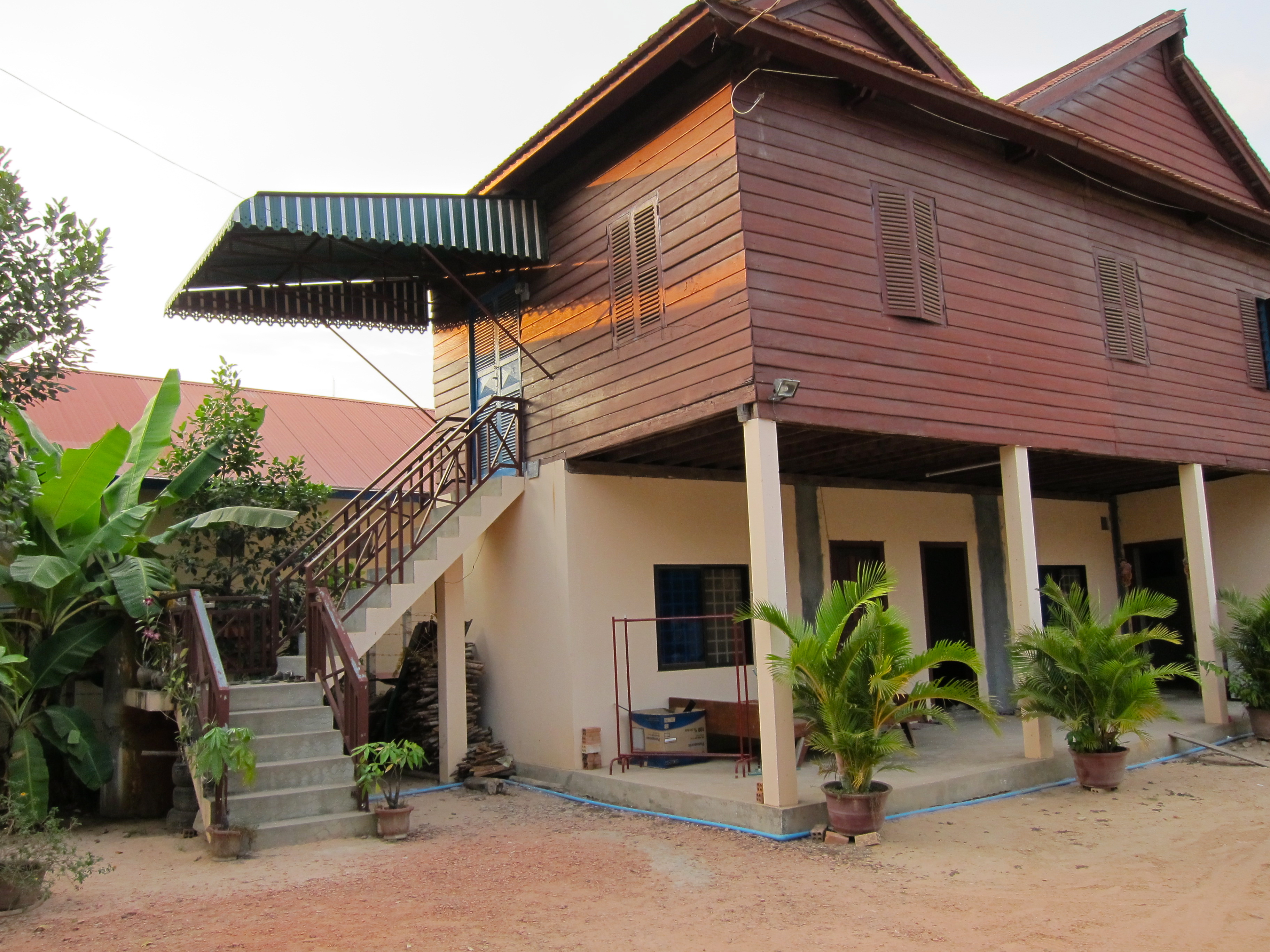
We’re renting the top floor of a home owned by Oma, a girl that I work with at AHC:

http://www.flickr.com/photos/12339764@N00/6959004473/in/set-72157629253597145

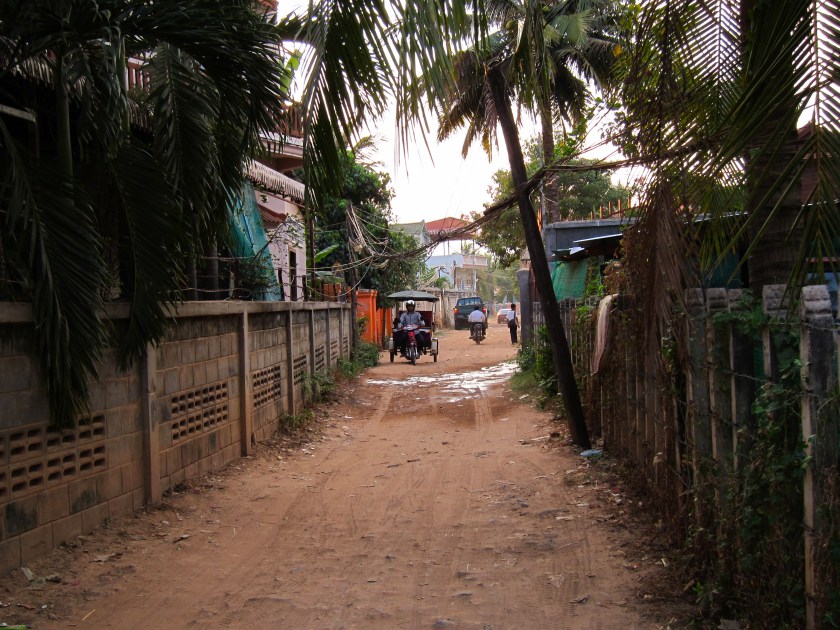
Oma lives with her husband, 6 month old daughter, and mother downstairs, while we have the top floor of their home to ourselves. It’s a little dark and cabin-like, but we have tons of space, and we love living in an actual neighborhood rather than in a hotel. In addition to the bedroom and private back deck, there’s a separate living room with some gnarly orange 70’s furniture and a small “kitchen”, which includes a mini-fridge and small table with some dishes for cooking.

Our road:IMG_0532
IMG_0533

http://www.flickr.com/photos/12339764@N00/6850200161/in/set-72157629253597145

http://www.flickr.com/photos/12339764@N00/6850127941/in/set-72157629253597145

http://www.flickr.com/photos/12339764@N00/6850186471/in/set-72157629253597145

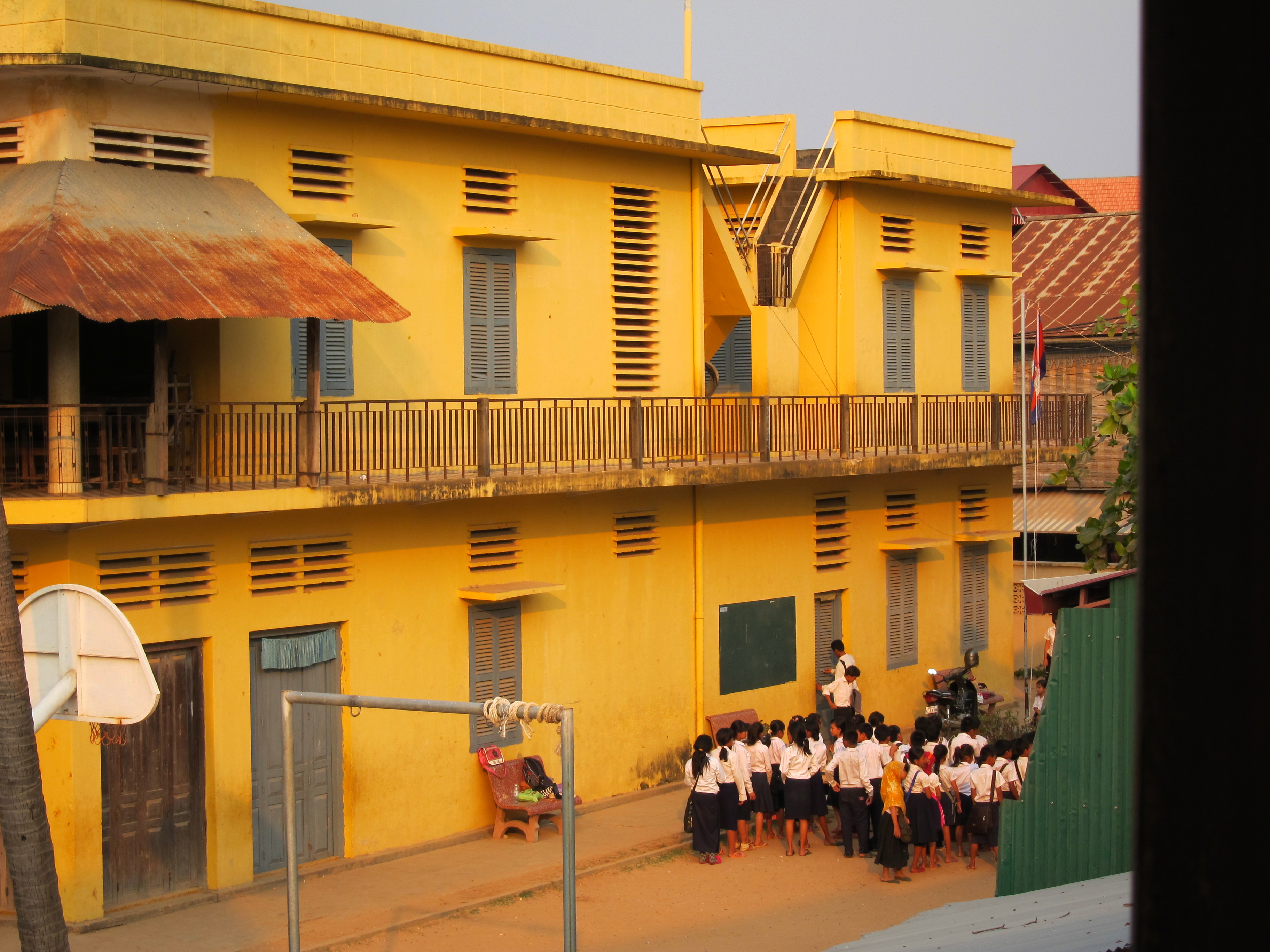
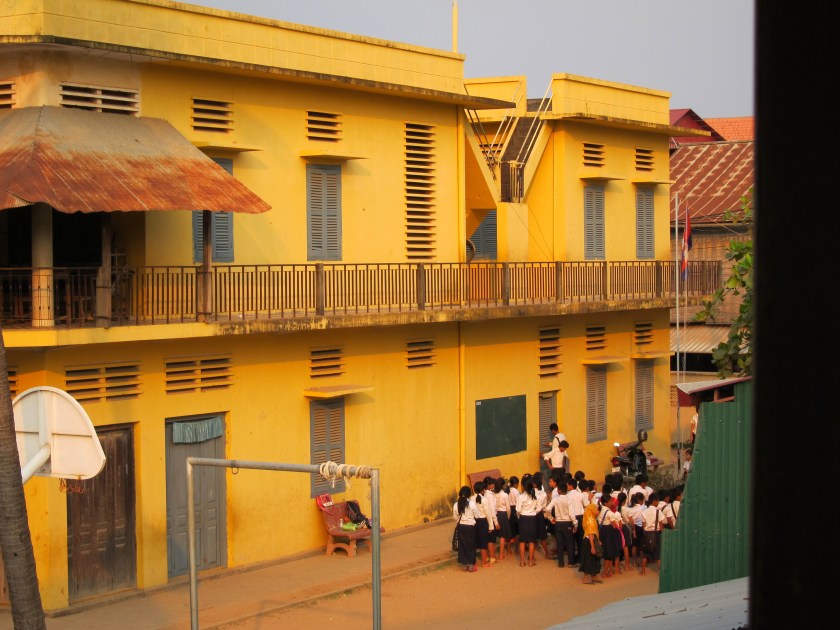
RIght outside our back door, there is a primary school full of adorable, screaming kids who wake us up at 7 am every morning on the dot. Knowing that I would be at work Mondy-Friday, we did not think this would be a problem… That is until Saturday arrived, when we quickly learned that Cambodian children attend school 6 days a week – Monday through Saturday. All was quickly forgiven though – once they discovered that there were foreigners living right outside their school,  their favorite activity became lining up on the upstairs railing to wave at us and scream “hello!” at lunch time– too adorable.IMG_0245
http://www.flickr.com/photos/12339764@N00/6850196715/in/set-72157629253597145

http://www.flickr.com/photos/12339764@N00/6910375735/in/set-72157629253597145

A google map of our apartment: Our apartment on GoogleMaps.

The only problem with our apartment is that we tend to break things in it or otherwise manage to accidentally break the rules – a lot. One day, after a failed attempt at the barber, I cut Scott’s hair in our bathroom; this meant that the next day our landlord had to come up and unclog all of the pipes leading to the shower and sink (oops!).

Ever since the clogging incident, the shower never really worked again, and they had a maintenance man in our apartment every day until we moved out. He was never able to fix the problem, and we ended up taking cold bucket showers for our last full week there. Joke was certainly on us.

Next, we managed to get locked out of the family compound one night by coming home too late and leaving our gate key locked inside our apartment. WIth the help of the neighbors across the street, Scott scaled the 10-foot tall security fence and then let me inside. Seeing that it was around midnight, we thought we had gotten in without being see by our hosts.

http://www.flickr.com/photos/12339764@N00/6812892522/in/set-72157629253597145

However, two days later, we came home to find this:
http://www.flickr.com/photos/12339764@N00/6812919476/in/set-72157629253597145

–barbed wire strung across the entire top edge of the security fence.  Coincidence? We decided not to ask, and they were too nice to mention the incident.

Finally, on our last day living there, while trying to unlock the front door, we accidentally triggered the vertical bolt on the inside of the door to fall down into its notch in the floorboards, completely locking everyone out of the apartment. After 30 minutes of trying to jam our fingers through the door to pull the lock up again, we had once again attracted the attention of all of the neighbors across the street, who then alerted our landlord. We nearly gave our landlord a heart attack (there was no other way into the apartment other than sawing a hole in the wall), but our very-pregnant neighbor and her friend were able to jimmy the lock open by reaching through a crack with their smaller hands. Crisis averted.

Food!
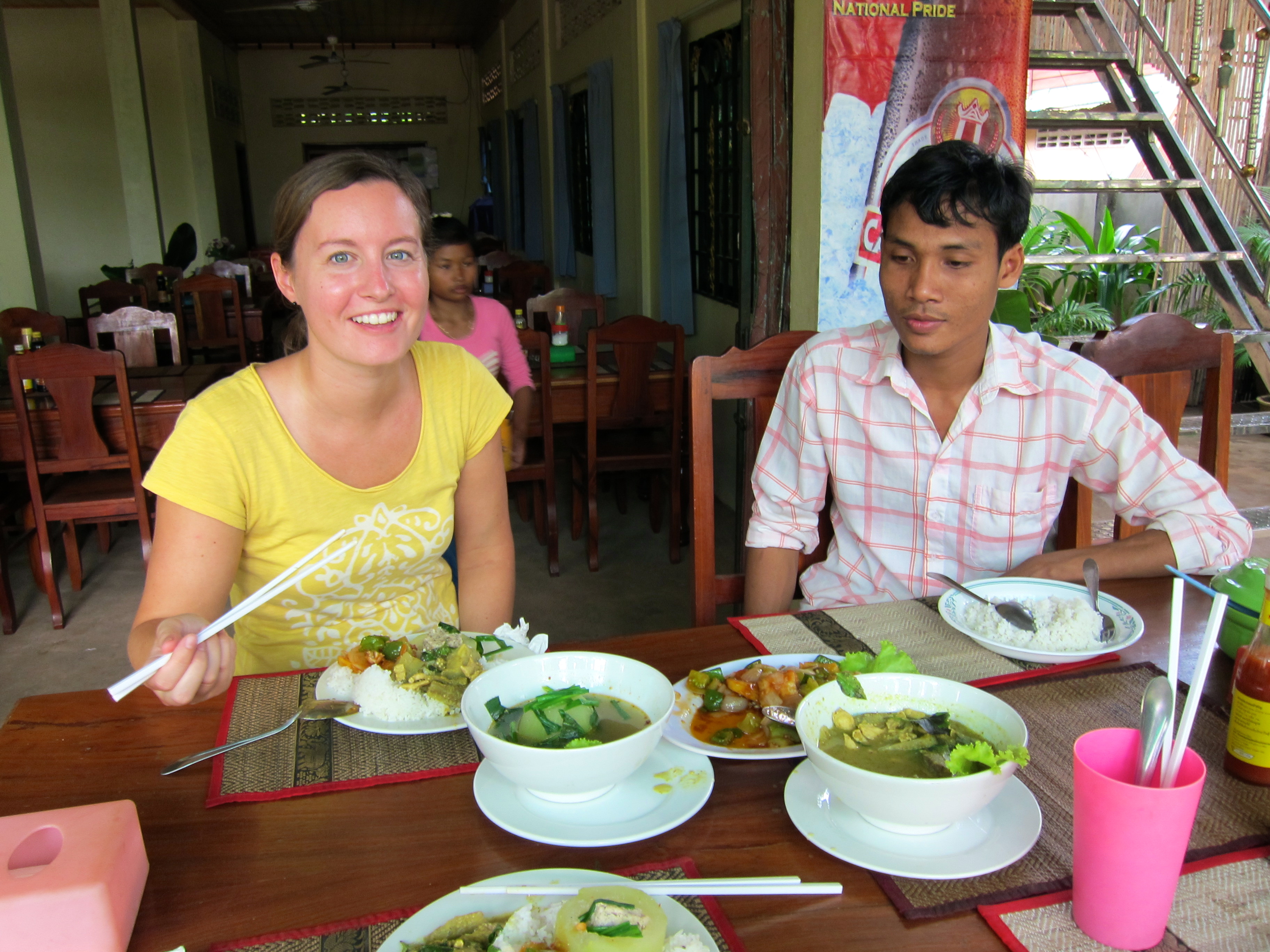
Siem Reap is full of good food. And because eating out at a restaurants here costs the same as cooking at home, we get to eat every meal out (about $1- $2/ meal)! I thought I would be sick of Asian food after a few weeks of traveling here– surprisingly (and thankfully), I’ve found the opposite to be true; by being here for so long (going on 5 months now), we’ve really been able to delve deeper and experience the extraordinary variety that exists in the cuisine and appreciate the subtleties of flavor as it changes from region to region. And I love every bit of it.

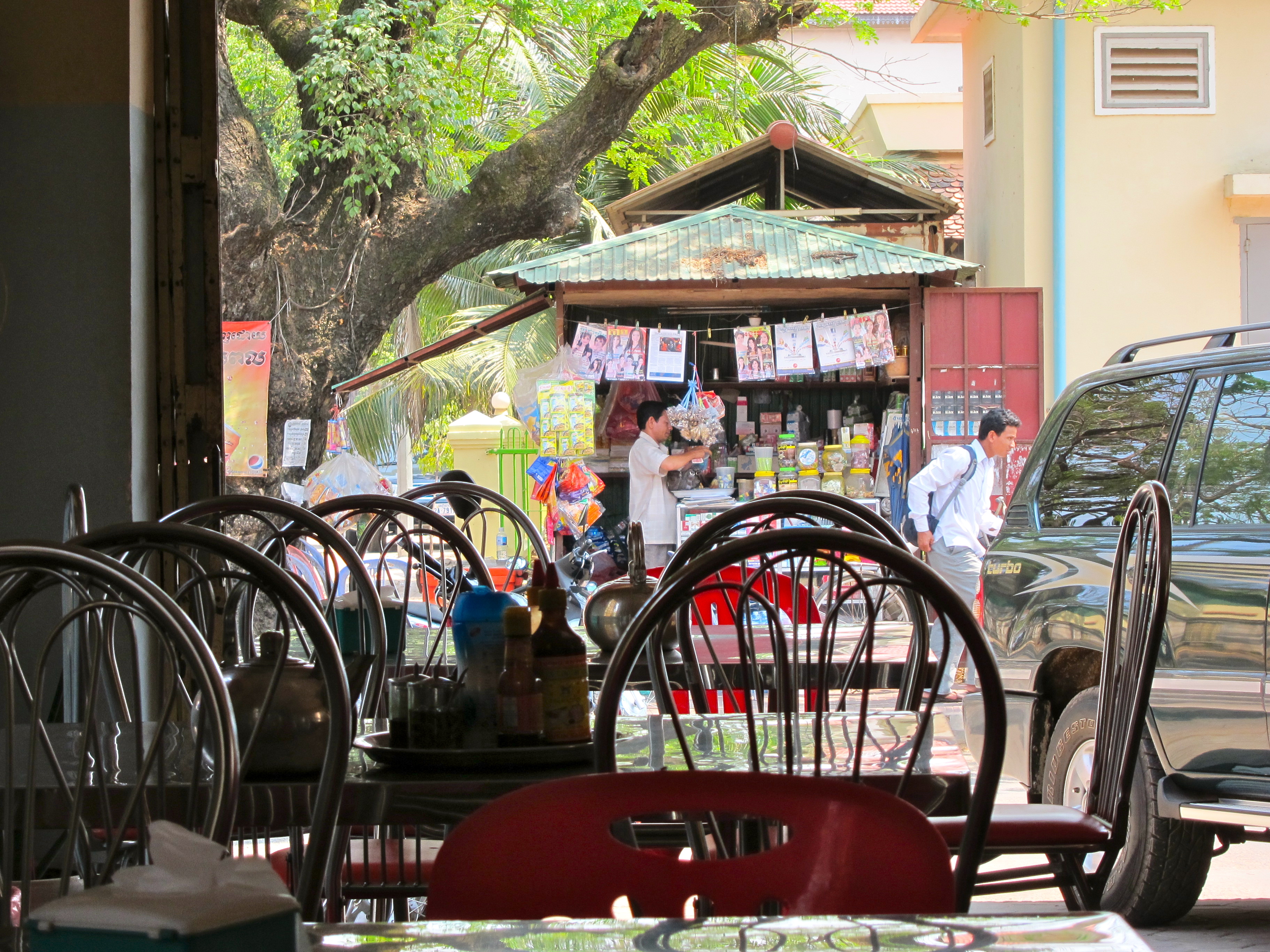
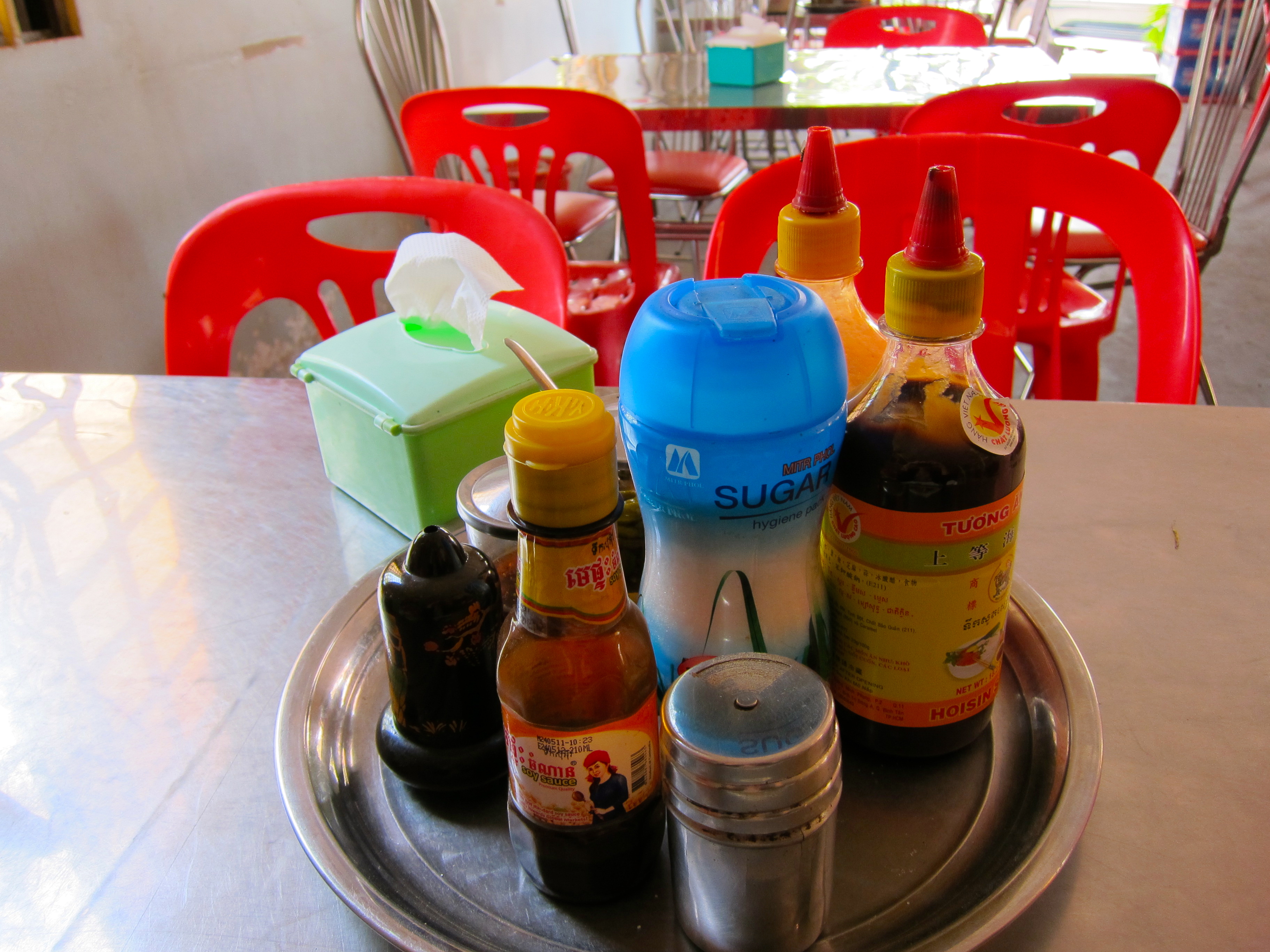
For breakfast, we always have the traditional Cambodian noodle soup (our favorite…) at a very local place right across from Angkor Hospital. The first few days, the young staff were absolutely terrified to serve us (since we didn’t speak much Khmer) and would literally push someone else to go wait on us. One day, the girl that was most scared of interacting with us yelled into the back kitchen for someone who spoke a little English to come wait on us– to which I quickly shot back in perfect Khmer, “Hey– I speak Khmer, and I want to order the noodle soup, please!” By day #30, she had finally started to come around… a little.IMG_0432
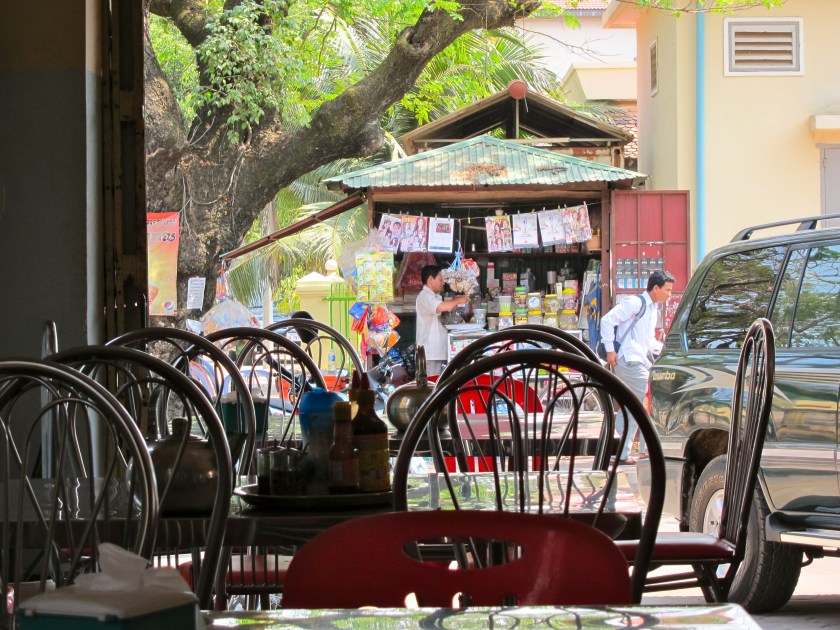
[The requisite tray of condiments to season your soup to your liking: green chilies, pepper, sugar, salt, hoisin sauce, soy sauce, red chili paste:
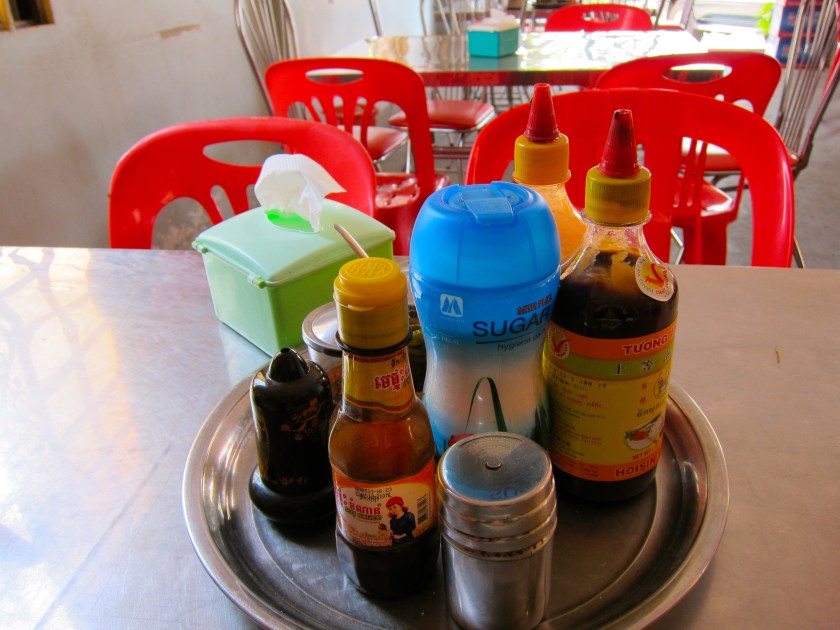
IMG_0430

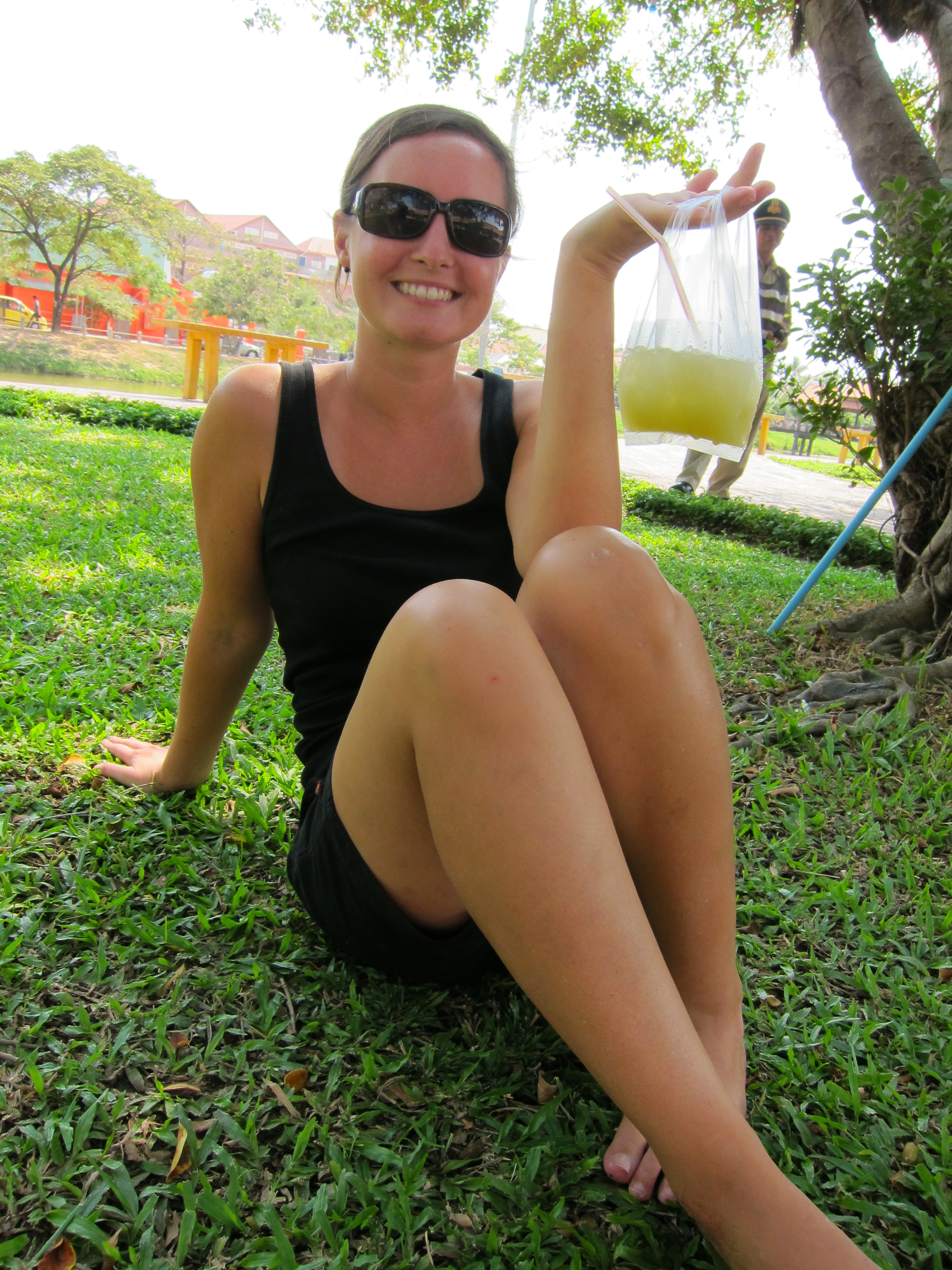
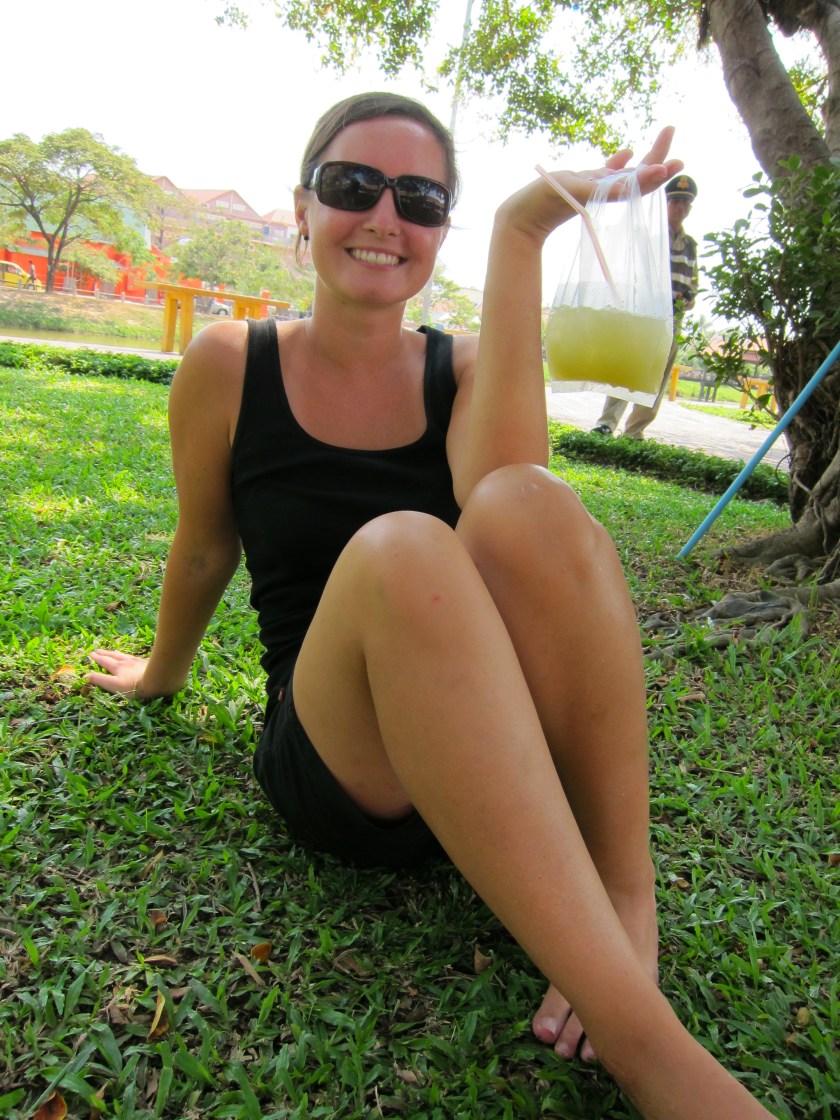
At lunchtime, Scott usually braves the 100+ degree heat to meet me at the hospital for my lunch-break. We generally skip eating (because the breakfasts are so filling) and instead enjoy a fresh-pressed palm-sugar drink from my favorite drink vendor, while hanging out by the river (in a take-away plastic baggy for just 12.5 cents, these little drinks can’t be beat!):IMG_0307Dinner is always varied but is usually traditional Cambodian food– stir-fried noodles, fried rice, sour soup, or amok curry. Here are some of our more interesting meals…
The pumpkin curry and cassava fritters (first pic) and “wedding day dip” and traditional wedding day “cakes” (second pic) at Chamka Vegetarian Restaurant:
http://www.flickr.com/photos/12339764@N00/6910421489/in/set-72157629253597145
http://www.flickr.com/photos/12339764@N00/6959029929/in/set-72157629253597145

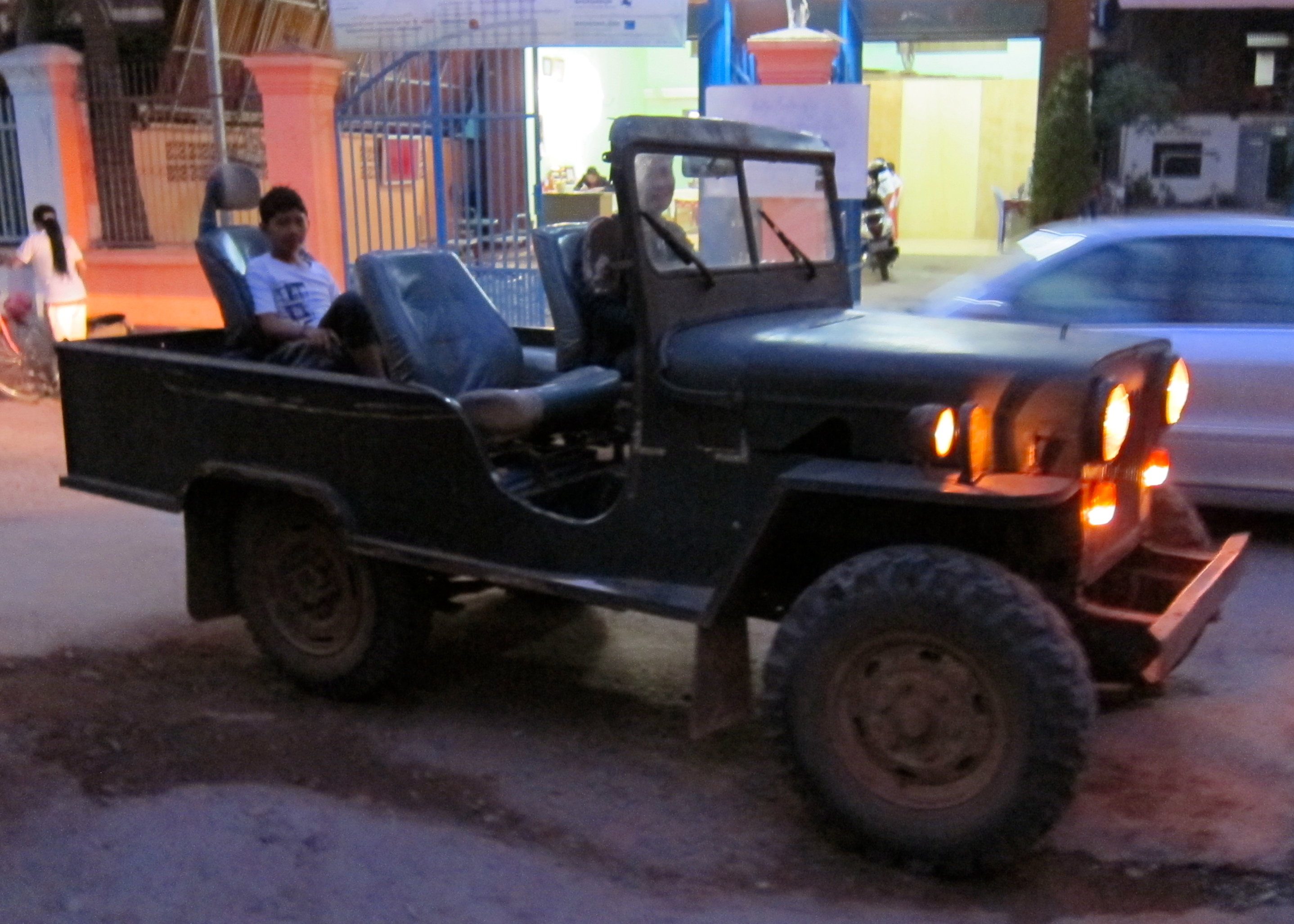
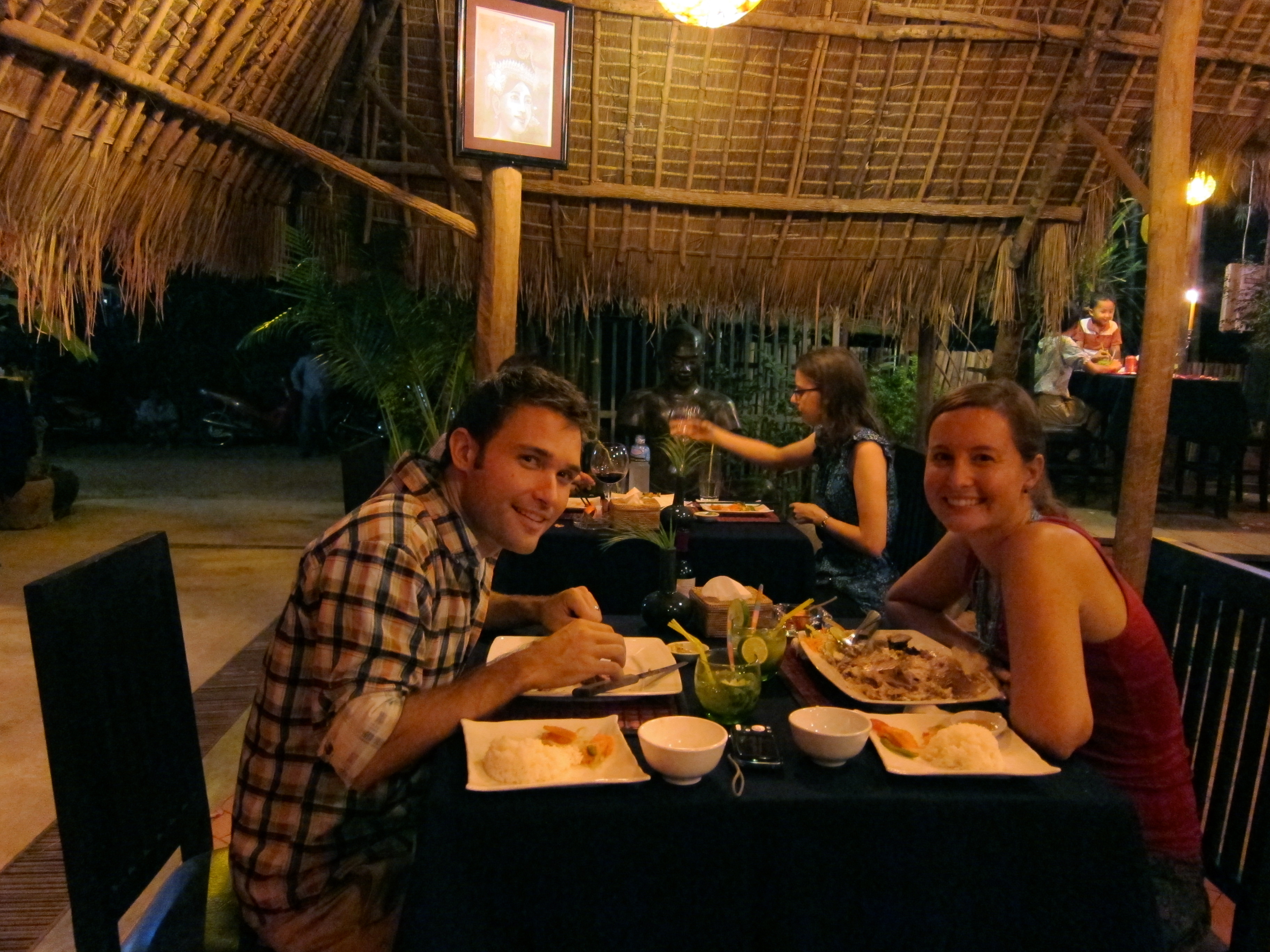
Out to eat with our friend Bon from the hospital– the best part of this meal was the Sweet and Sour Fish. I ordered the “watermelon soup”, which actually turned out to be a typo in the menu for “winter melon soup”– big difference!!IMG_0659For Valentine’s Day we ate at a local family-run restaurant called “Touich”, where they picked us up at our apartment in an old 1964 French jeep to take us to the restaurant. The whole salt-packed, roasted fish was one of the best fish I’ve ever eaten:
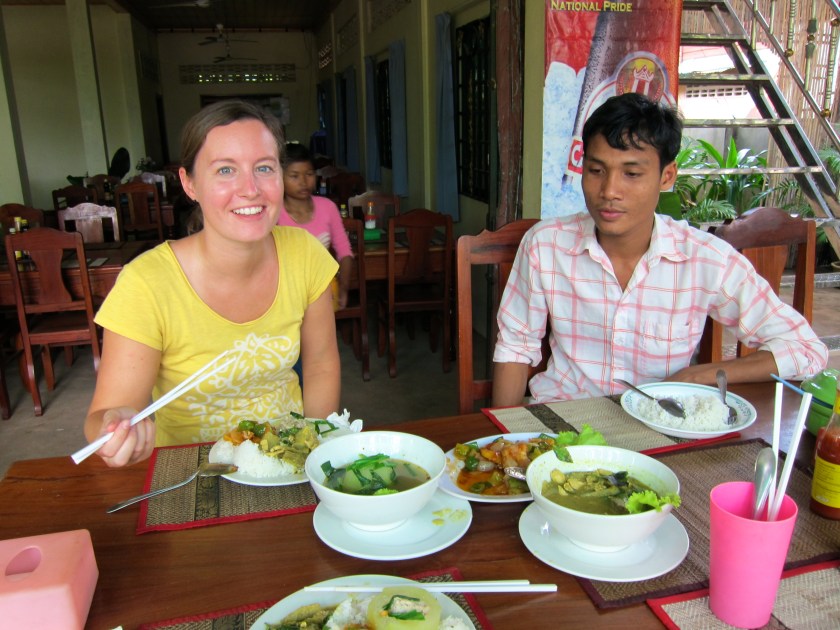
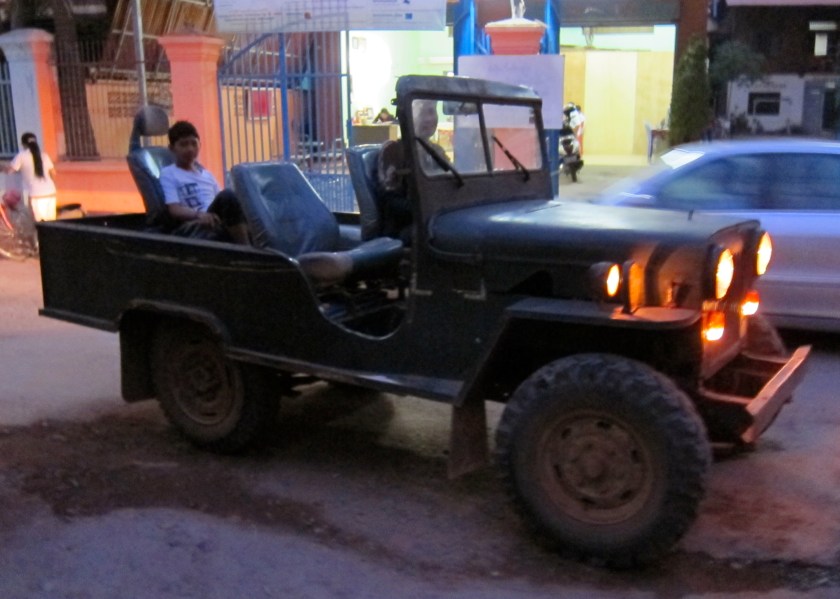
IMG_0354http://www.flickr.com/photos/12339764@N00/6910417517/in/set-72157629253597145
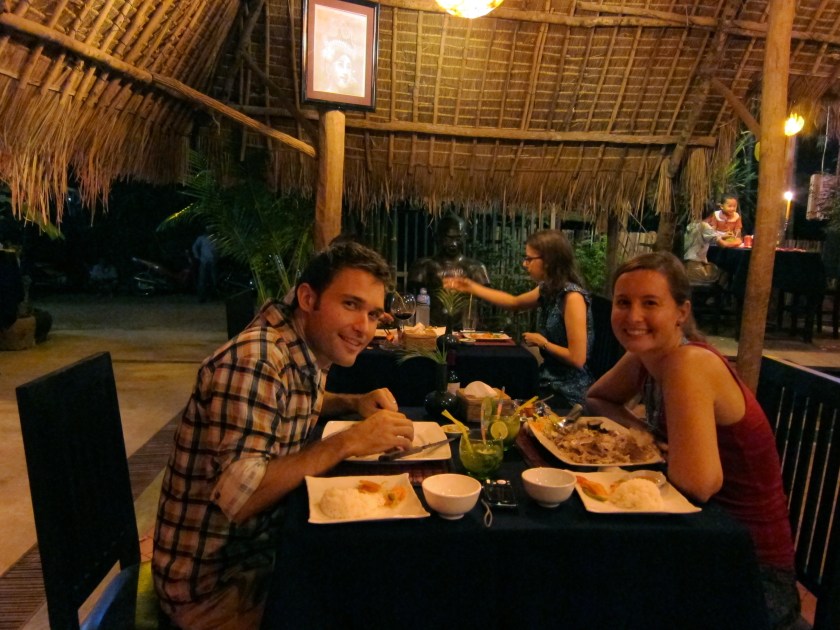
IMG_0360(The above picture was taken because, halfway through our meal, the waitress walked up to us and asked if she could take our picture to put it on Facebook! So we asked her to get one with our camera too. We haven’t checked to see if our pic made it to Facebook or not yet..)

Traditional Khmer amok curry at Amok Restaurant:
http://www.flickr.com/photos/12339764@N00/6812902180/in/set-72157629253597145

Siem Reap was also home to the first bag of Doritos I had found for the first time on the whole trip!!! woohoo
http://www.flickr.com/photos/12339764@N00/6910385103/in/set-72157629253597145
Wow, that’s an embarrassing picture.

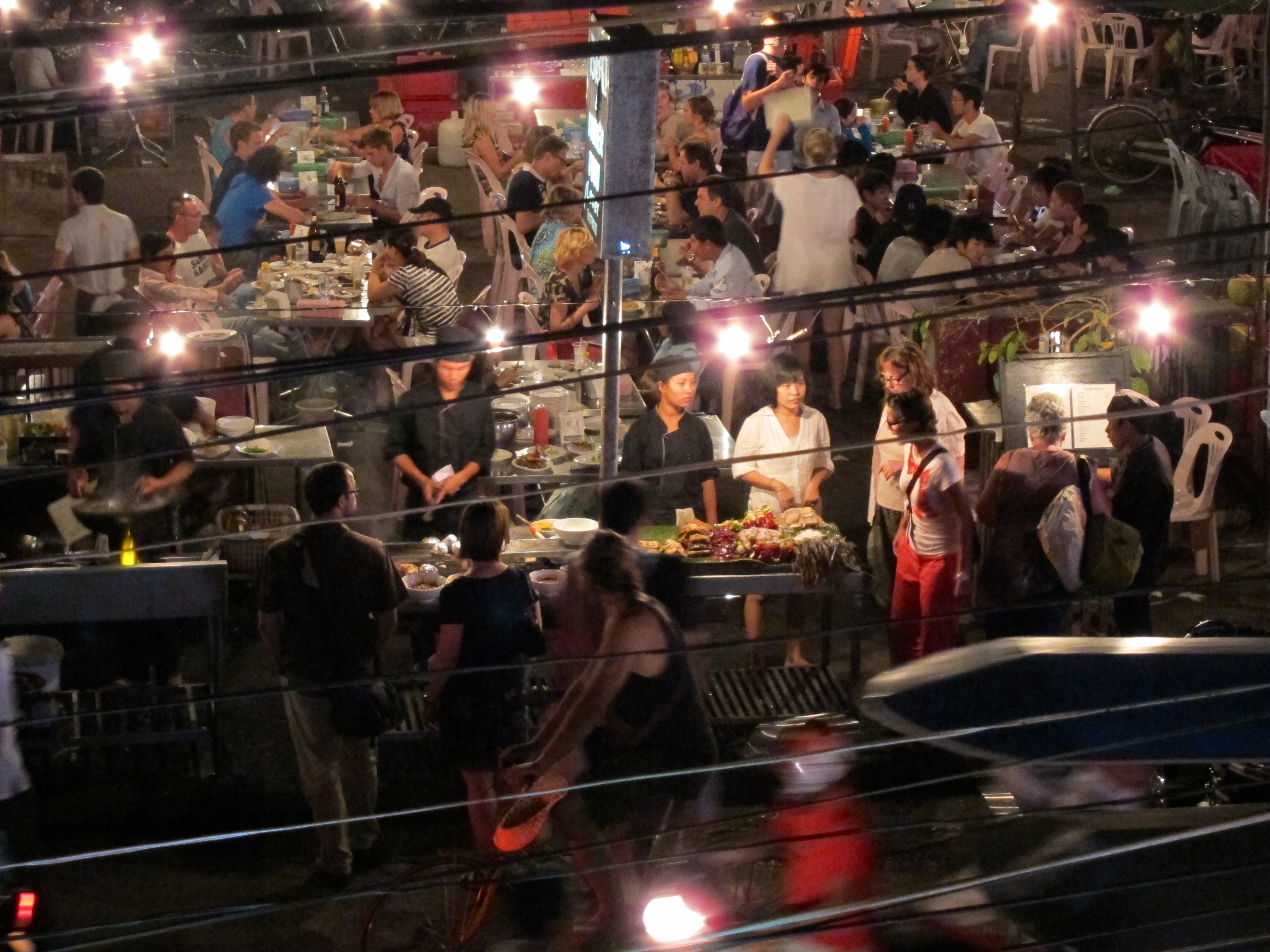
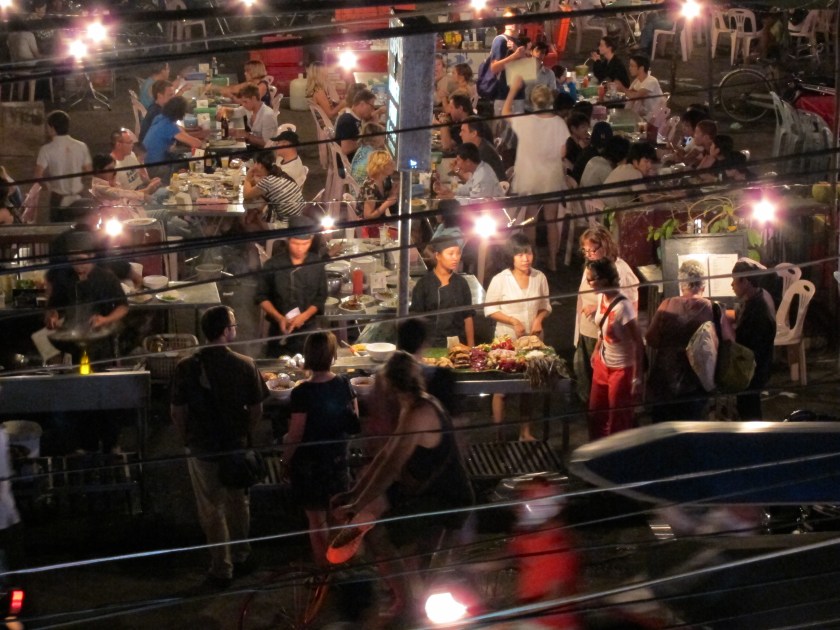
The night food market…IMG_0376Worklife
Scott spends his days working at our favorite cafe in town, Art Deli. It is not only an amazing space, decorated with tons of great local art, but they also make the best homemade iced lime soda in town and have the nicest waitstaff (…occasionally surprising us with free drinks and such:)). We will miss them when we look back on our time in Siem Reap, and I keep wondering, will they still be here, working, when we return some day?
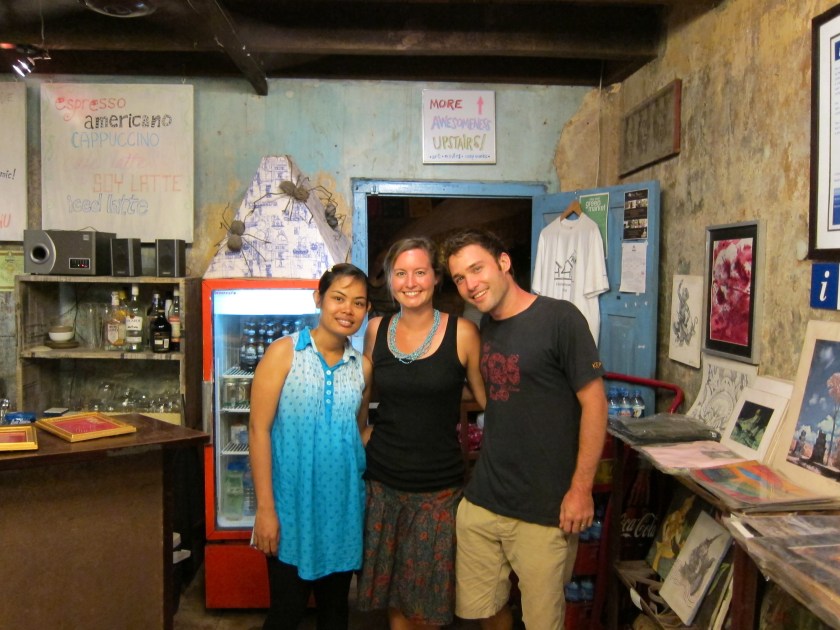
IMG_0685http://www.flickr.com/photos/12339764@N00/6910379397/in/set-72157629253597145
http://www.flickr.com/photos/12339764@N00/6910380337/in/set-72157629253597145
(…notice the old bathtub being used as a table… water pitchers strung together for lighting… the big screen by the windows is for watching free movies with your cuppa joe!)

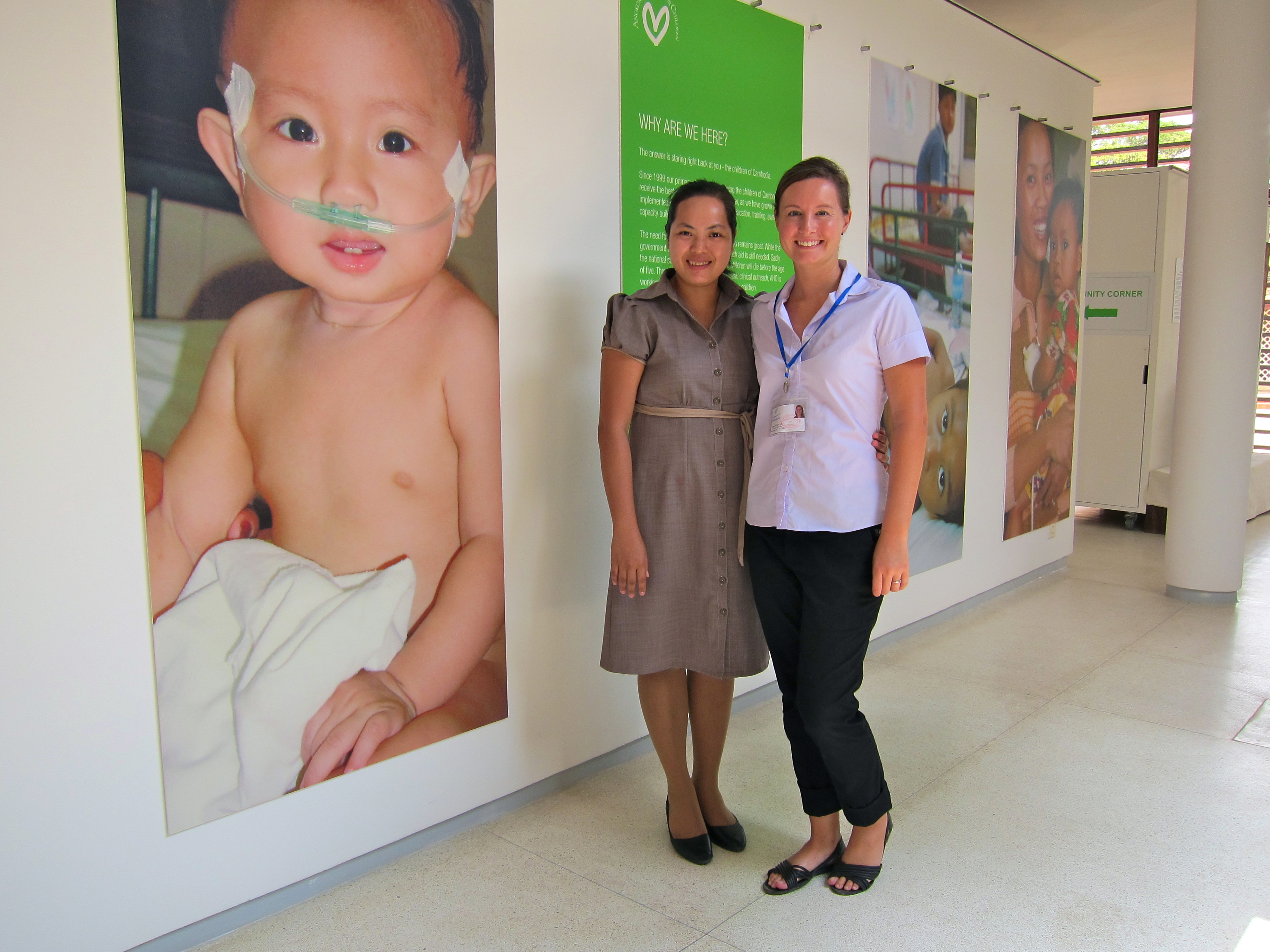
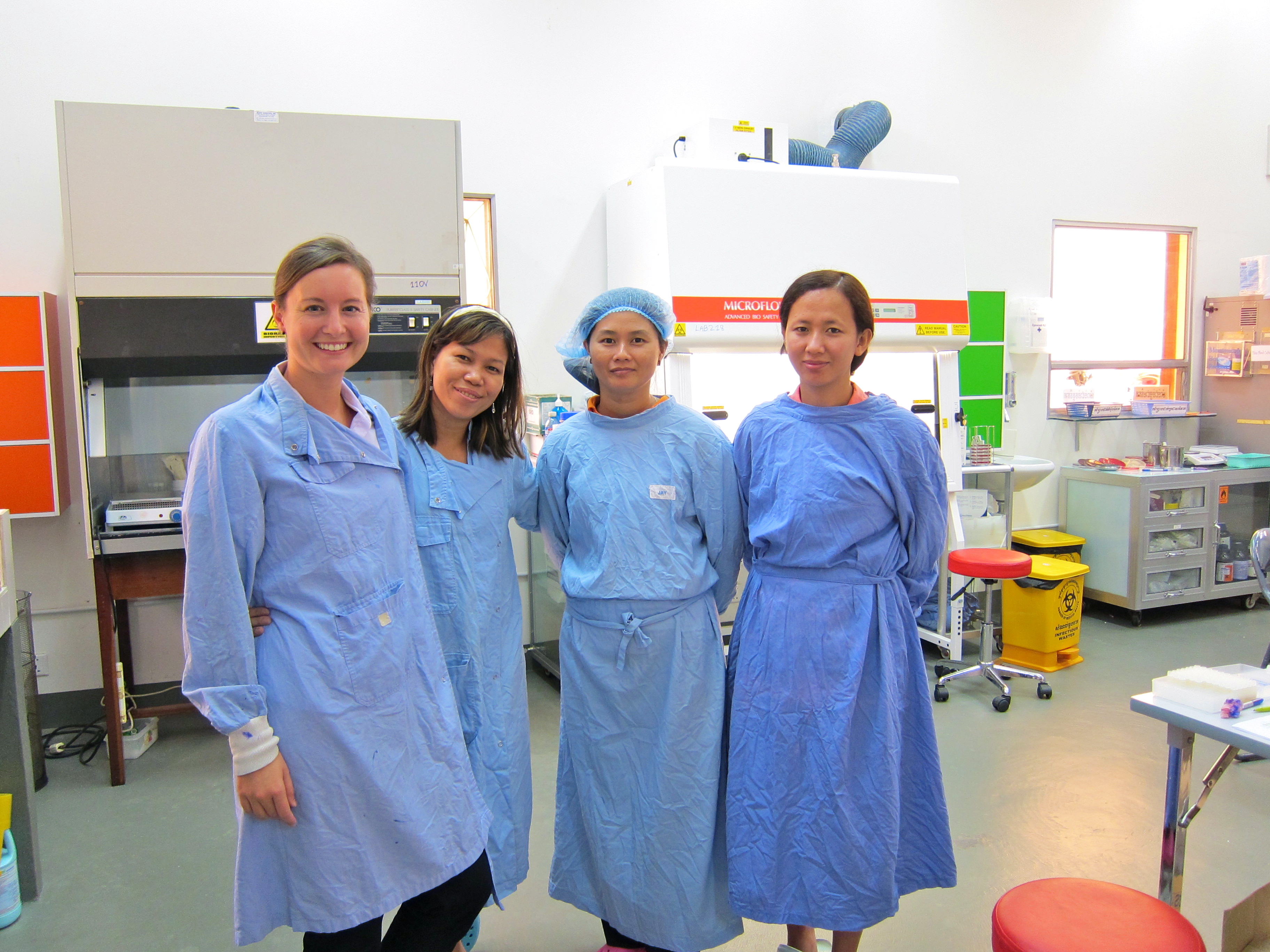
I spend my weekdays working in the diagnostic lab at Angkor Hospital for Children (detailed in an earlier post- pictures can also be found in that post).

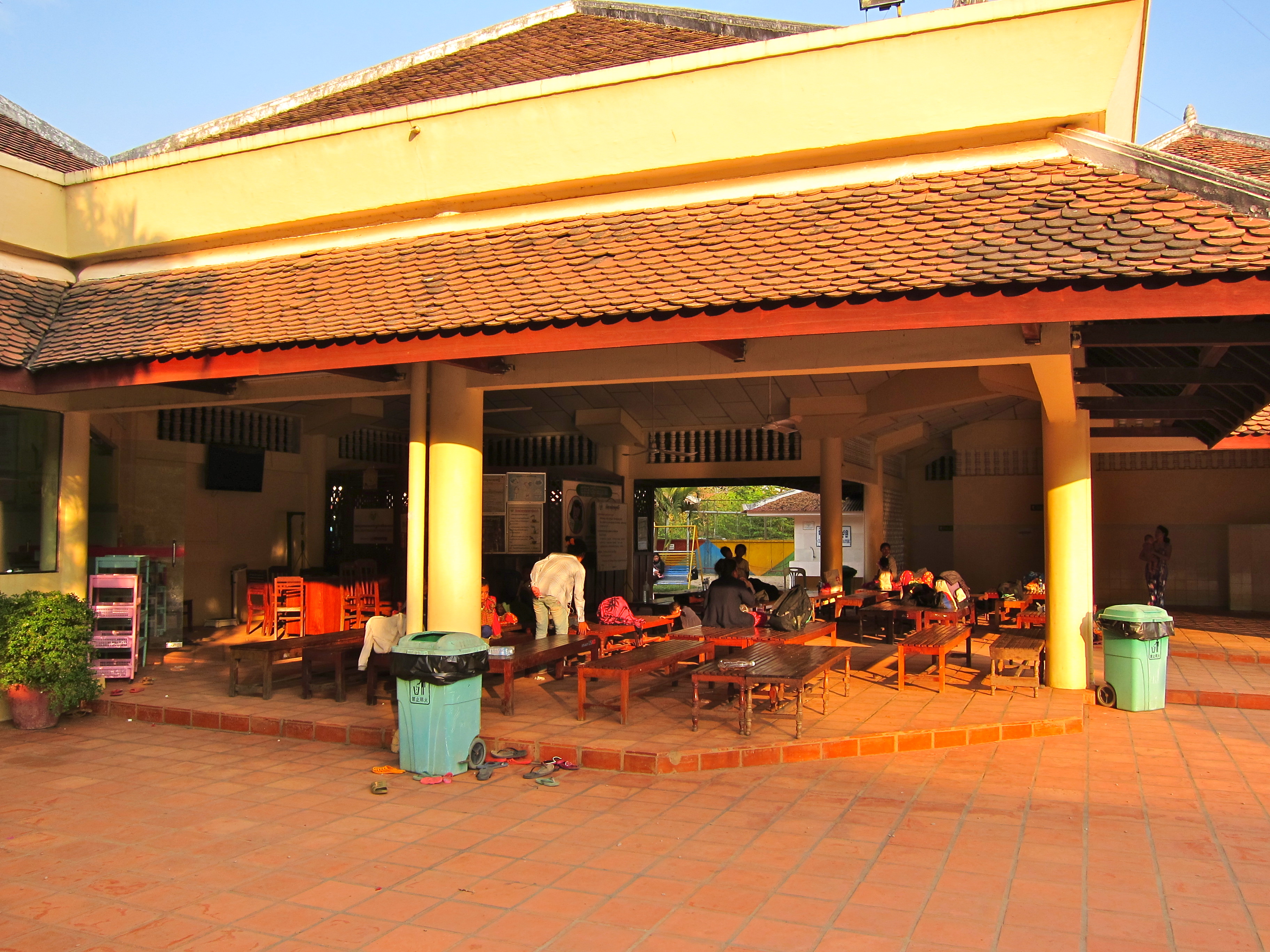
The hospital entrance and waiting area:
http://www.flickr.com/photos/12339764@N00/6959011107/in/set-72157629253597145

http://www.flickr.com/photos/12339764@N00/6959008147/in/set-72157629253597145

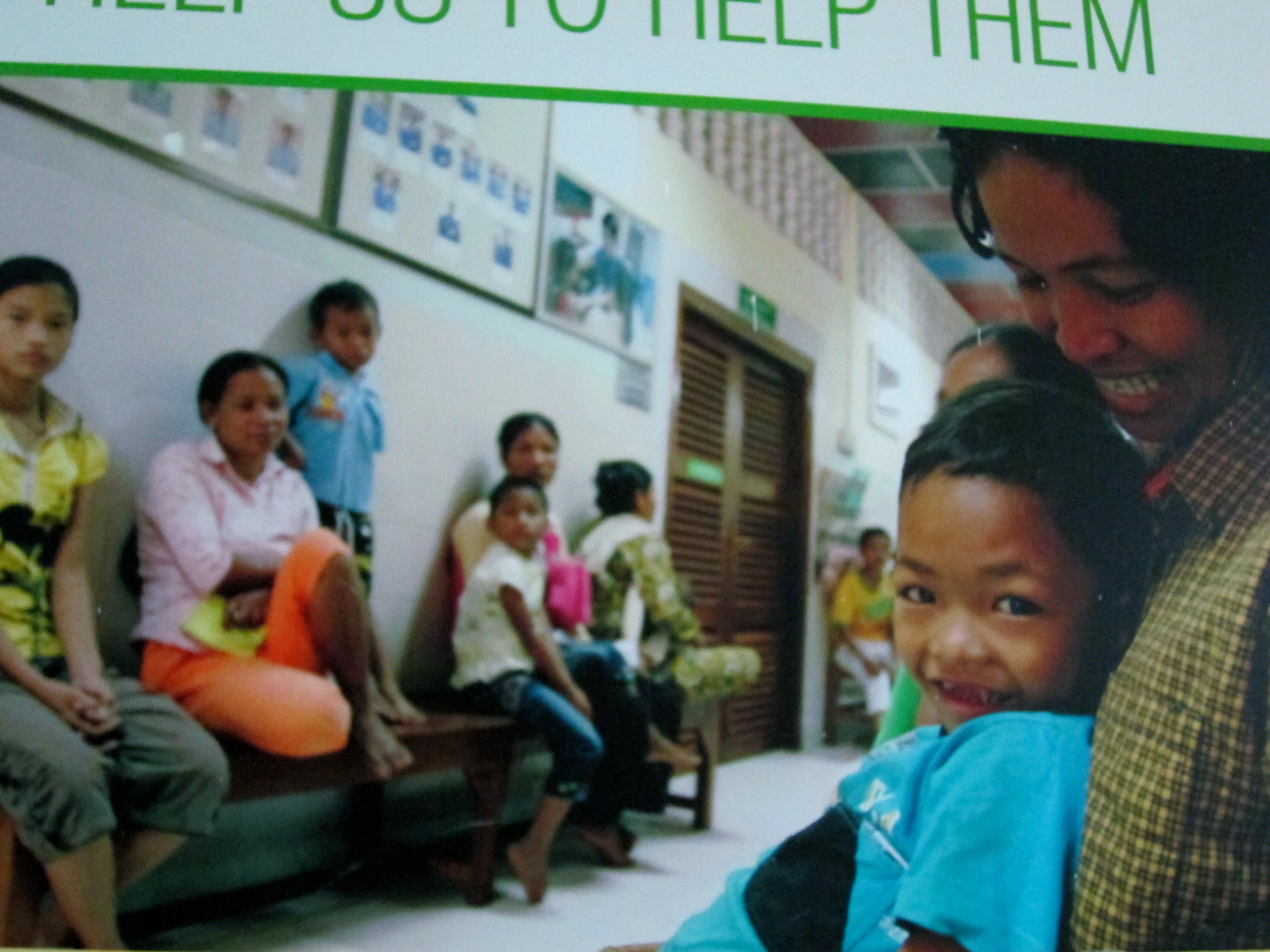
Registration and out-patient clinic. (AHC sees over 500 patients a day– a day!! Most of those patients are seen right here on these benches in the waiting room by a nurse, who determines if the child is sick enough to be seen be admitted and seen by a doctor.)
http://www.flickr.com/photos/12339764@N00/6812899754/in/set-72157629253597145

I work in the microbiology department along with Sona (next to me) and Poda (next to Sona), who keep me laughing all day long:
http://www.flickr.com/photos/12339764@N00/6812893724/in/set-72157629253597145

First day of “school”…
http://www.flickr.com/photos/12339764@N00/6850195275/in/set-72157629253597145

It’s official!

http://www.flickr.com/photos/12339764@N00/6850230007/in/set-72157629253597145/

http://www.flickr.com/photos/12339764@N00/6850223385/in/set-72157629253597145

My desk and lab space:
http://www.flickr.com/photos/12339764@N00/6850190729/in/set-72157629253597145
http://www.flickr.com/photos/12339764@N00/6812892684/in/set-72157629253597145

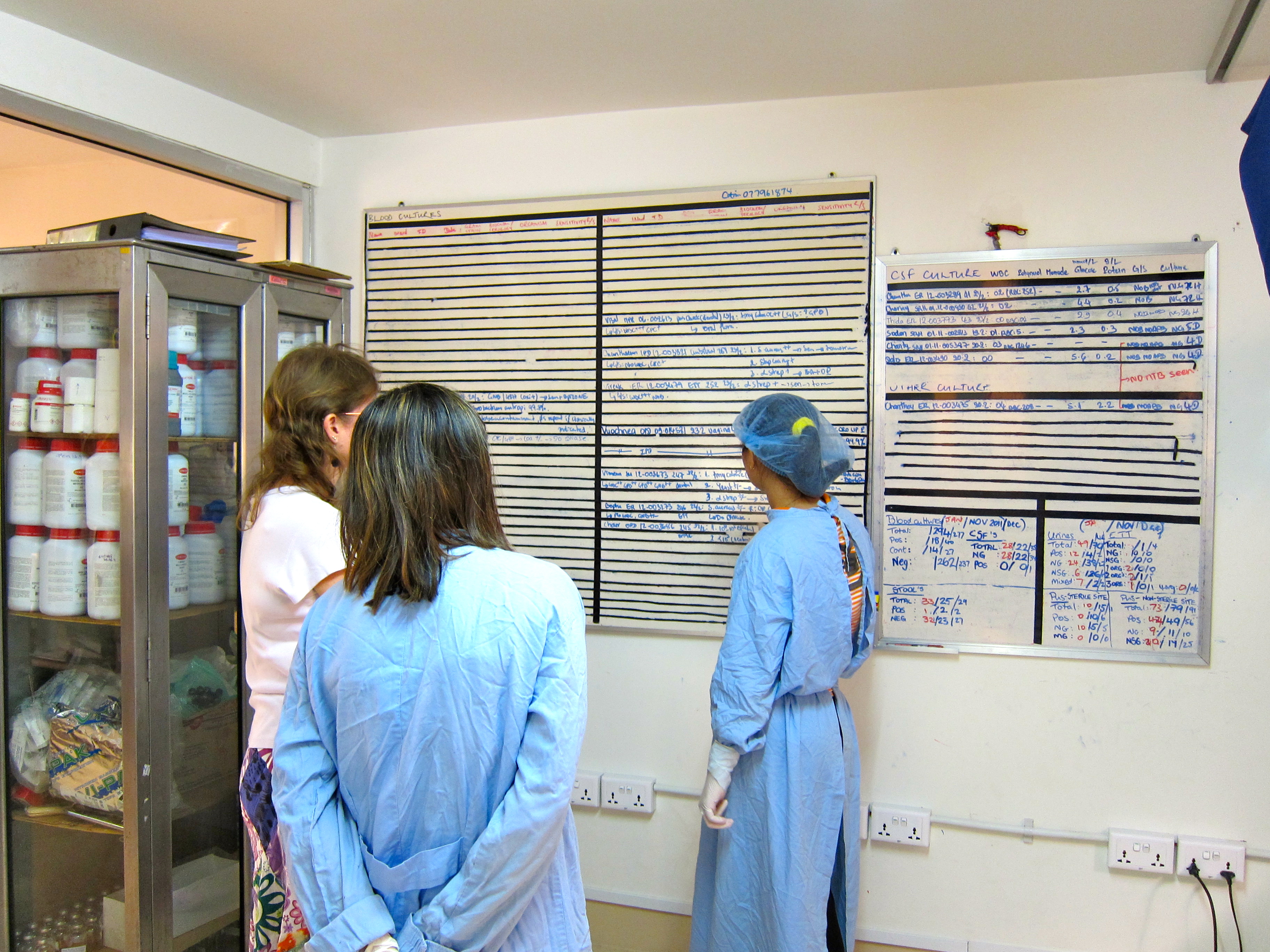
All of our results are written on a large board, which we review with the resident doctor around 11am each morning.
http://www.flickr.com/photos/12339764@N00/6959004713/in/set-72157629253597145

The permanent laboratory staff:
http://www.flickr.com/photos/12339764@N00/6812895660/in/set-72157629253597145

Ambulance:
http://www.flickr.com/photos/12339764@N00/6812894932/in/set-72157629253597145

The 4-bed emergency room:
http://www.flickr.com/photos/12339764@N00/6812898152/in/set-72157629253597145

The Capacity for Health and Education Building:
http://www.flickr.com/photos/12339764@N00/6812893948/in/set-72157629253597145

The hospital garden, which is used to educate the villagers on how to set up a proper garden when they return home. The villagers are also given free seeds to start gardens of their own:
http://www.flickr.com/photos/12339764@N00/6959010231/in/set-72157629253597145

The dental clinic:
http://www.flickr.com/photos/12339764@N00/6812898622/in/set-72157629253597145

The Visitor’s Center:
http://www.flickr.com/photos/12339764@N00/6850225623/in/set-72157629253597145

The hospital laundry is still all done by hand:
http://www.flickr.com/photos/12339764@N00/6959010493/in/set-72157629253597145

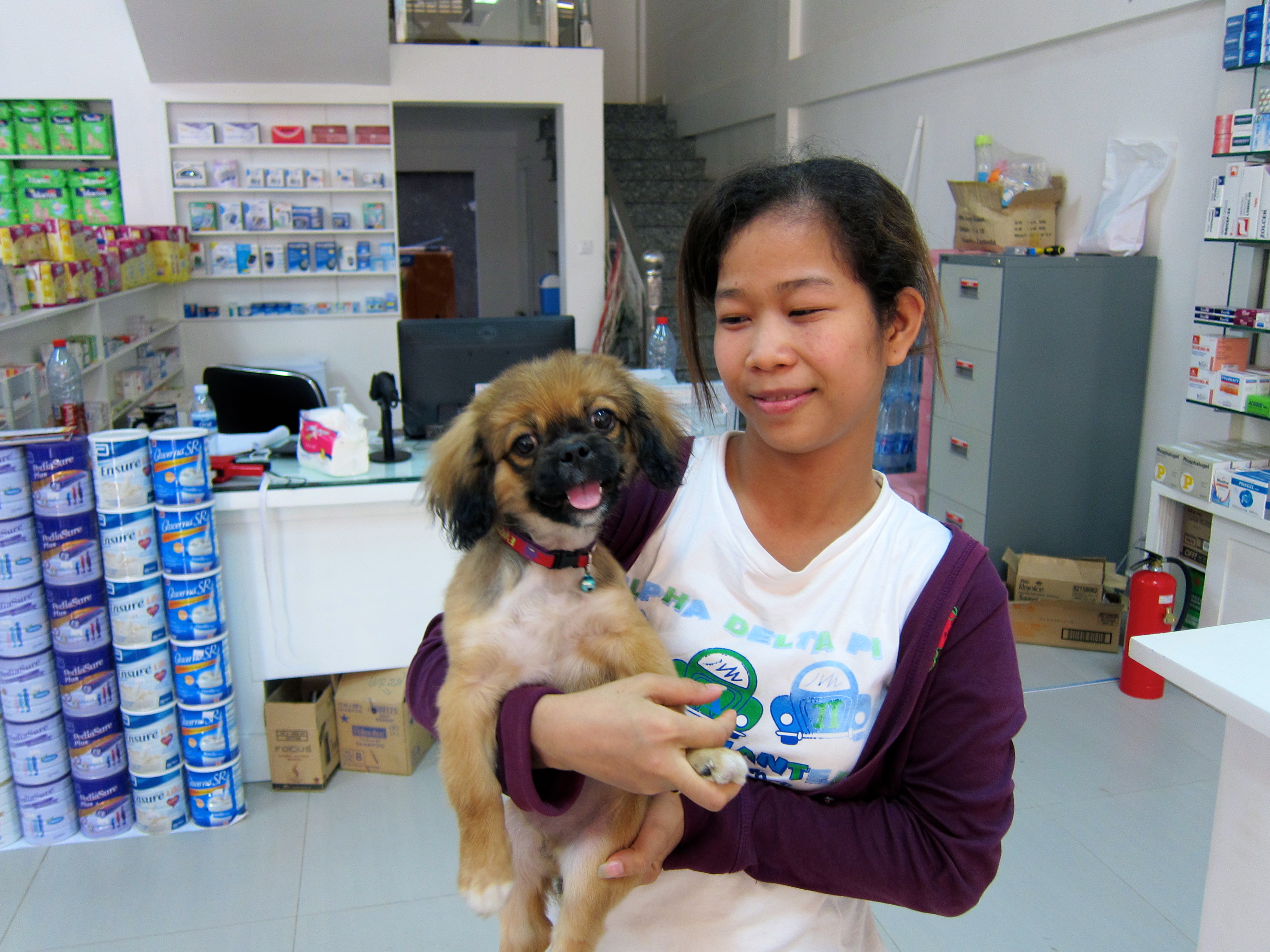
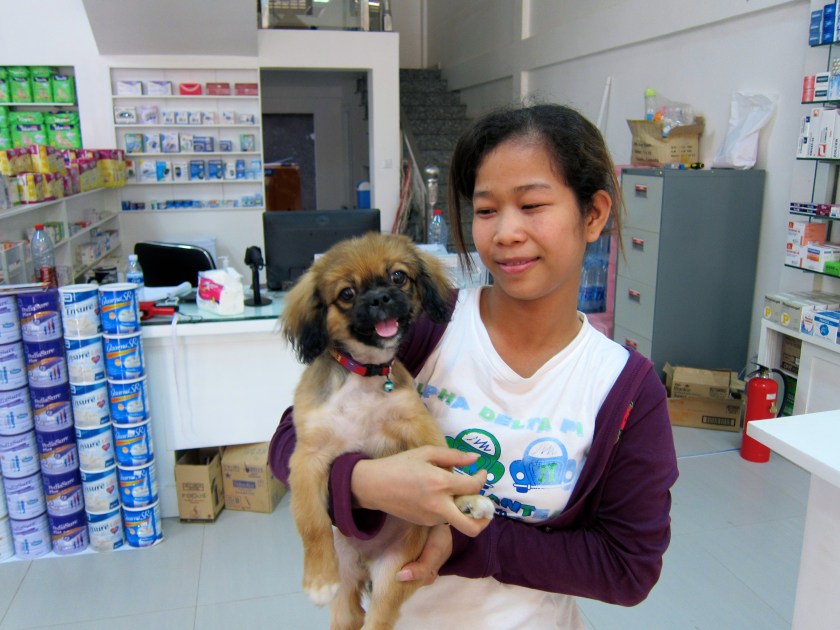
On my walk home from work each day, I usually stop in the pharmacy next to my work to love on Doot-doo, perhaps the cutest puppy in the world. His owner always sees me coming and has Doot-doo awake and ready for cuddling by the time I get to the store.IMG_0528Nightlife!
Being a touristy town, Siem Reap is also full of good (if touristy…) nightlife, and we were never far from a good after-dinner Angkor beer or snake wine:
http://www.flickr.com/photos/12339764@N00/6910383735/in/set-72157629253597145

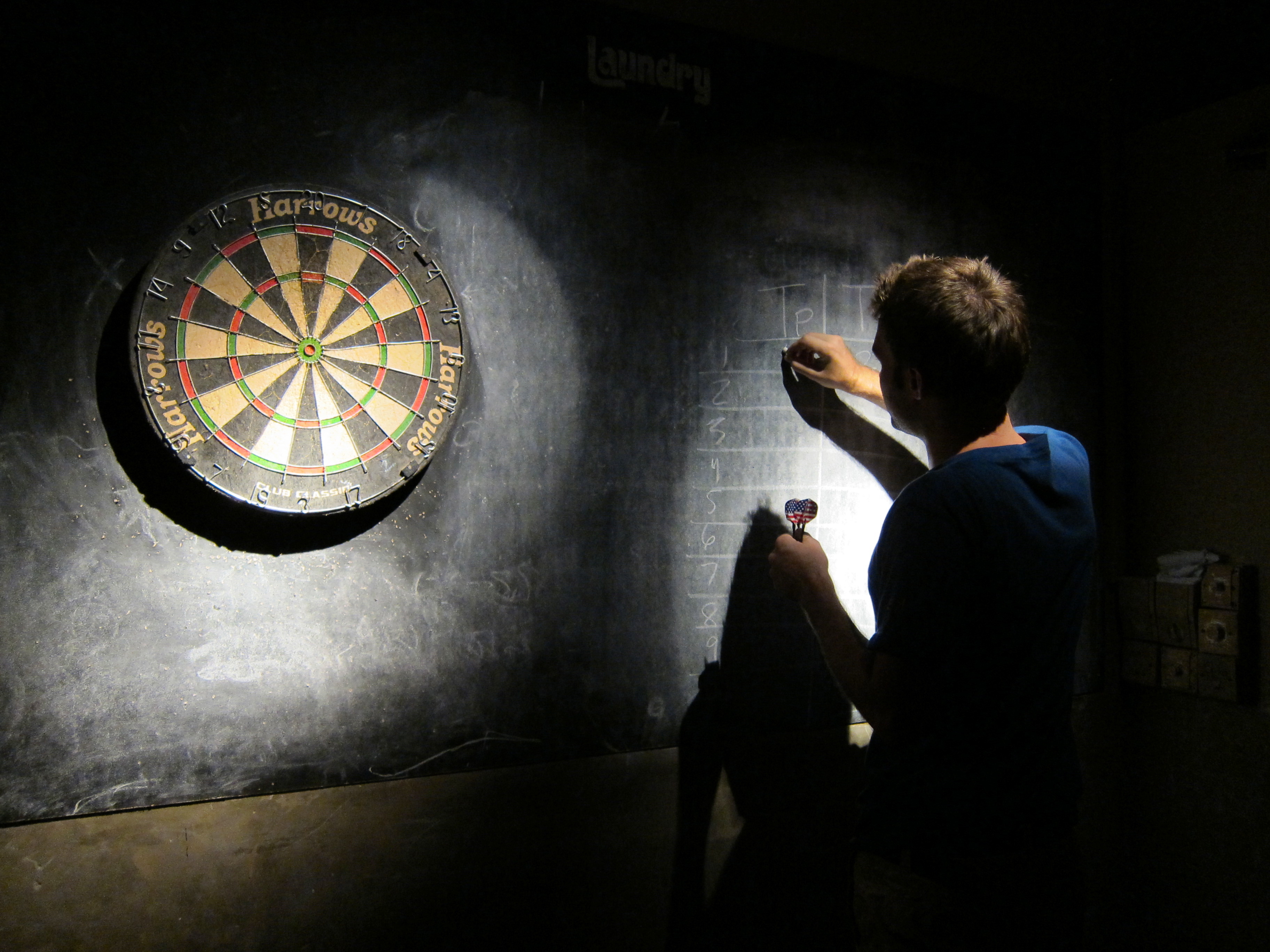
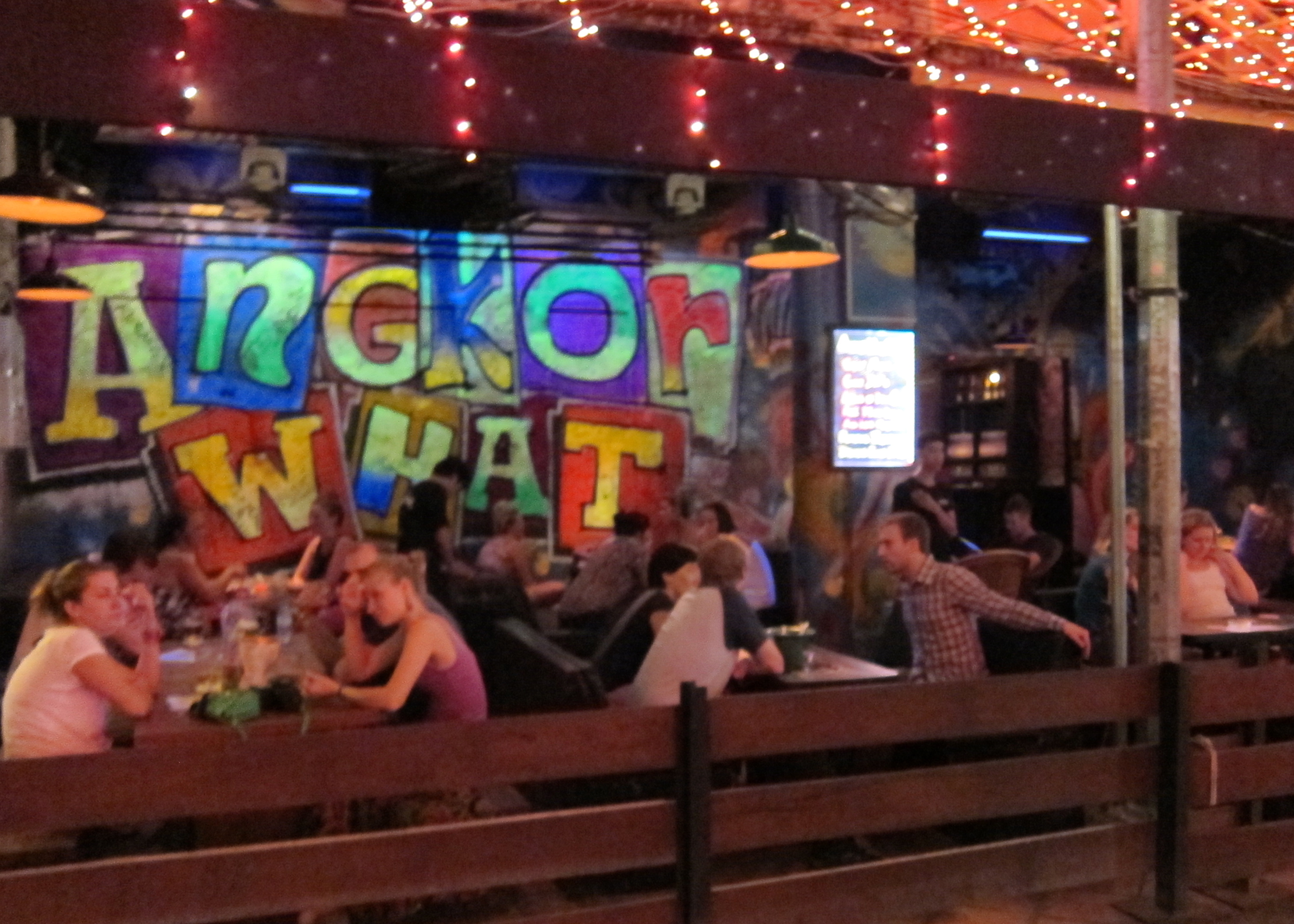
One of our favorite bars (anywhere in the world), “Laundry Bar”. Not only did they have delicious cocktails, but they will also burn 20+ movies or music albums to your USB stick for less than $5! All legally, of course…….. (right..?)IMG_0341“Angkor What?” bar, where we found ourselves dancing on occasion… the best part about this bar is the UV lights, which illuminate anything white into an other-worldly glow. The clientele is a little young/backpackery, but it’s hilarious to read some of the things that people write on their glowing white T-shirts before heading out onto the dance floor.
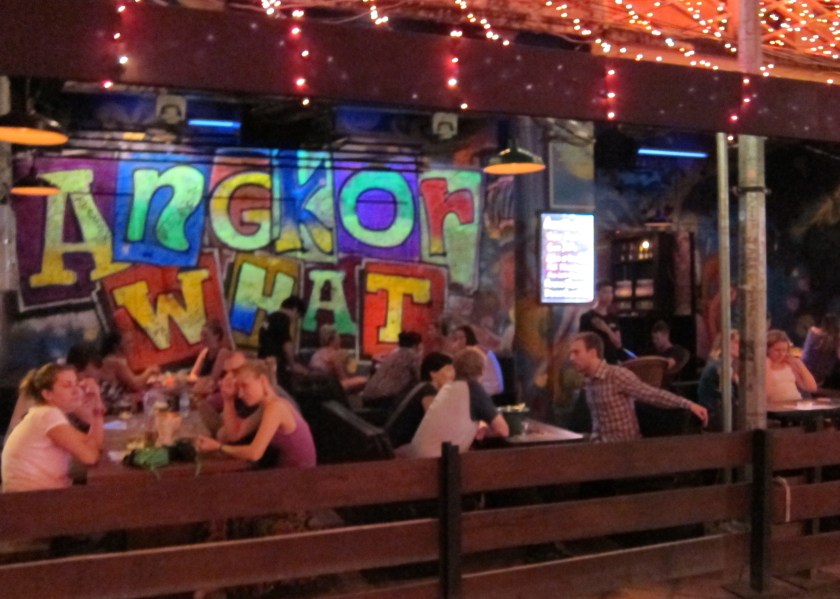
IMG_0347http://www.flickr.com/photos/12339764@N00/6959030343/in/set-72157629253597145

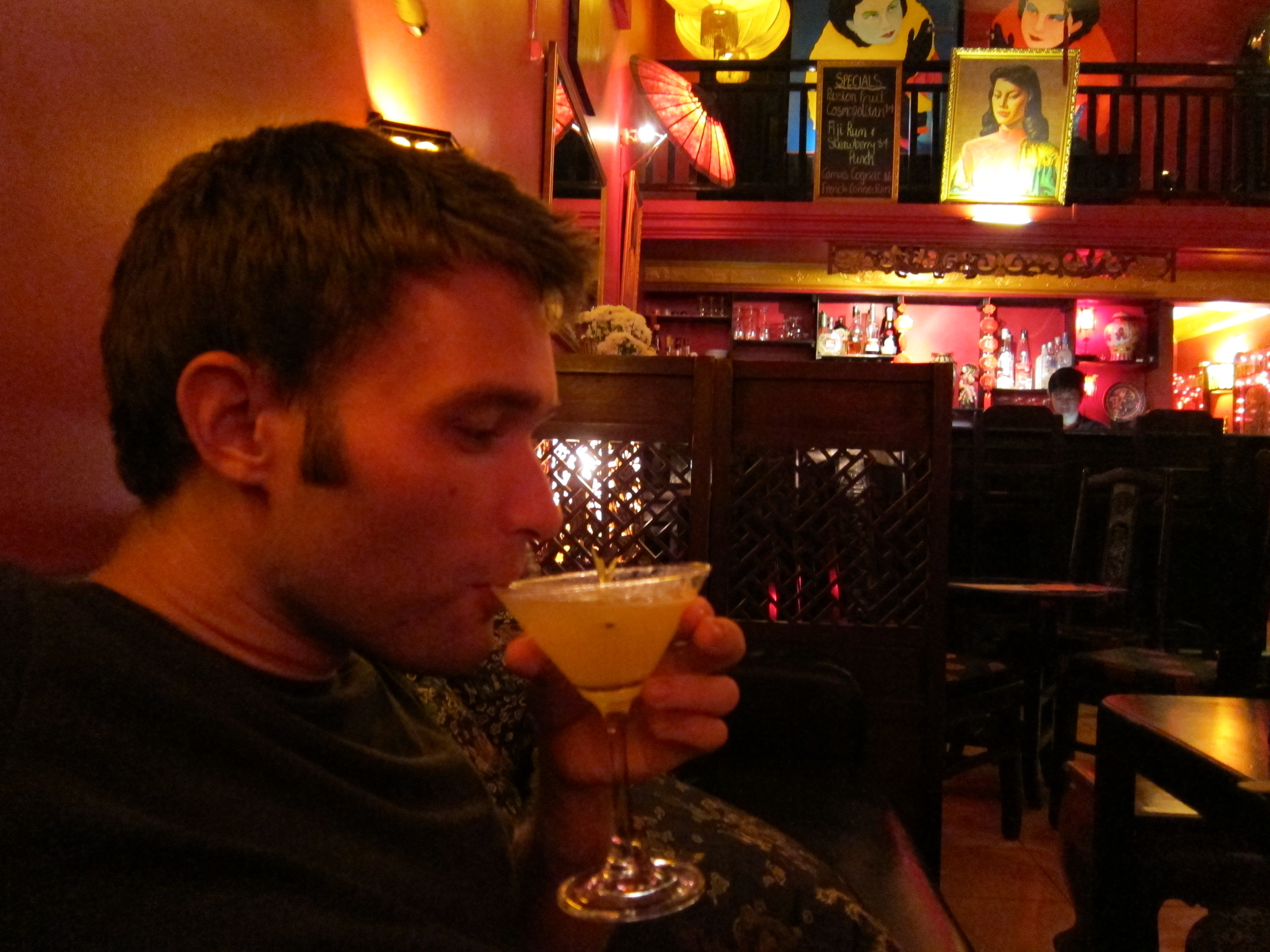
“Miss Wong’s”: a classy place with delicious upscale cocktails (passion fruit cosmos… jasmine martinis… real (Belgian) beers… :))IMG_0486Drinks by the river on a lazy Saturday:
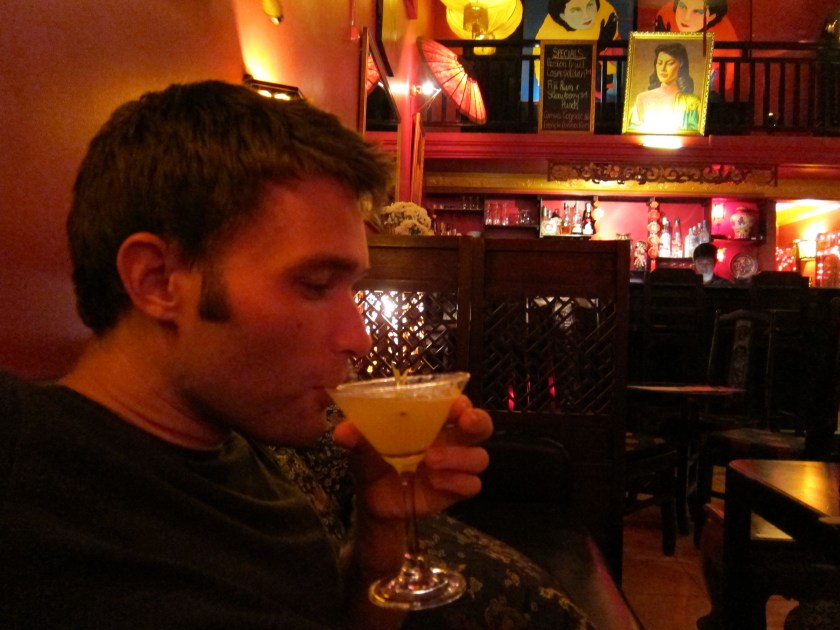
http://www.flickr.com/photos/12339764@N00/6959013519/in/set-72157629253597145

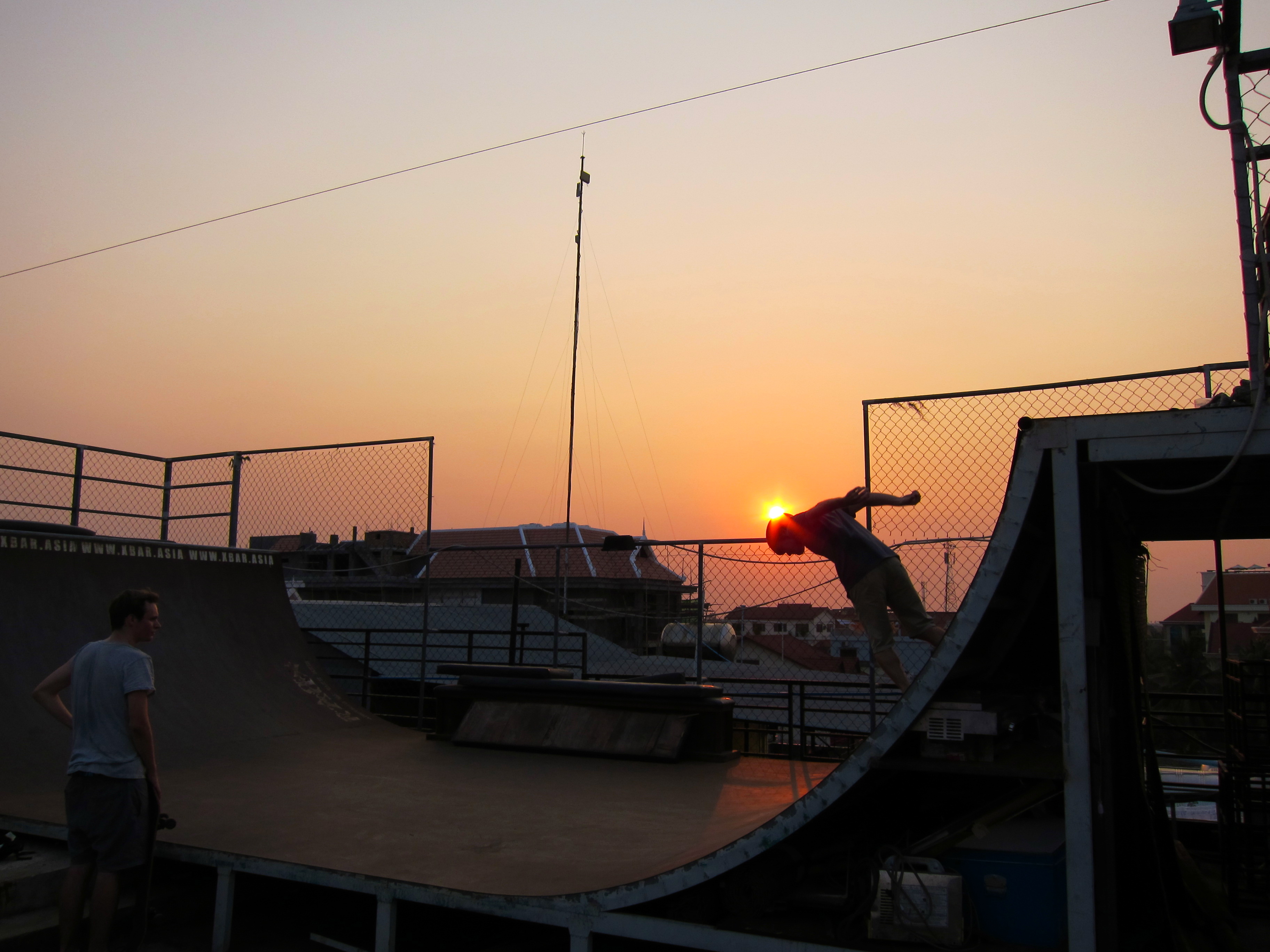
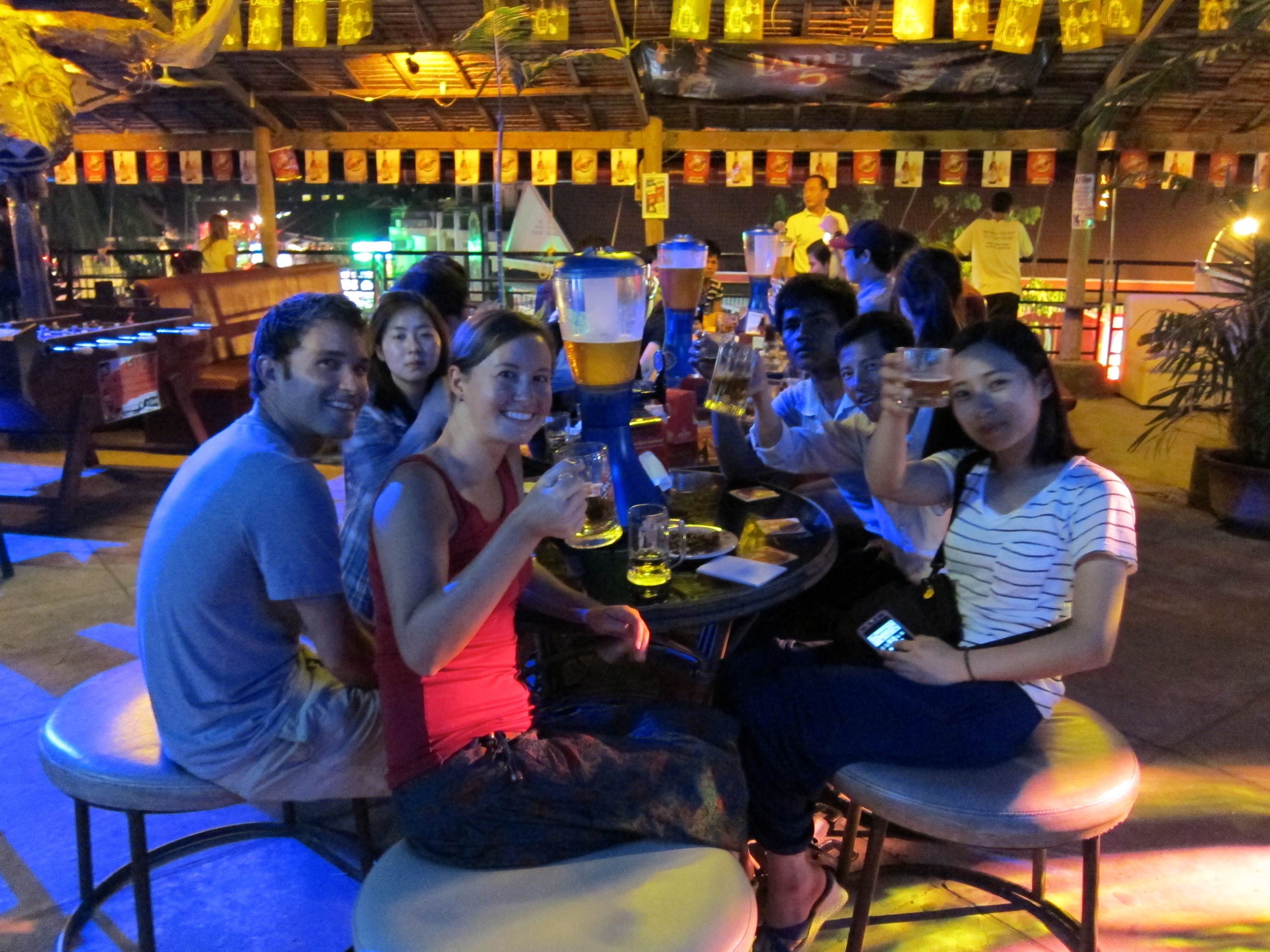
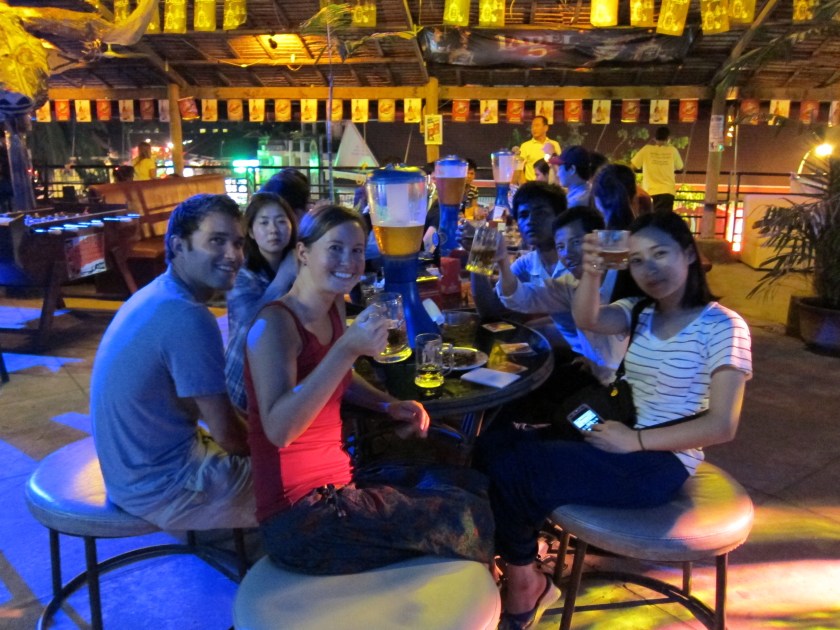
“X Bar” had a roof-deck skateboard ramp that Scott would use, prime for watching the sun go down over Angkor Wat.IMG_0442One night we were hanging out at X Bar when we noticed a large, fun-looking group of 20-year old Koreans and a handful of Cambodians hanging out, taking down a serious number of beer towers. An older man in his late 40’s, who seemed to be in charge of the group, wandered over our way and told us that the group was here to volunteer to teach English to kids out in the countryside. He asked us to join the group, so that we could, in turn, help the Korean group practice their English as well (because even though they were teaching it, some of them had only a basic understanding of English). He eventually coaxed us to walk over to the group, where he got everyone’s attention and said, “I just met these nice Americans at the bar; they asked if they could join you.” That wasn’t exactlyhow we remembered the conversation going, but everyone happily made room for us and proceeded to teach us an uncanny number of odd, confusing, and hilarious Korean drinking games.
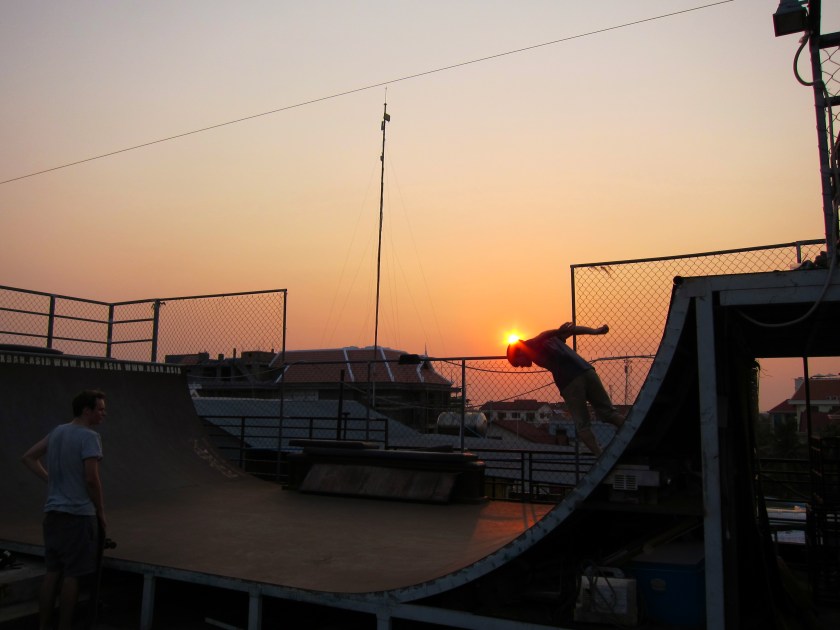
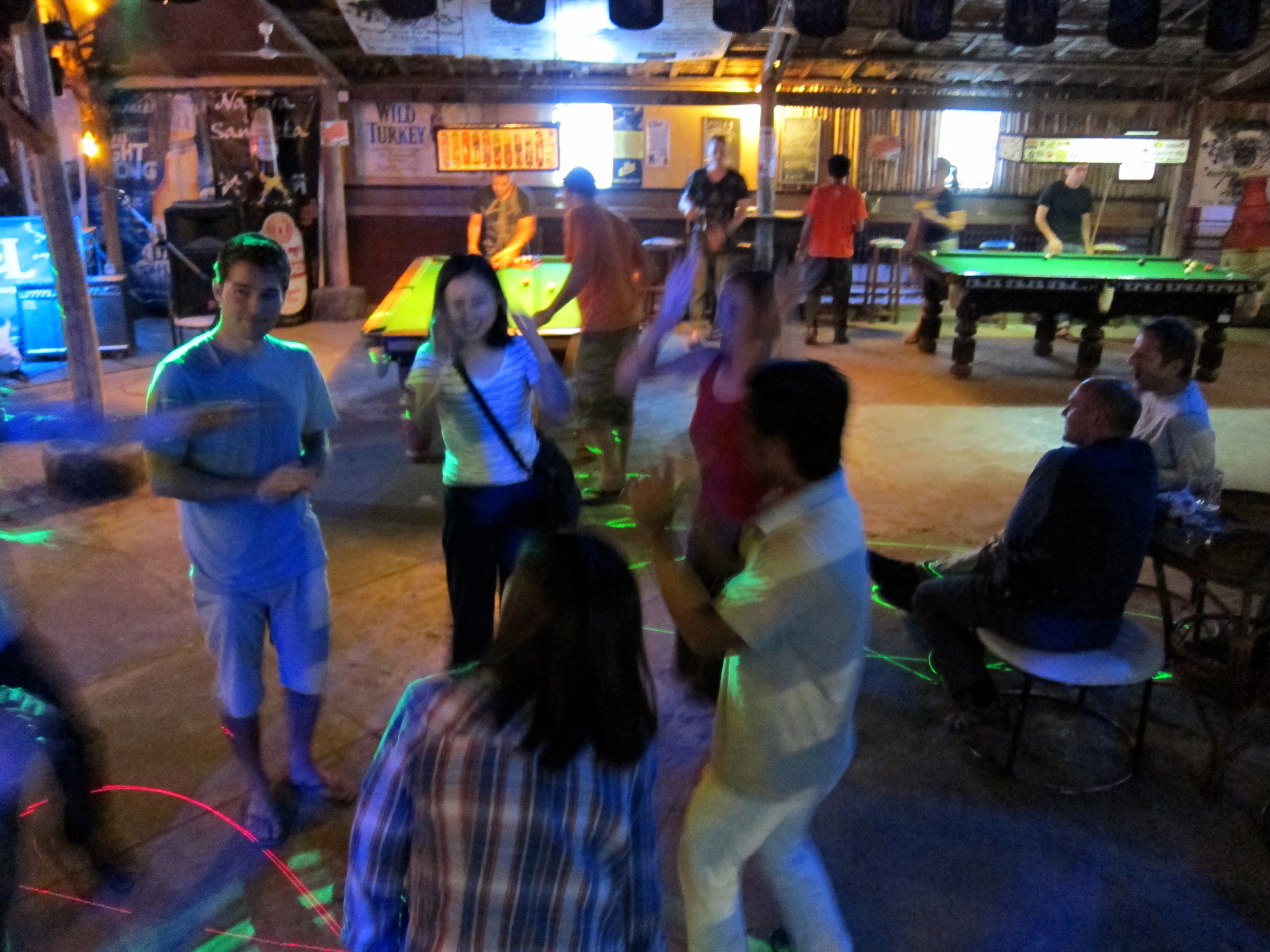
IMG_0260By the end of the night, we were all up dancing to the live band that was blasting out 70’s American rock tunes.
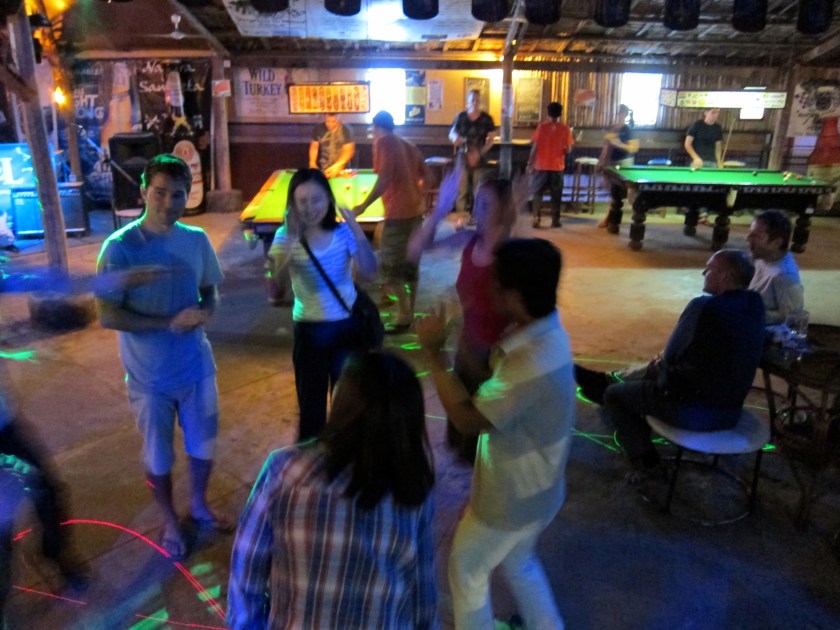
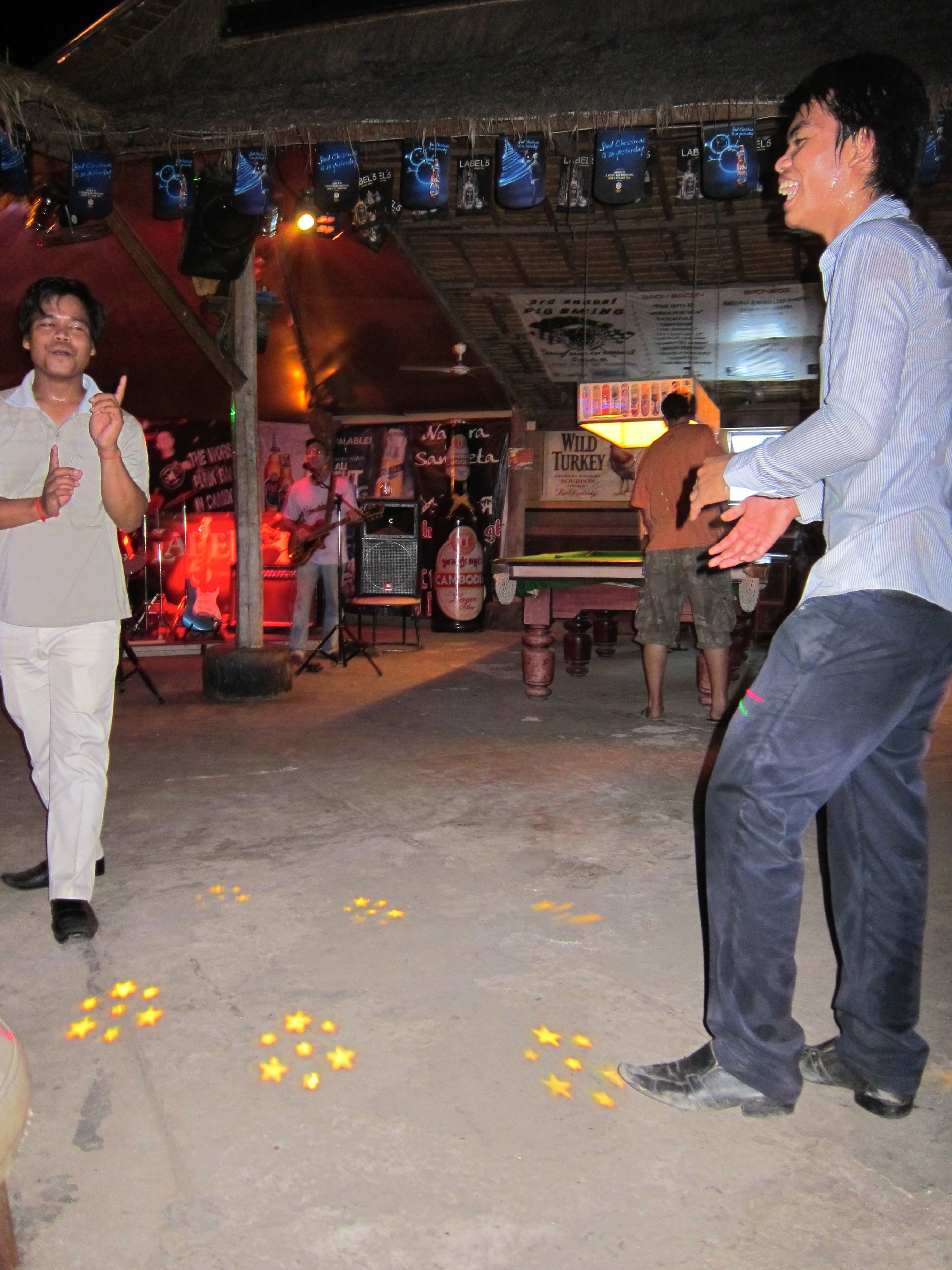
IMG_0266…things quickly got a little sweaty! At least for this guy…
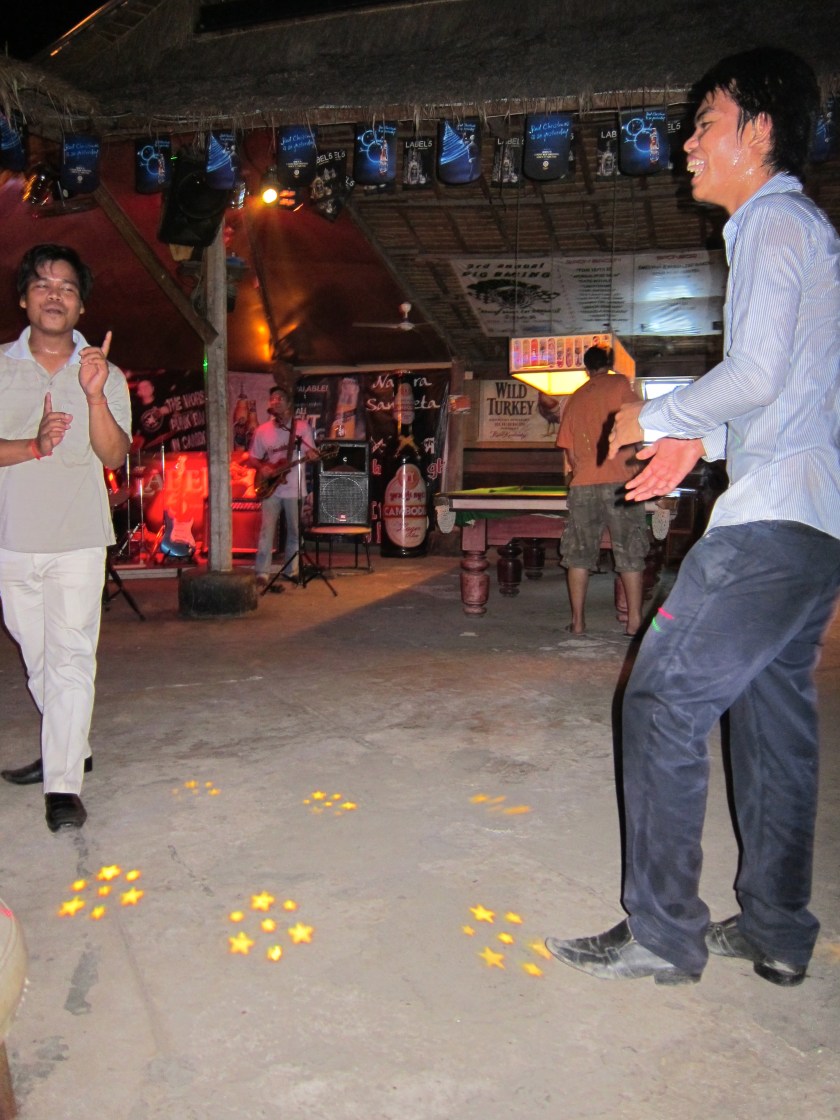
IMG_0276Whereas most of us were doing the typical funny/clumsy move-to-the-beat kind of thing, one of the Cambodian guys started doing a traditional Cambodian “Apsara” dance when it was his turn in the middle of the dance floor – I can’t do the dance justice to explain it in words – perhaps it would be comparable to if I started waltzing in a dance club, for example. But he wasn’t joking around – it was simply what he knew how to do. One of my favorite travel memories.

http://www.flickr.com/photos/12339764@N00/6850215449/in/set-72157629253597145

http://www.flickr.com/photos/12339764@N00/6850206821/in/set-72157629253597145

Learning to speak Khmer
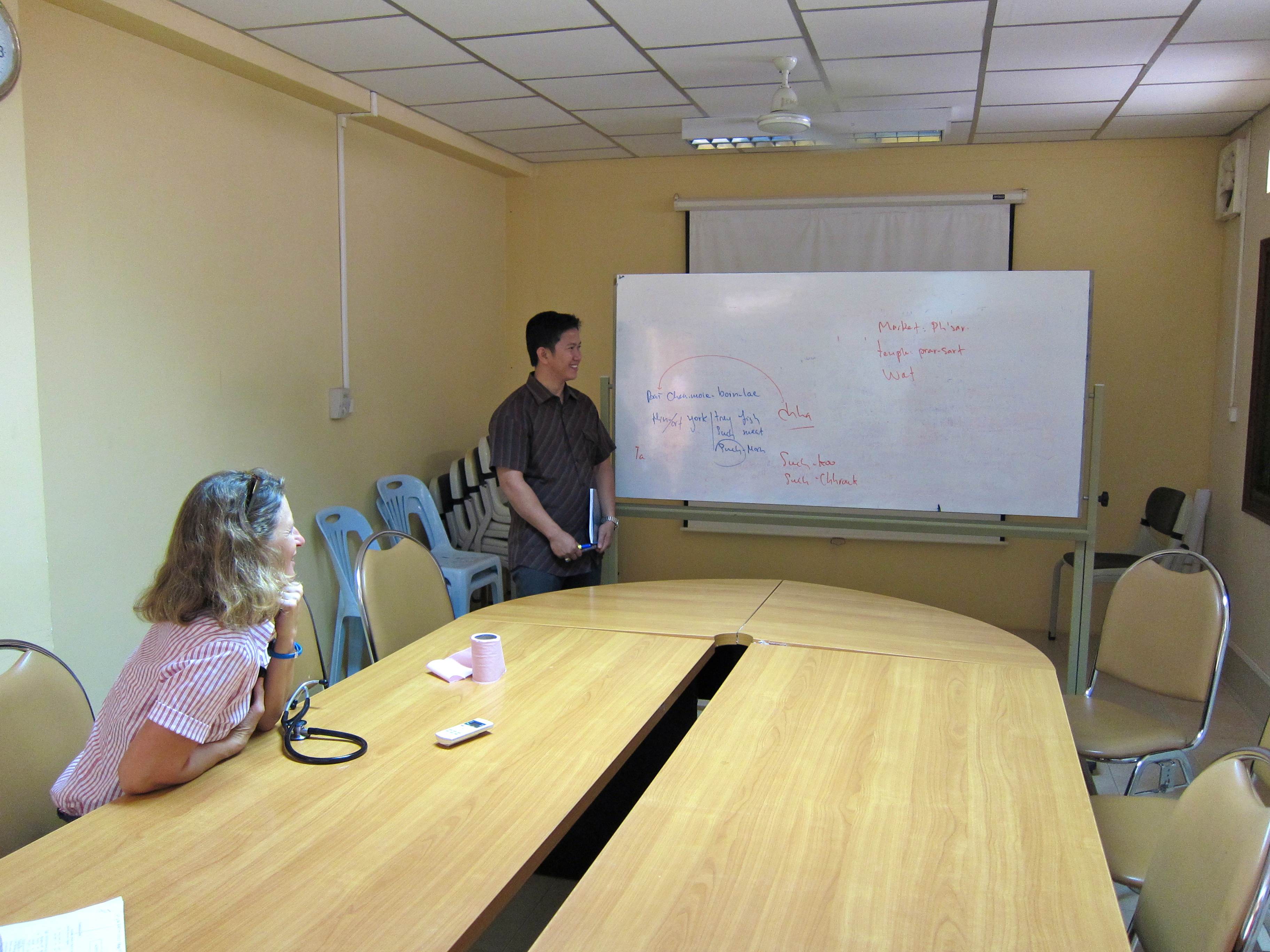
Three days a week, I’ve been attending Khmer language classes, which are offered free to hospital volunteers. One of my hobbies has always been learning new languages, and Khmer definitely presented the greatest challenges yet with its difficult pronunciation and sounds.
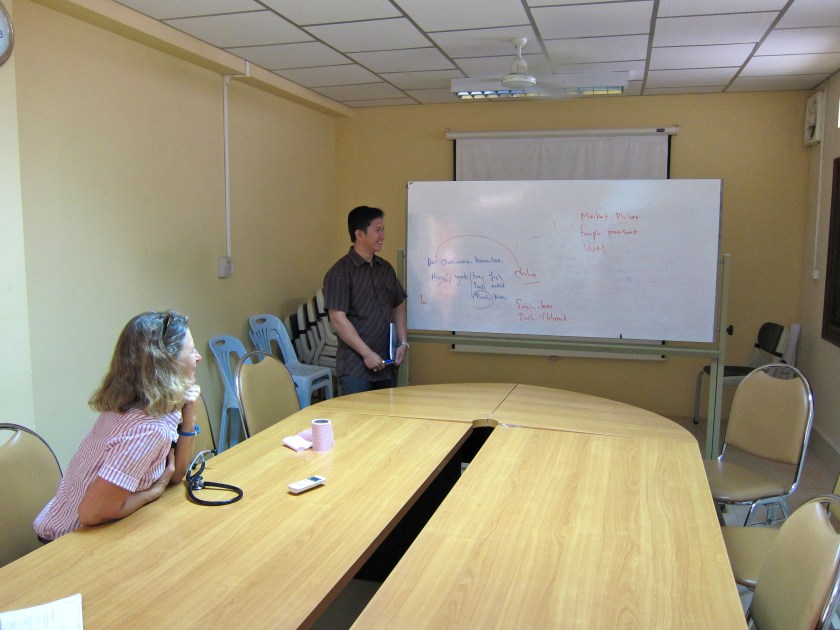
IMG_0469My first week learning Khmer, I tried to ask a waitress at a restaurant (that same noodle soup shop mentioned above, in fact…) what they had available that day in my very best Khmer (since the items that are available there vary from day-to-day), to which she replied “Sorry; no speak English.” Clearly, I needed some work.

The next day in class, I told my language teacher what had happened. He laughed and told me that my pronunciation is great and that maybe she was not expecting me to speak Khmer and thus thought I must be speaking English. I had my doubts.

The next day, I simply tried speaking more confidently and loudly (since I’m famous for being quiet), and voila! She was so surprised that she looked like she would fall over, but she understood me perfectly.

The need for making it very clear to people that we are actually speaking Khmer (and not English) became so essential for one of the phrases that we learned, lest it be deemed that we were just speaking rude English…. That phrase is pronounced “git loy”, and it means “I’d like to see the bill, please,” but we found that it was often confused for us saying rudely in English, “Get me _____!” The waiter would respond, “Get you what?” And we just felt terrible… A clear “git loy” response usually resolved the situation!

Once I felt more confident with my pronunciation, I tried to use Khmer as often as I could, and it paid off both figuratively and literally. One day I asked a woman in English how much that hoola hoop that I had my eye on would cost (since there are no prices on anything, and everything is bought by bargaining). “Two dollars and fifty cents,” was her response. Deciding that I didn’t want to carry it home then, I came back a few days later to buy it. I asked the same woman the same question, but this time I asked in Khmer… Her response? “Two dollars!”

Fish spas
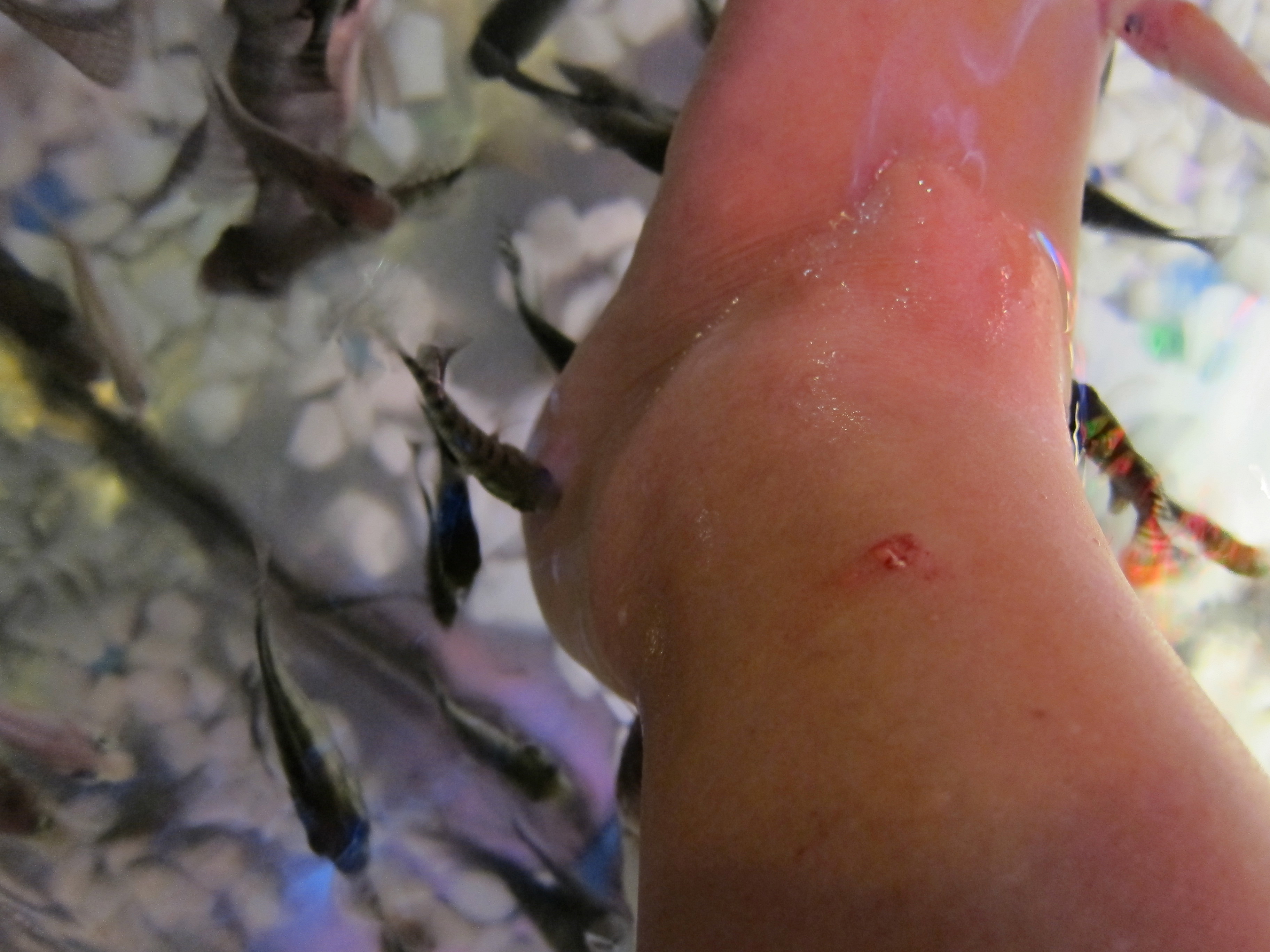
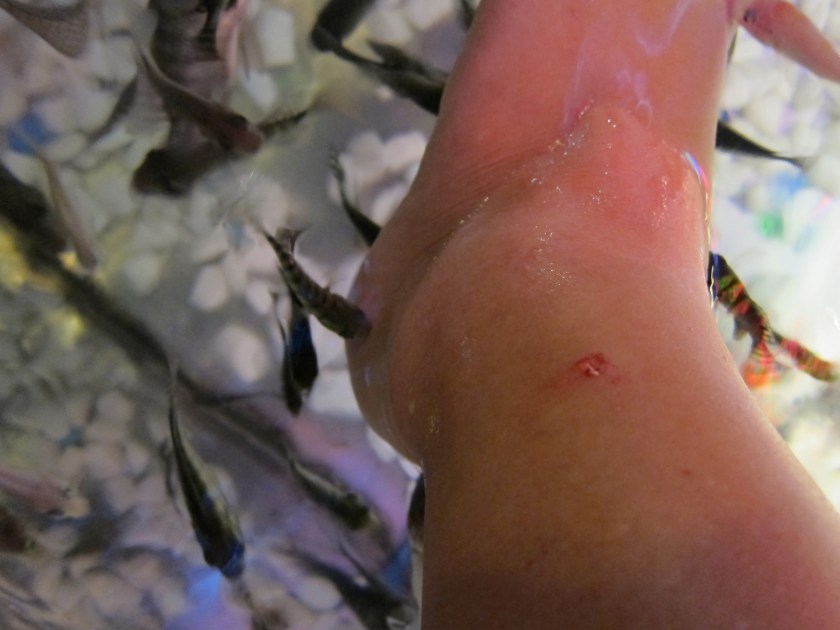
I love, love, love the fish spas.  At first it was something that I tried just for kicks, but once I realized how good it made my feet feel, I was hooked. That is, until this booger actually bit my ankle and left me bleeding down my leg!!!IMG_0484(In fairness, it was a scab that he nibbled off to begin with, and I’m still a staunch supporter of the fish spa. Sorry, is that TMI?)
Toilets…
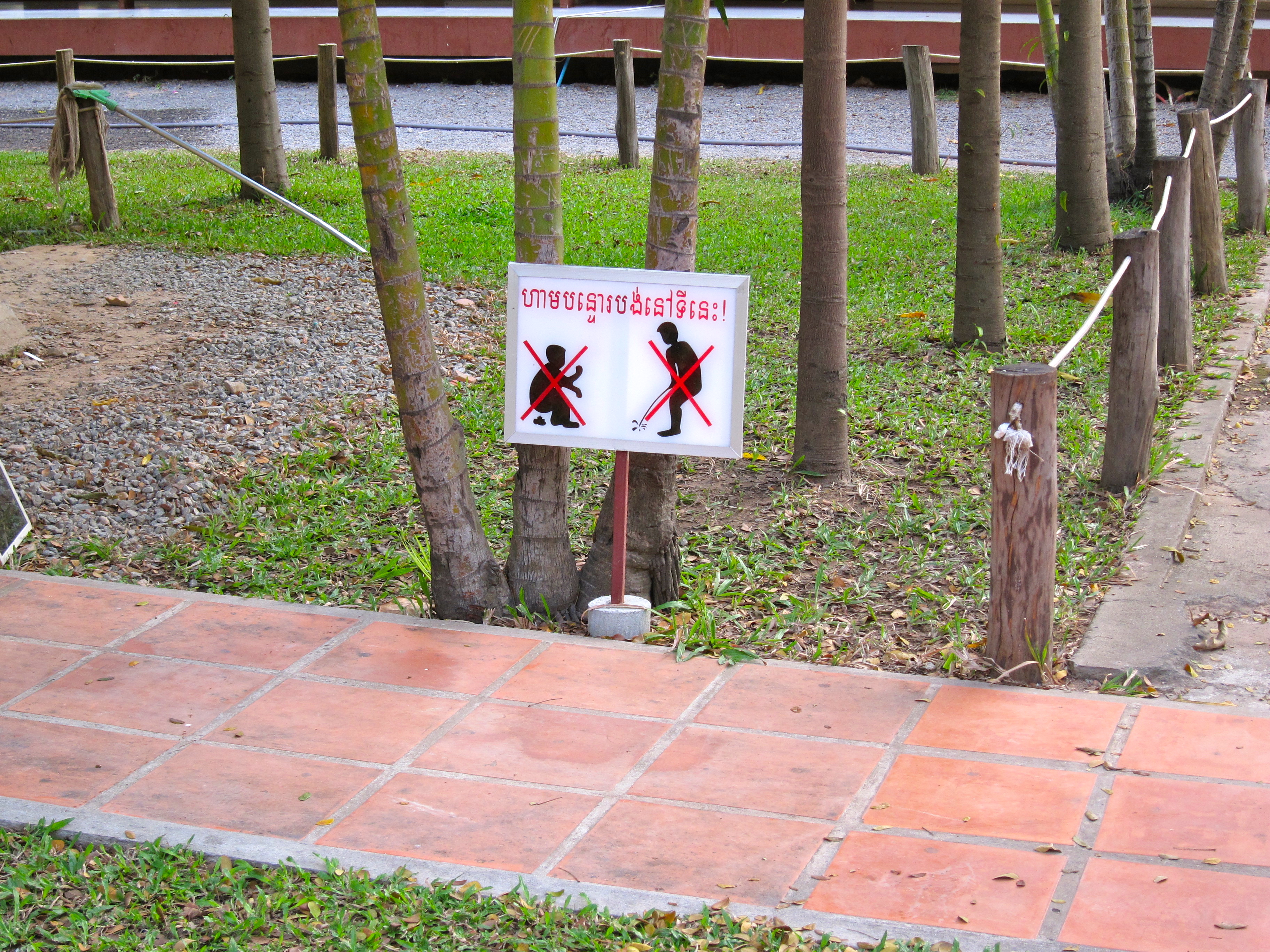
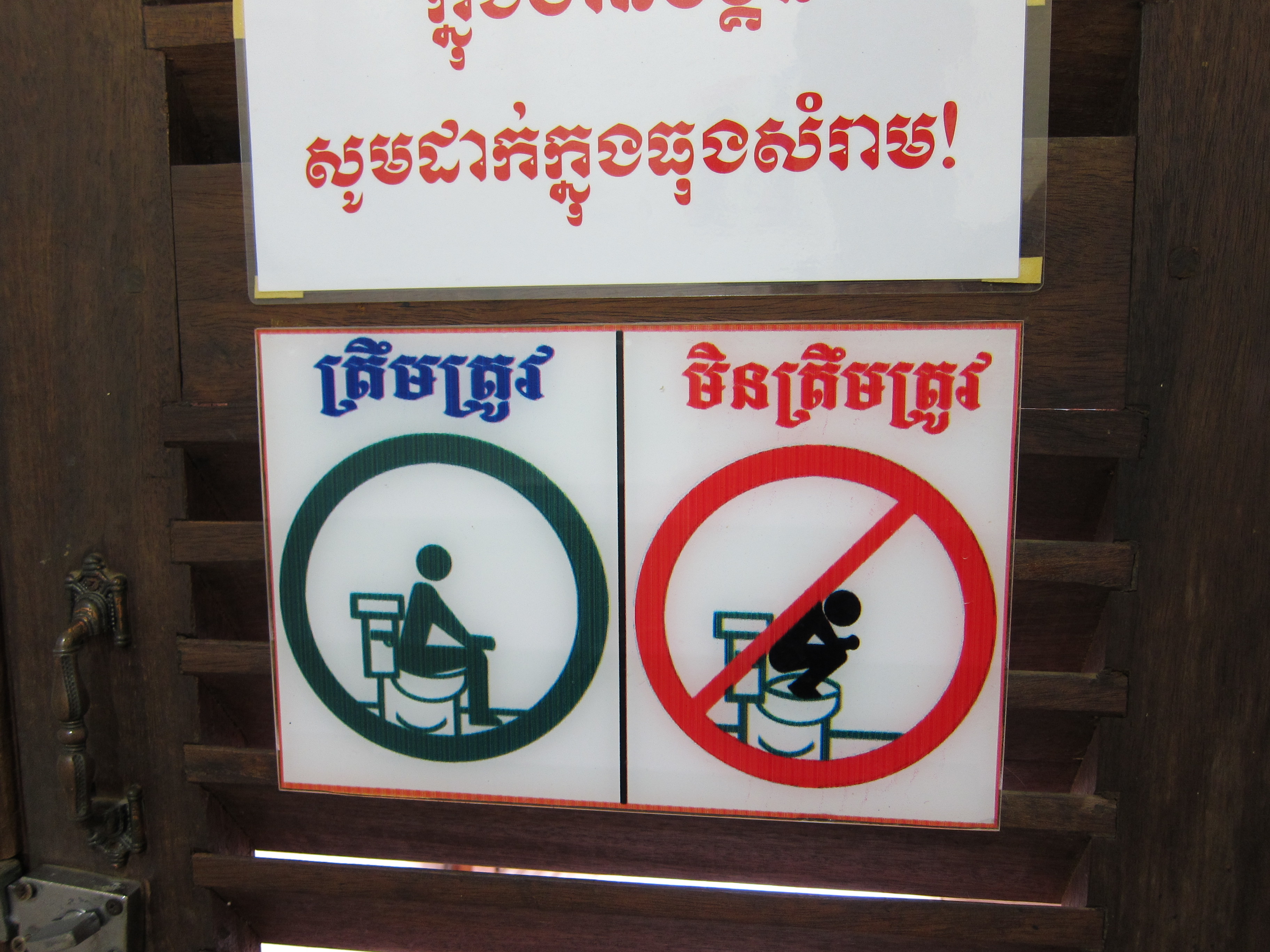
We’ve finally grown up a little and started leaving out the majority of our toilet stories on here… but Cambodia was just too prime for good toilet encounters to leave them all out. First, there were the signs at Angkor Hospital that demonstrated that you should use the toilet and not the grass to relive yourself:
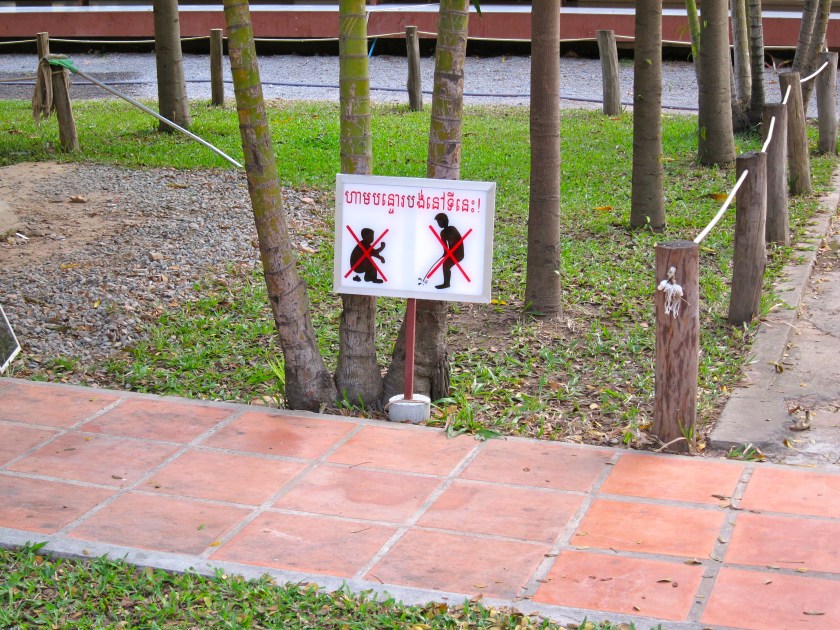
IMG_0239(All immaturity aside, these signs are a part of the hospital’s community education initiative on proper hygiene, etc, and I think it’s great that they have these.)

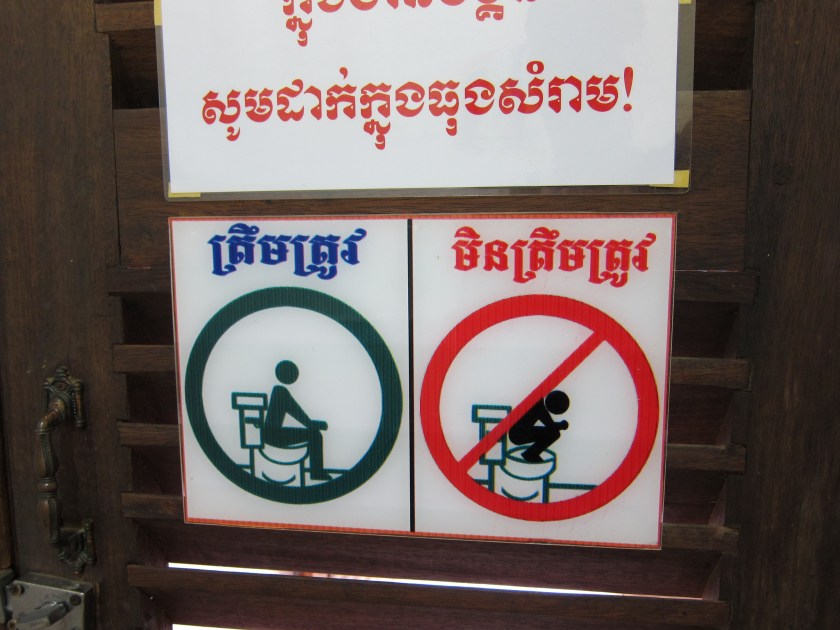
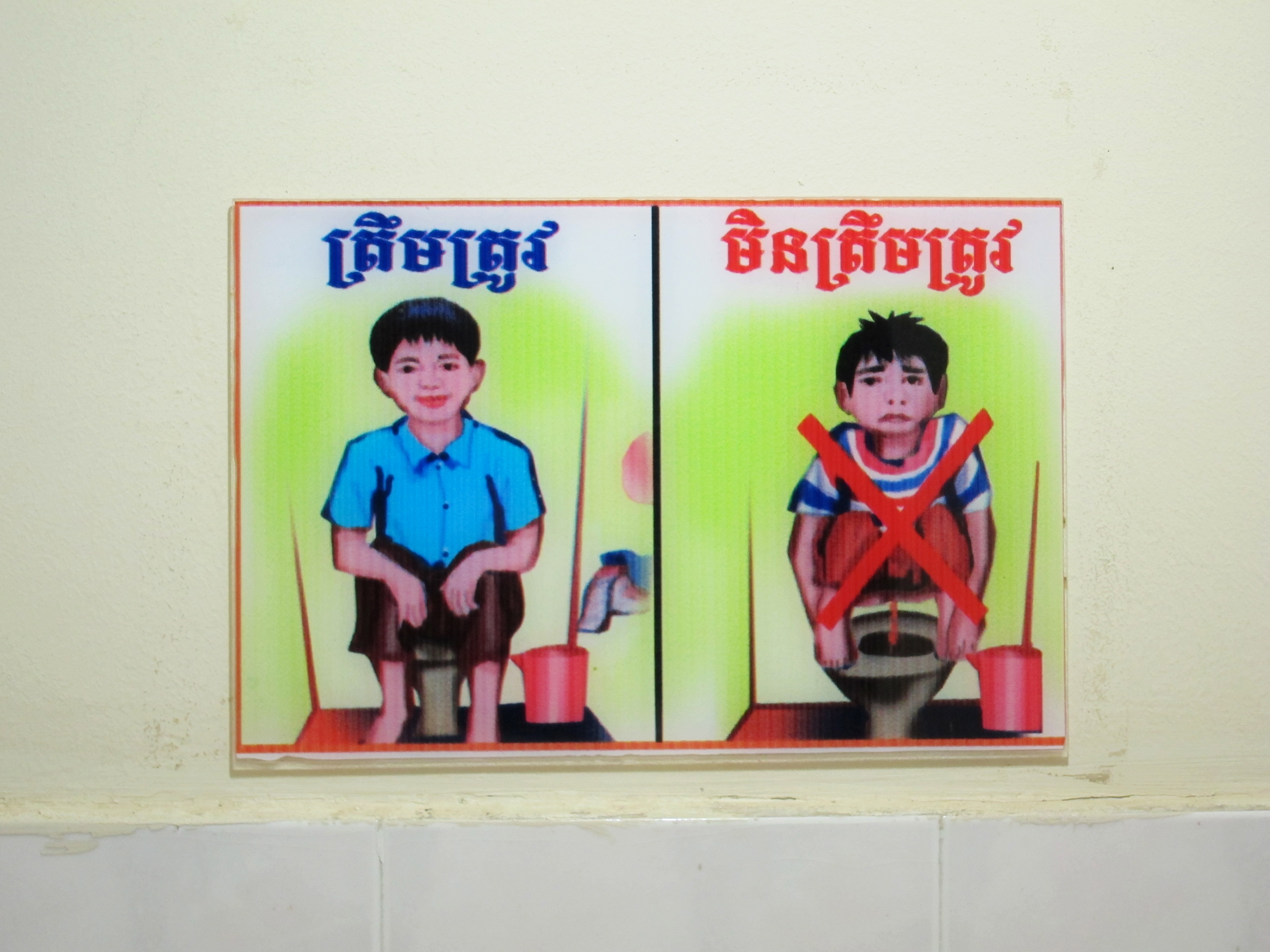
There are also signs on how to properly use a “Western-style” toilet. They had me respectfully chuckling to myself whenever I saw them:
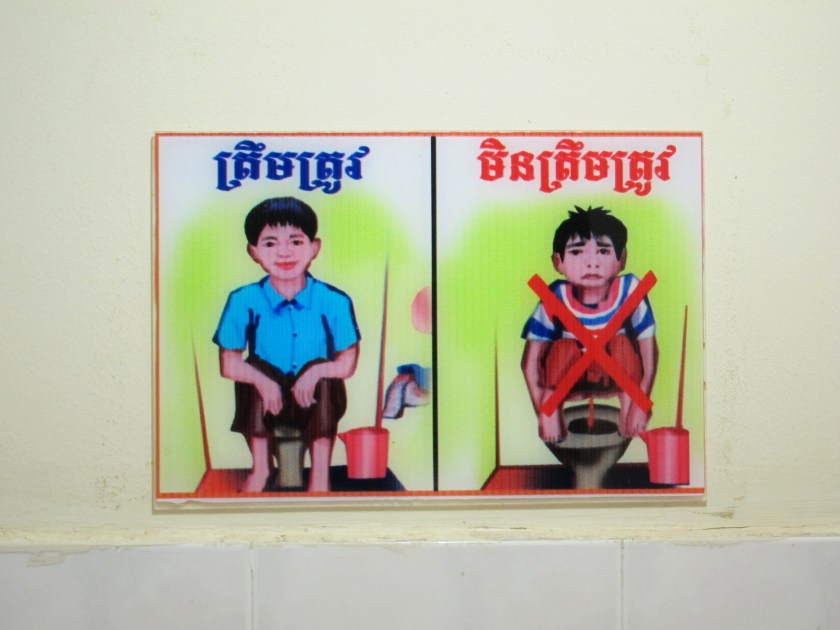
IMG_0236IMG_0237

But as funny as these pics were, I always found myself asking, “Why are there no pictures showing foreigners how to use the squat toilet?” Seriously, I only figured out which way you’re supposed to face on it just recently!! And this is after 5 months! Just when I thought I had the squat toilet “down pat” (or “hands down”, if you’re Scott..), I got hit with a new hurdle:
I was on a home-visit to a patient’s house in the countryside for the hospital, and as inappropriate as it might be to ask to use their bathroom (since the families are extremely poor and might be ashamed or embarrassed by their homes), I could not wait any longer. I asked the family if I could use their bathroom. To my relief, they happily directed me to their daughter who would show me where it was. She took me to the back of their home and handed me – a sarong. Here I wanted to use a toilet, and I was being given a sarong. She smiled and motioned towards the backyard. “Where?” I asked, while pointing aimlessly toward the open field in front of us. She didn’t speak English and basically motioned “go figure it out” and left me to do just that. I put on the sarong over my work pants and prayed no one was watching as I wrestled to keep the sarong up around me, while shimmy-ing the pants down, trying to hiding between the banana plant on my left and the big open field to my right. At one point, the sarong was so bunched up that I just felt like I was holding onto a hoola hoop of fabric circling my waist – not covering me at all but definitely taking away a hand that I could have used for balance! I definitely needed a picture showing how it’s done (I think they were secretly snickering to themselves, knowing it’s not possible to use a sarong-toilet with pants on underneath.)

Keeping in touch
Throughout our trip, we’ve been using Skype to keep in touch with friends and family. It’s been a blessing, and I don’t know what we would have done without it. …I even get to watch my nephew have his diaper changed LIVE – what could be better??! (Thanks, Mom…)

We’ve also recently instituted “BYOB” Friday night get-togethers with some of our friends over Skype, where we get to hang out live for a couple of hours. With the 12-hour time difference, that means we are sometimes sipping wine by 9 or 10:00 am on Saturday mornings. 🙂

Random (…stuff I can’t even begin to categorize)
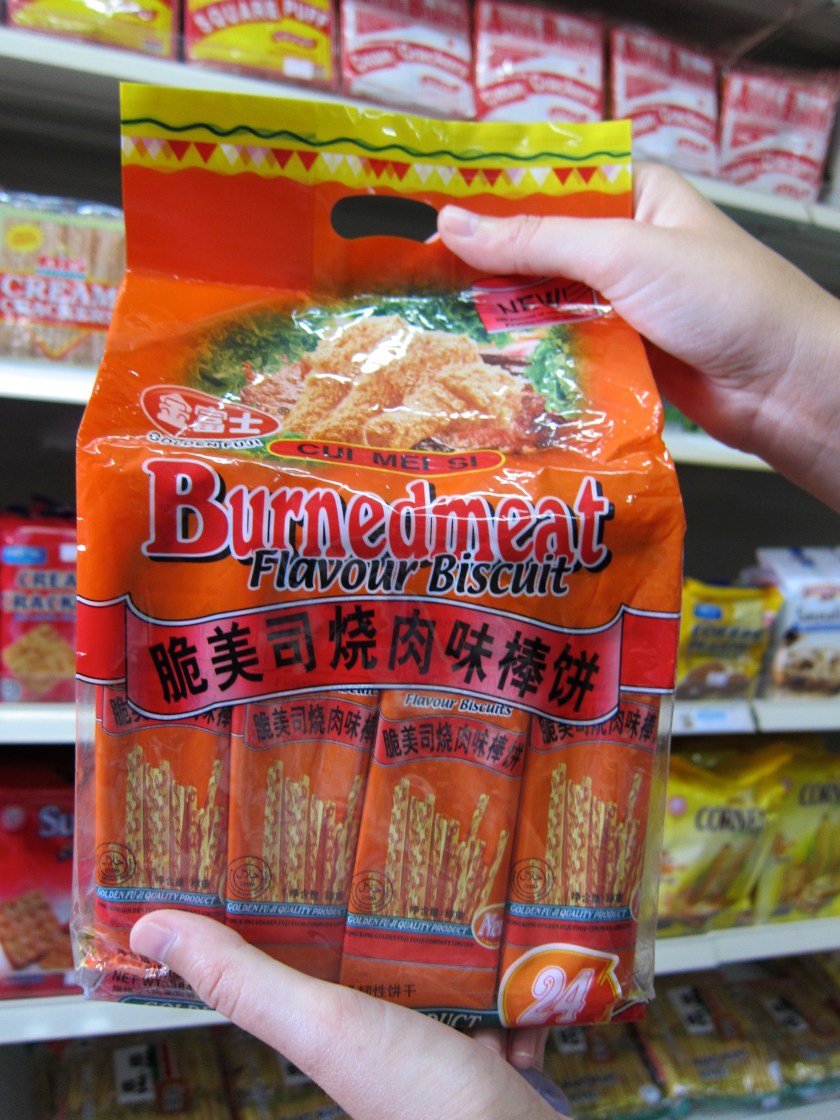
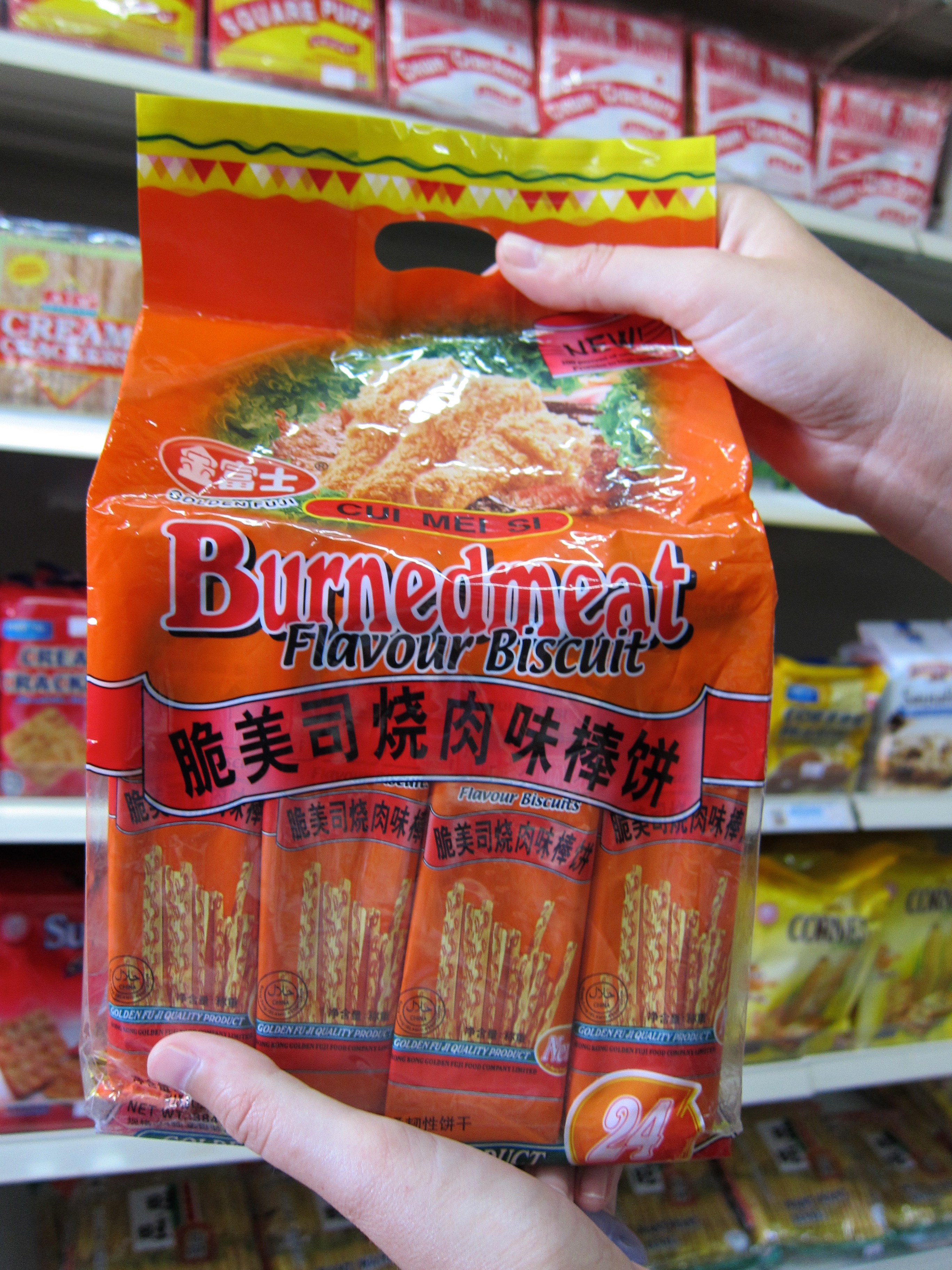
Found in the grocery store one day: breast-enhancing coffee, “Rady Big Boomz”, and “Srim Cup” tea, which is “Easy for Lady”:IMG_0282Burned Meat-flavored biscuits:

IMG_0281At the same store, I tried to get a new stick of deodorant for myself, and I was sad to see that all they had was the roll-on kind…ugh. And not only was it roll-on, but it was also “whitening”, which I’m sure has some dangerous side-effects. Having no choice but to buy it, I was not surprised to find that the purported “whitening” effect does not seem to work– that third arm that’s now growing out of my armpit is just not any whiter than the other two.

————-

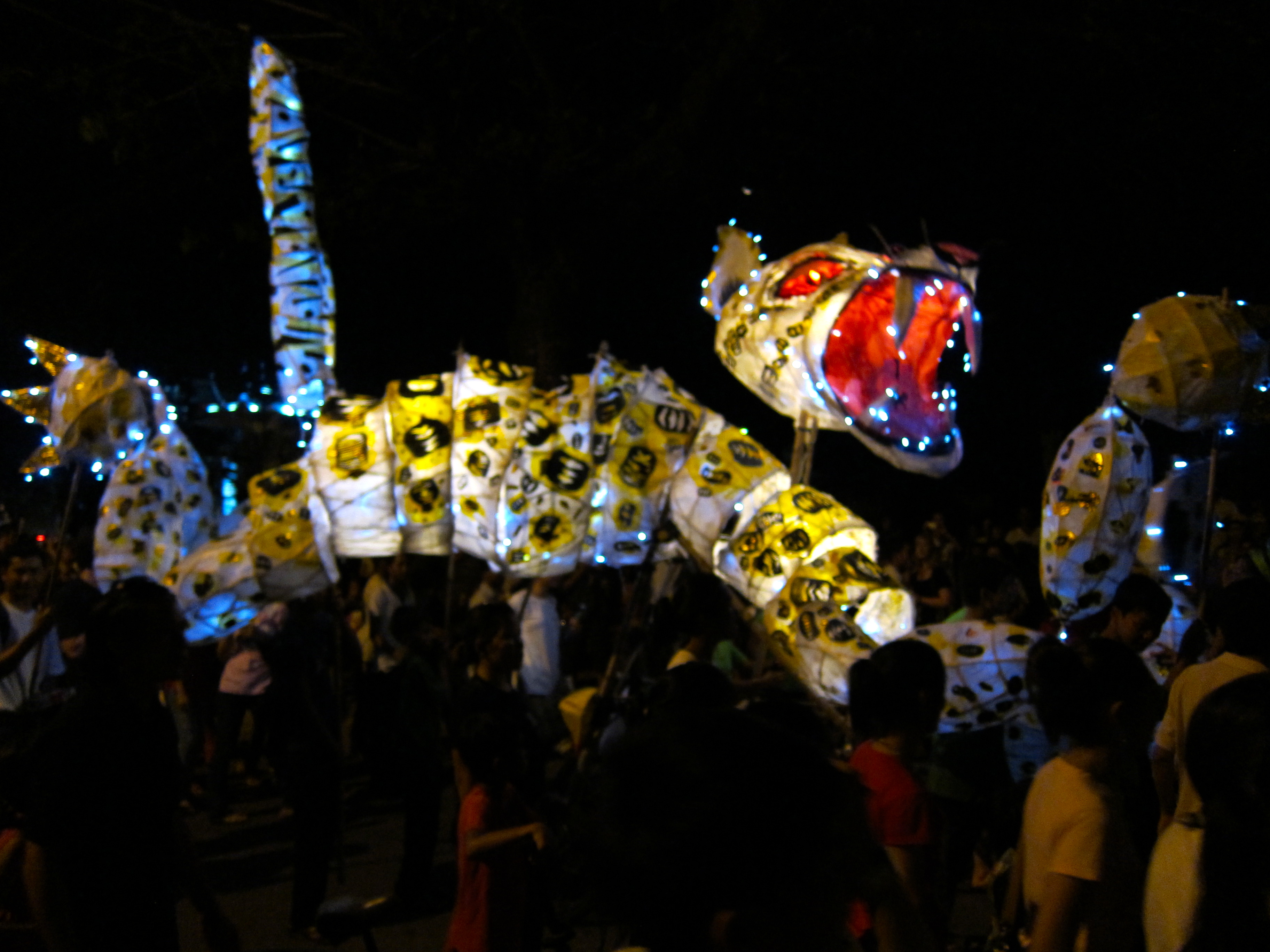
The annual puppet parade through downtown Siem Reap, which was basically a huge street party with amazing giant animal floats that would move their arms and mouths. It put any parade I’ve ever seen to shame!IMG_0554
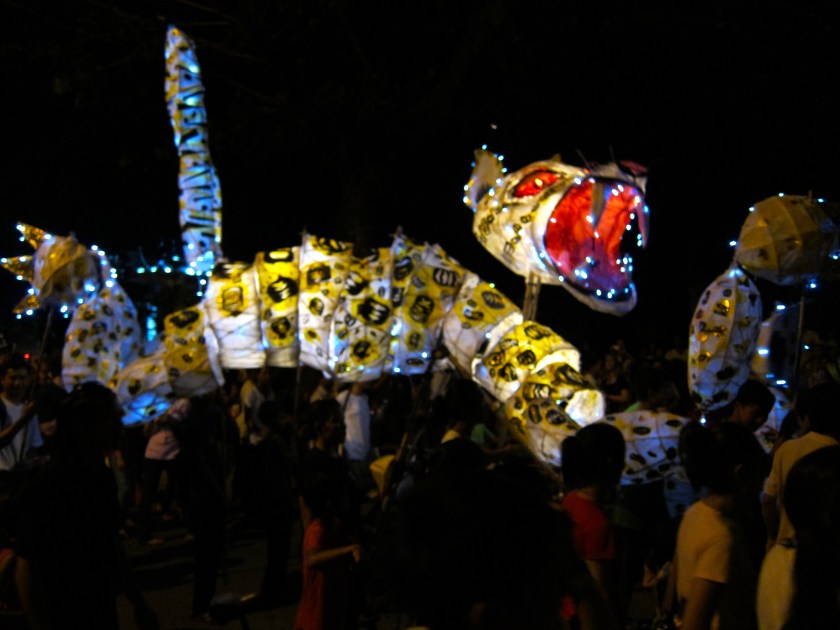
Video:

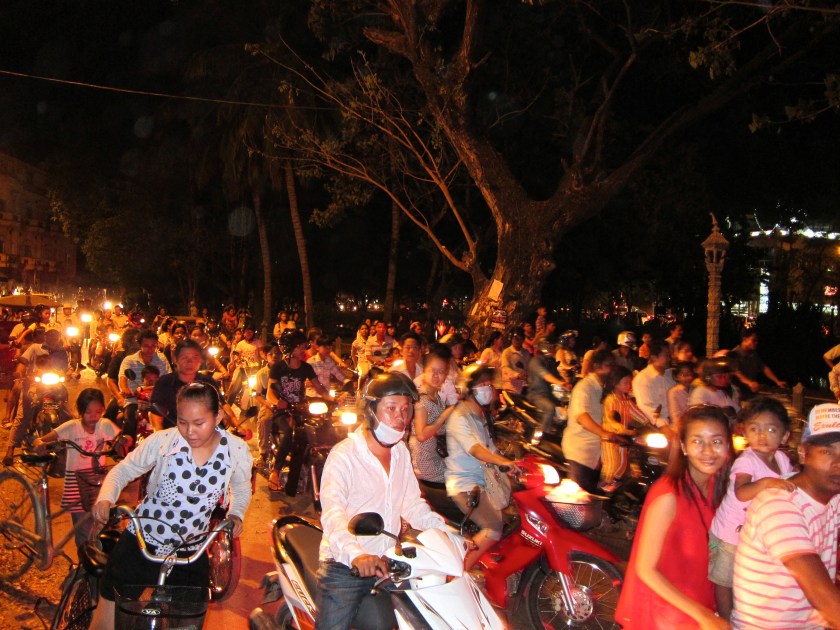
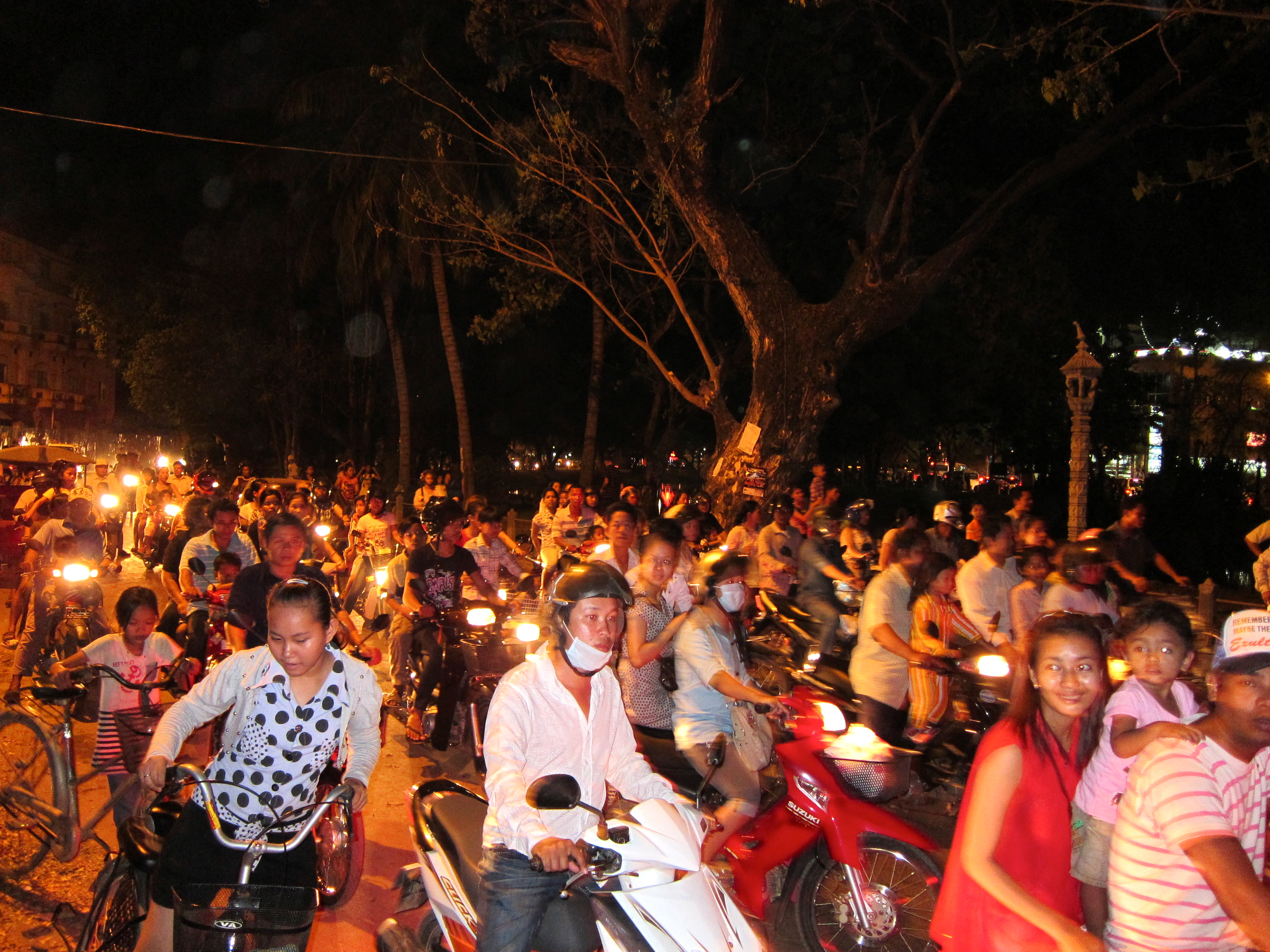
Traffic behind the parade:IMG_0561————–

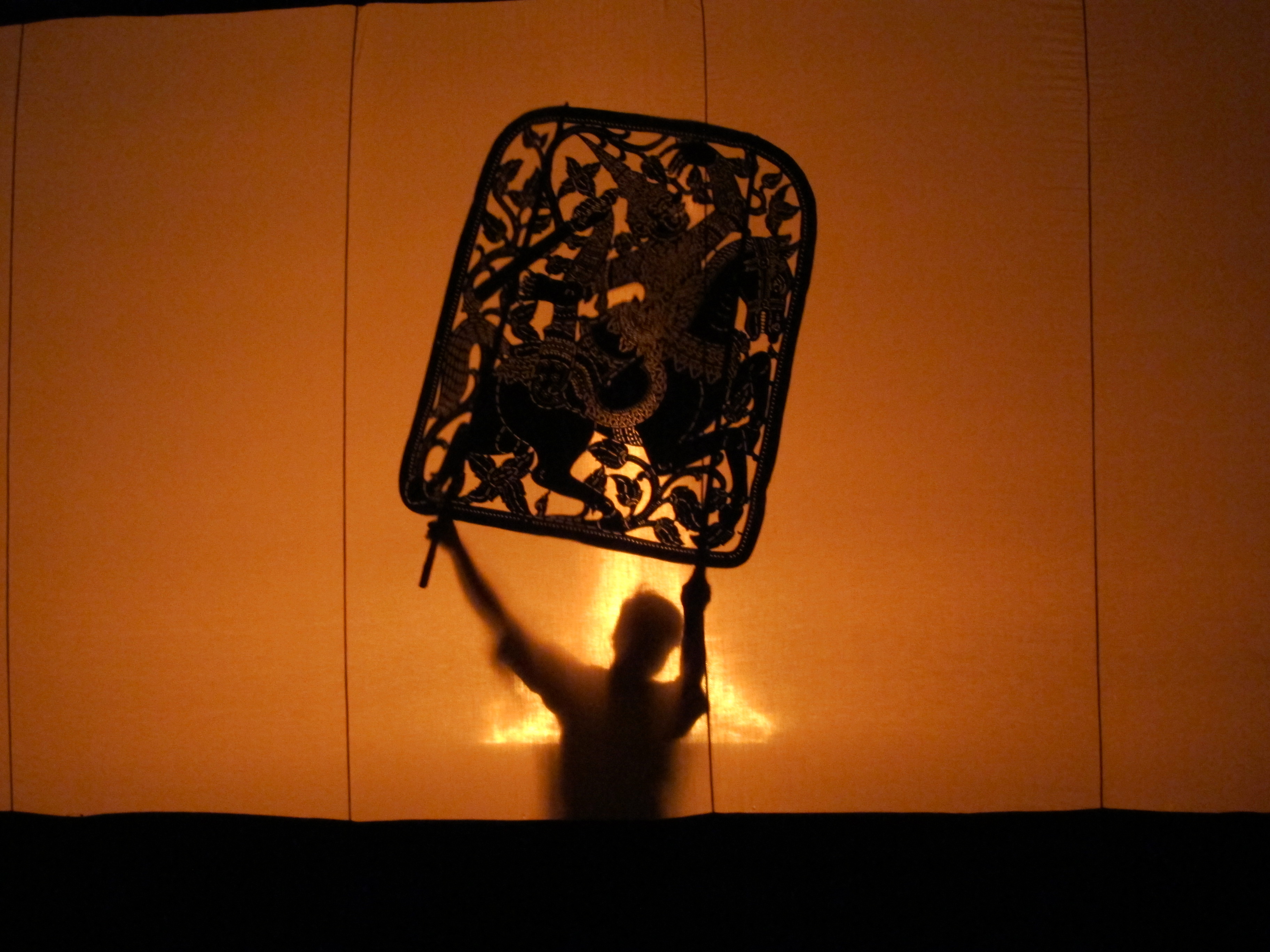
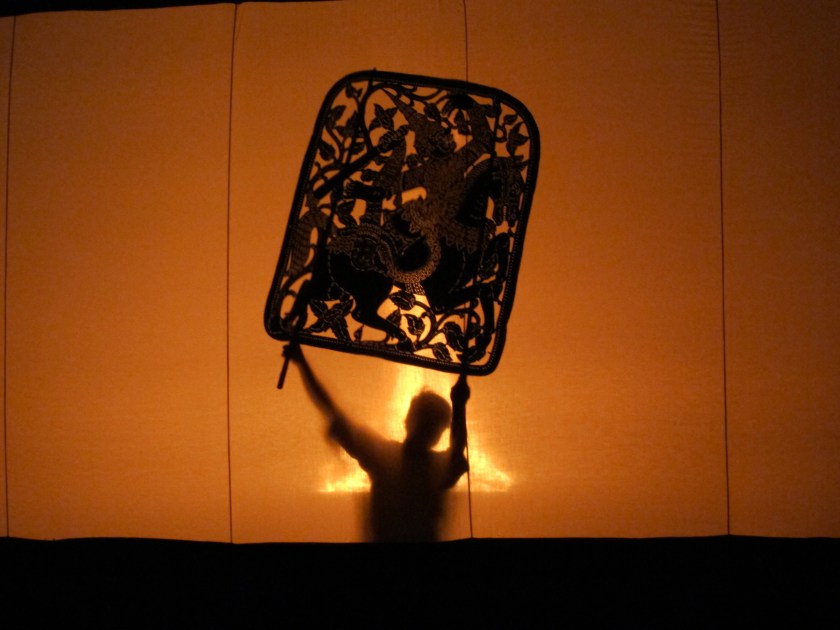
The shadow puppet show put on by Angkor Hospital for Children for the patients and their families:
http://www.flickr.com/photos/12339764@N00/6958992337/in/set-72157629253597145IMG_0481————–
One thing we rarely get to do on the road is keep up with movies, as movies here are usually not in English, or our internet speeds are not fast enough to download them on our own. Siem Reap had a twist on the movie theater we’d never seen before though: personal cinemas that you could rent out for a couple of hours and watch one of hundreds of movies they had in store. Even better than a real cinema, you get to sit in plush couches and order food and drinks to the room (including beer)! Here we are watching either Harry Potter or Moneyball…
http://www.flickr.com/photos/12339764@N00/6850216409/in/set-72157629253597145

—————–

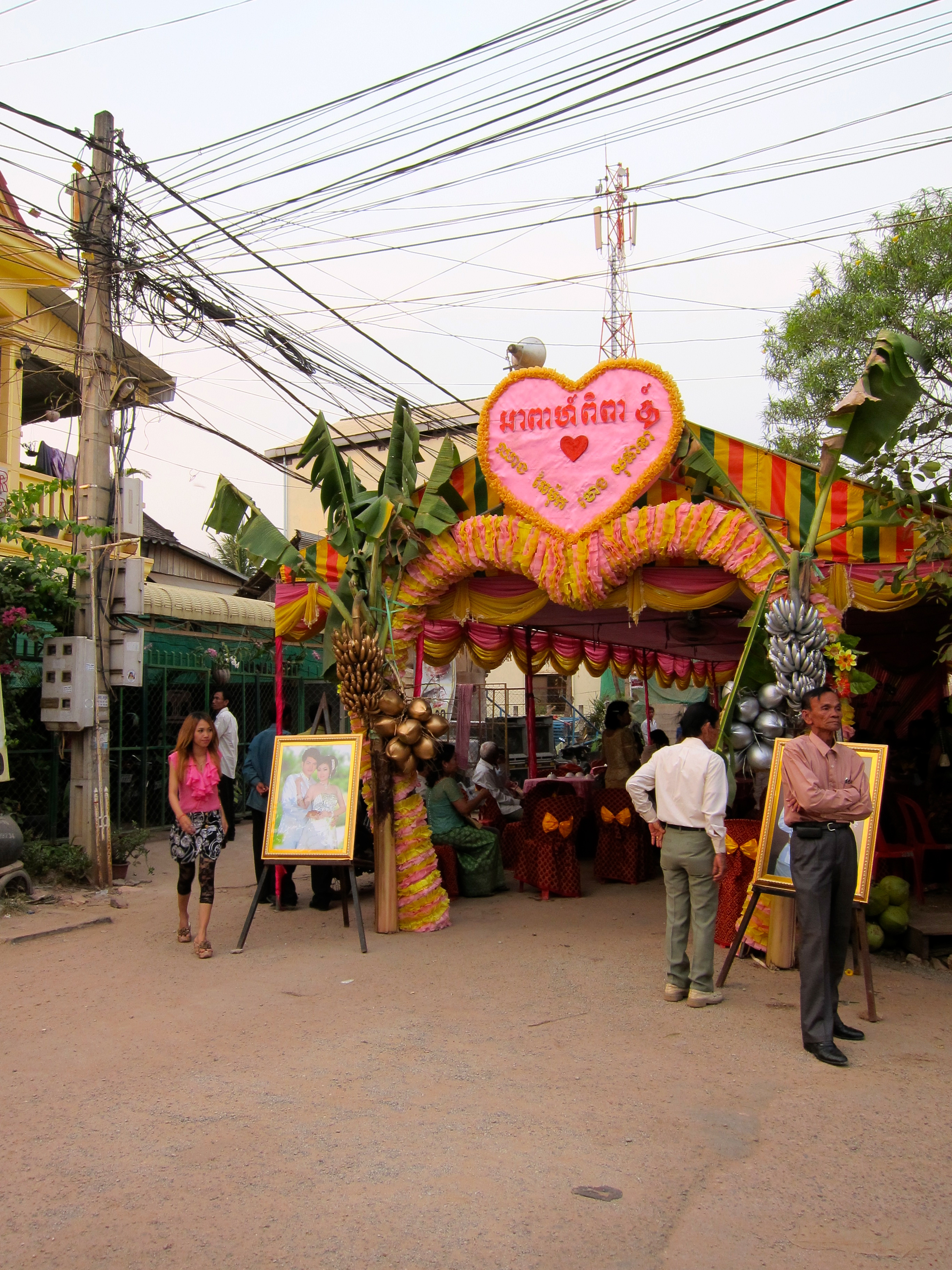
What do Cambodians do when they want to hold a wedding (or funeral) but don’t have any space to hold it? Put it in the middle of the road and make traffic drive around it, of course! This wedding went on for 3 days… and so did the traffic jams. (Luckily, everyone here drives bikes, not cars, so everyone was able to drive around it.)IMG_0250————–
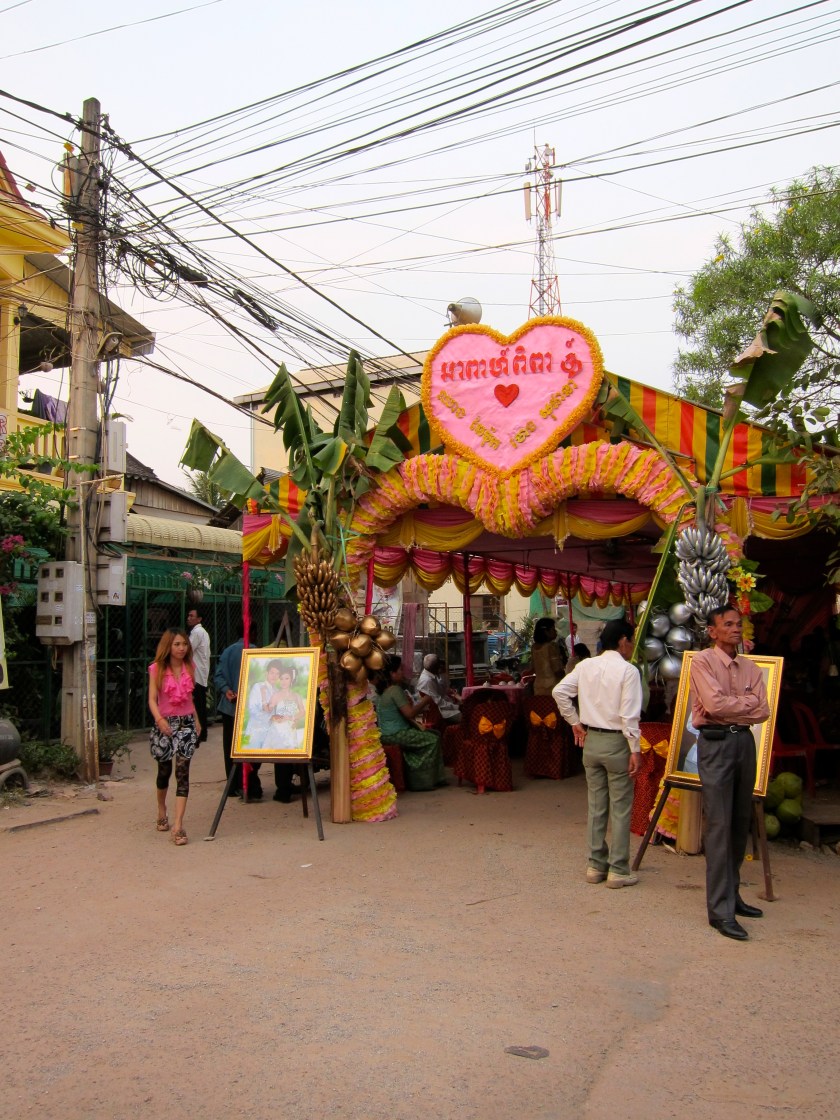
And finally, a parting shot–  definitely for the “random” category:
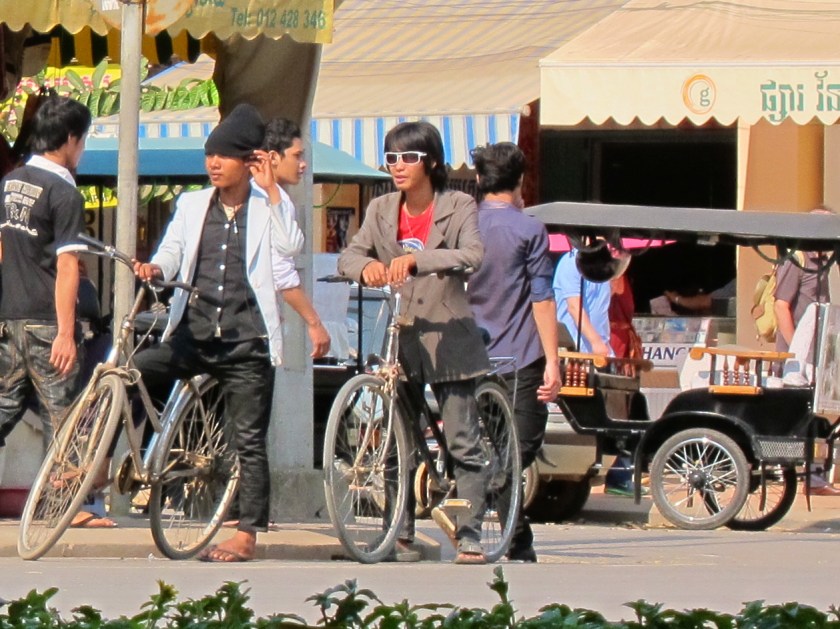
IMG_0320

Cut in Translation

The other day our head lab technician at AHC, Sona, bounded up to me, obviously excited about something. She told me that a Japanese group was coming to the hospital and that there would be some kind of “cutting” happening.

“Ohh, is it a ribbon-cutting ceremony? For the hospital?” I said.

Sona smiled, “Hmm… I don’t know.” Smile. (I should note: the language barrier between Sona and me is so great that many of our conversations end with me saying, “It’s OK, nevermind,” and Sona smiling and saying “I don’t know,” as in, “I don’t know what you’re saying right now.”)

Of course, she did know what the “cutting” event was, but she didn’t understand my question. I pressed on, “Ohh right, the founder of Angkor Hospital is Japanese; is the ribbon cutting ceremony related to his foundation? Are they opening a new wing of the hospital?”

“I don’t know.” Smile.

“Ok, well, can I go? What time is the cutting happening?” I asked.

“Yes, you can go; I’m going too. I don’t know what time to go, though.”

I felt like I had made some progress; now at least I knew she would tell me when the time came to attend “the cutting”, and she would show me where it was. We both smiled, shrugged, and went back to our work.

(below: me and Sona, directly on my left)

That afternoon, Sona approached me again and said, “Ok, I’m going to the cutting now! Do you want to come?”

“Yes, of course!” I replied.

We doned our AHC lab coats (want to look professional for the staff picture, I thought) and weaved through the halls of the hospital until we reached the registration area, where children and their families were milling about, waiting to be seen by a nurse. Sona walked up to the head receptionist and began chatting, while the entire crowd of patients and families just stared at me, the only foreigner in the room. Sona eventually turned back to me and said, “She said not now. Maybe at 9 o’clock.”

“Oh, the cutting was at 9:00 this morning? We already missed it?”

“Maybe 9:00 tomorrow.”

“OK…” They moved the entire ceremony to tomorrow? How unorganized could they be? That entire Japanese group came all this way to Cambodia, and now…..

Sona and I walked back toward the lab in silence (it’s so hard to communicate that we sometimes don’t even try). Eventually she turned to me:

“What kind of cut will you get?”

I could literally see the puzzle pieces falling into place at once, the snippets of our conversation from the morning all coming together like clues at the end of a good mystery movie, and I finally realized what was going on. How could I let her know I had had no clue that I was signing up for a haircut without my knowing it the whole time? “Ohhhh, you know, I just want a little trim off the bottom……” I said, without missing a beat and holding up the ends of my hair for her to see. “And you? What do you want?”

“I want bangs!!!”

Later that afternoon, Sona came up to me again. “The cutter is here, but she’s not Japanese; she’s your color.” Smile. “Want to go now?”

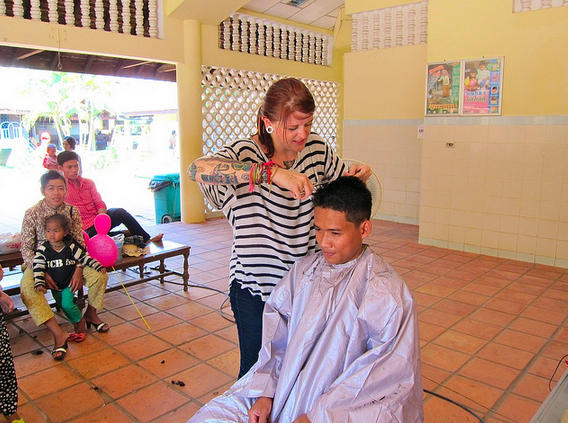
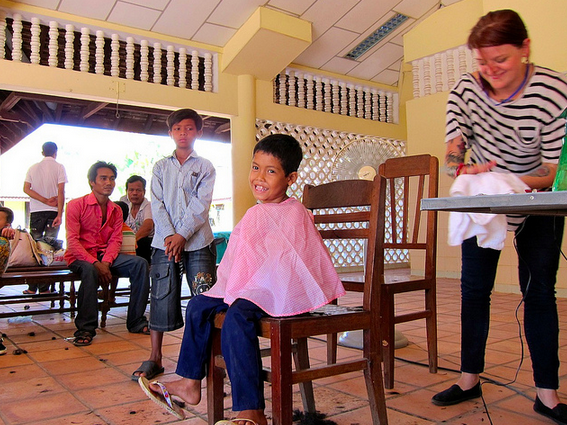
By this point, I had to go to save face, no matter the fact that I was trying to grow my hair longer. We walked back to the registration area, where a 20’s-something woman in full-sleeve tattoos was hunkered over an AHC janitor. The staff prodded me to go ask her where she was from. “New York now, but she grew up in Texas,” I told them. I further gathered that she was a volunteer for the week, giving free haircuts to the hospital staff, patients, and families.

Screen Shot 2014-12-17 at 7.10.43 AMNext, they prodded me to ask her if she wanted a surgical face mask to wear while she was cutting his hair. This was pretty funny, since no one in the U.S. wears face masks, unless they are immunocompromised or contagious (and even then, only maybe). But in Southeast Asia, people wear face masks all the time: while riding their motorbikes, on busses, selling goods in the market, just going about their every day lives. And many people here would never think about giving someone a haircut without wearing a mask.

Although I knew what the hairstylist’s answer would be, I entertained the staff’s request. “I know we don’t use these back home,” I began, “but the staff wants me to ask you if you would like a face mask.”

“Umm… no, I’m fine,” she answered with a confused look. Then a few minutes later, “Why? Do you think I should have one? Is there something I should be worried about?” I laughed and assured her that no, it is just a cultural difference. I don’t know why they wear them to cut hair here, either, I said. 🙂

Sona and I waited about an hour but kept getting “skipped” by all the cute kids who wanted a haircut. Of course, I was happier just watching (I was really just getting the haircut for Sona’s sake) and really didn’t want to take the stylists’ attention away from the people who wanted a free cut more than I did.

As I was watching, I realized that I had never seen a Cambodian person with a hairdo as short as the ones she was giving to the men and boys. Don’t get me wrong- the haircuts were fantastic (giving cuts that she would charge at least $50 for back in New York)- but as a culture, the men here always wear their thick wavy hair a little long, sometimes swept forward or to the side in an uber-hip way. I was cringing to think they might be horrified by how short their hair was by the end of it, but Sona assured me that they were saying that they liked them. Maybe I was the only one who really noticed the difference. In the end, it was a tiny reminder of why I love travelling – it can teach us things we never even thought were there to learn in the first place.

Eventually, a woman in turquoise green flowered pants with matching top appeared with a fat little baby (wearing nothing but a diaper and a gold necklace) in one arm and a 5 year old kid attached to her other arm. She came up to me and gestured that the baby would be getting his first haircut. Then she turned to her older son, neatly folded down his shirt collar, and lovingly smoothed out his pants. She held his hand as she walked him up to the stylist and helped him into the barber’s chair, coaxing him to sit up straight and tall. His first professional haircut? His mom hovered throughout his cut, intermittently nursing her fat baby and tilting her older son’s head up for the stylist with her free hand.

http://www.flickr.com/photos/12339764@N00/6850228173/in/photostream

When I heard the stylist ask the little boy in English how short he wanted his hair, I asked Sona to translate for him. “Really short,” he replied in Khmer with a big smile –those short haircuts she was doing seemed to be just fine by him. Screen Shot 2014-12-17 at 7.12.27 AMSona and I waited around for a bit longer and decided to return to lab, sans haircuts.

The next day Sona went back and returned with an adorable bob cut – bangs and all. Luckily, I ended up not having the get one, deferring to my “busy schedule” in lab, as being the reason.

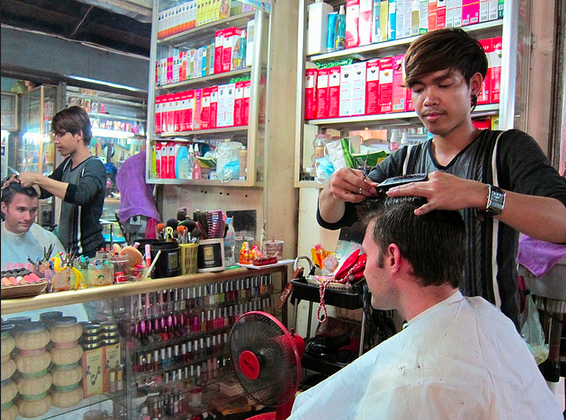
Scott, on the other hand, was in severe need of a haircut. His bushy mop was not only looking a little unkempt, but it was not serving him well in the 90-degree days that we had been enjoying (or suffering in, depending :)). Of course, he couldn’t get a haircut at the hospital since he was not staff or a patient, so we went to the Old Market together, where, buried deep within the alleyways and maze of stalls, you can get a professional haircut for $2. Scott sat down and asked someone to translate for him that he needed a lot cut off – at least an inch all around. The barber nodded and got to work.

Screen Shot 2014-12-17 at 7.13.23 AMA long 45 minutes later, he was done – annnnd it was exactly the same.

Scott asked the barber if he could take a little more off the top (any off the top, really…), and he happily agreed. Each time he went to make a cut, he grabbed a section of hair at jussst the right spot to make the perfect cut– I could sense Scott and myself literally holding our breaths in anticipation that he would actually make the desired cut– instead he would gradually sliiiide his fingers up as the scissors closed down, nicking barely a milimeter of hair with each cut.

“OK?” he asked Scott, smiling, when he finished.

Scott smiled. “Uhh, getting better….. maybe just a little more?”

He tried again, nicking away a few strays here and there for over 5 minutes. He smiled again, “OK?”

It was still the same length as it was an hour ago.

Suddenly, the realization that I had made at the hospital earlier in the week it dawned on me. The man was probably confused as to why Scott even wanted a haircut in the first place – by Cambodian standards, it probably looked plenty short already (too short, in fact). The barber’s hair was quite long indeed, swept forward in a really dramatic, stylish way across his forehead. Just as the American stylist was cutting the Cambodian’s hair far too short, this barber was afraid to trim Scott’s hair any shorter than 2 inches long all around, despite Scott’s constant request for “shorter, shorter.”

Seeing that he wasn’t making any progress, Scott paid and thanked the barber profusely. We then walked back to our apartment – where I grabbed my brush and pair of pink kindergarden-style scissors and proceeded to hack off the mop that still remained on his head.

By the end, I was sweating and covered in loose brown “fur”, the bathroom drain (which is on the floor) was sufficiently clogged, and I was wishing I had had someone to offer me a face mask!! Scott’s hair was a bit longer and choppier than his normal American ‘do, and was far, far too short for any self-respecting Cambodian, but not too shabby overall.

At lab the next day, Sona bounded up to me and asked me if I wanted to attend the “dying” that would be held later that morning. My horror quickly melted away into laughter as her smile told me everything I needed to know – the American hairdresser was now offering free hair-dyeing, as well.  Sona said she was going to get highlights, and that sounded pretty good to me, too.

Vicious Cycling

The moment we arrived, we realized we had made a mistake.

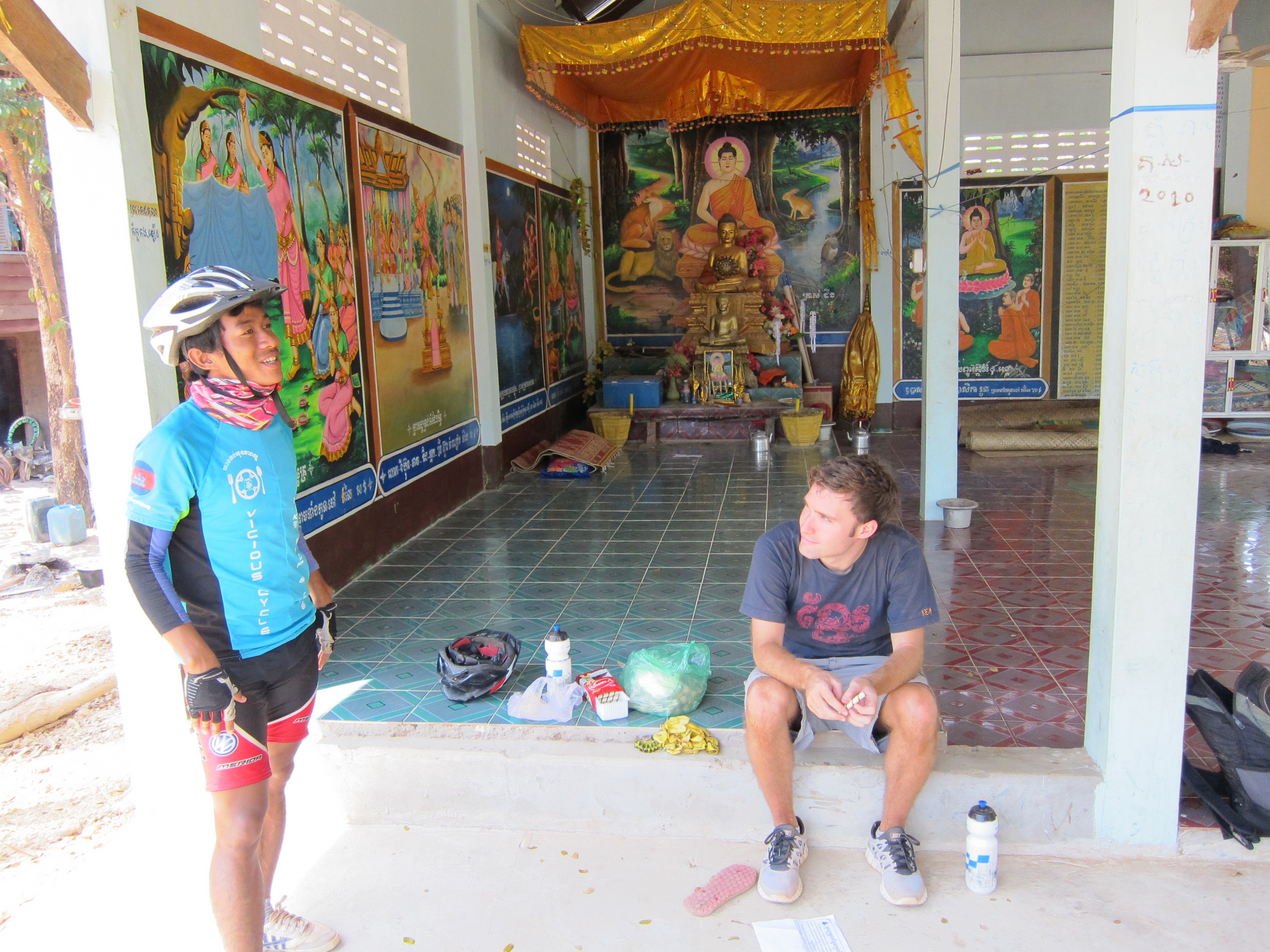
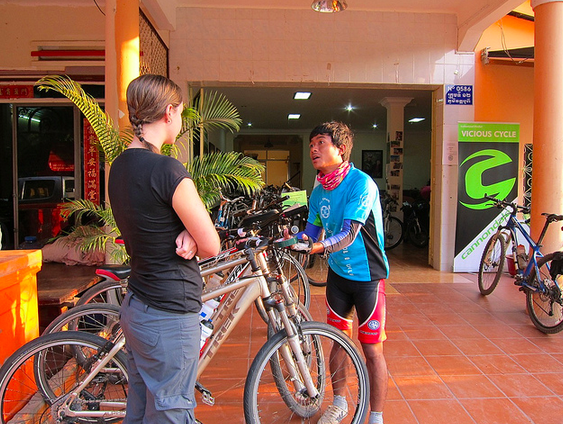
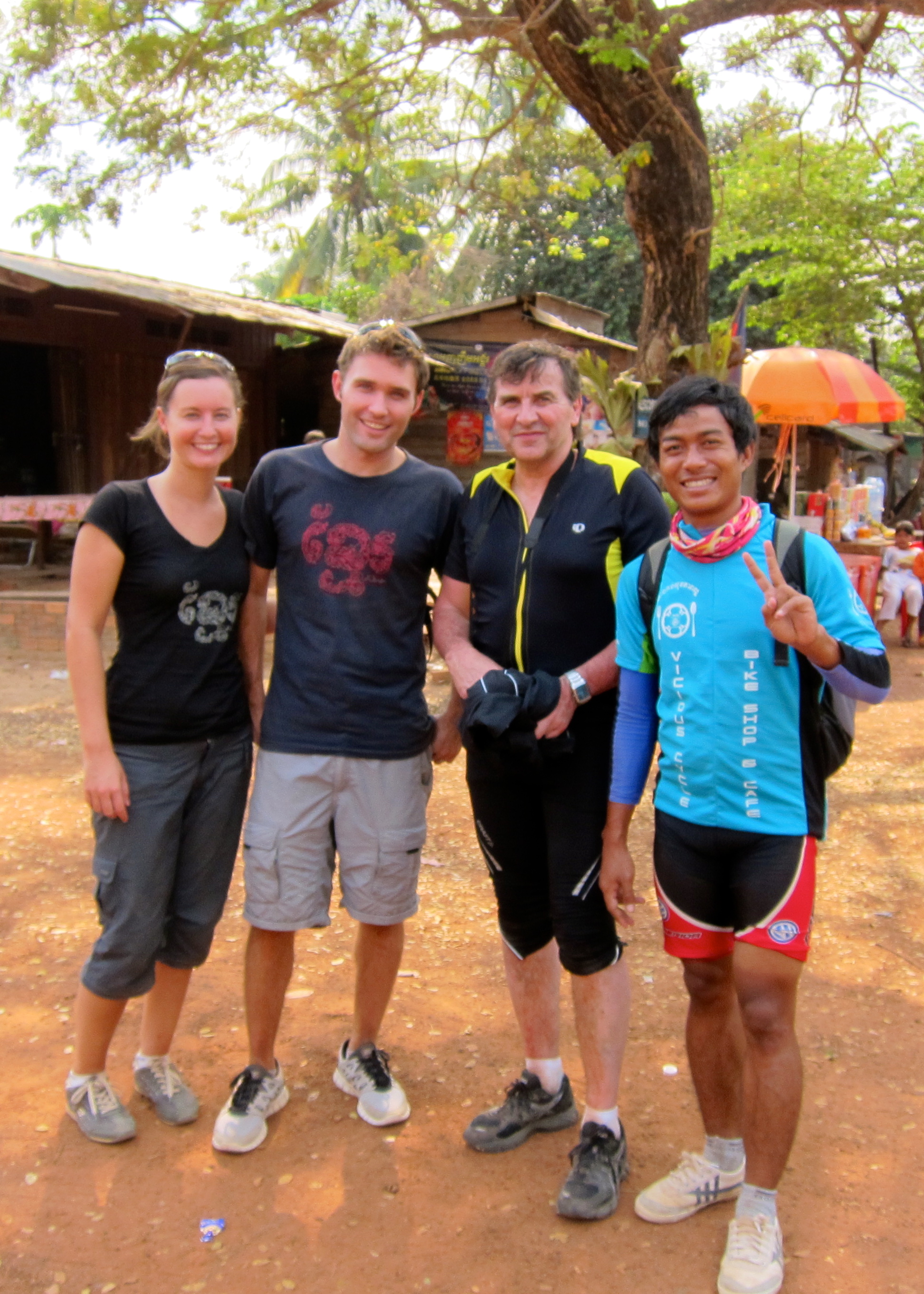
The sign next to the entrance read “VICIOUS CYCLE” in all-caps, and 3 young, whippet-thin Khmer guys in cycling spandex with high-school wrestler muscles were milling about the garage office, tuning up some Trek mountain bikes for a ride.

“Sousaday, ummm, do you know if Grasshopper Tours is near here?” I asked, hoping we had fumbled the directions to their office.

A girl behind the counter perked up, “Sousaday! Are you Scott? Doing the Beng Melea tour today? We are Grasshopper Tours, yes, or Vicious Cycle– same same. Please sit and have some water, the other man in your group isn’t here yet.”

We sat on the couch and looked around the garage, then at each other with a corner-of-the-eye glare that said, “oh crap… what the heck did we get ourselves into?”  What we thought we’d gotten ourselves into was decidedly less serious…

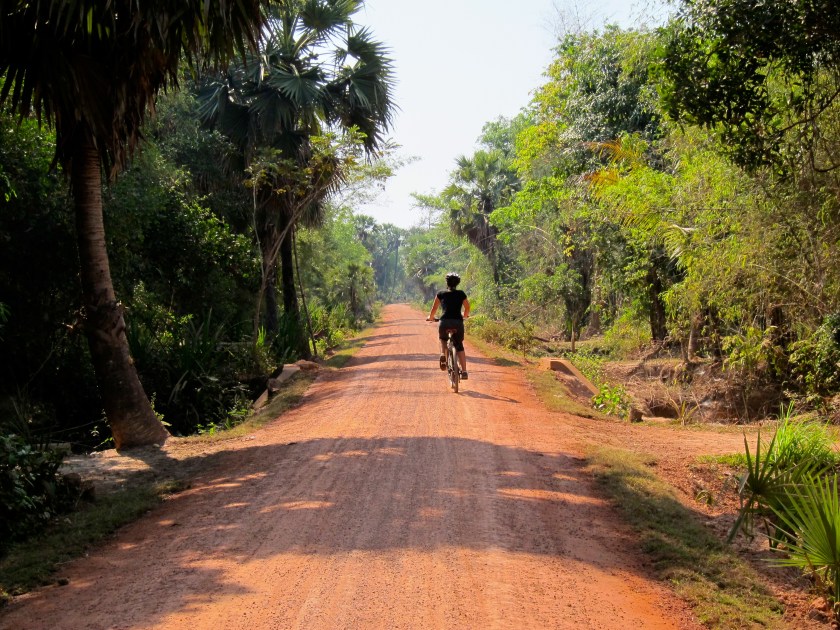
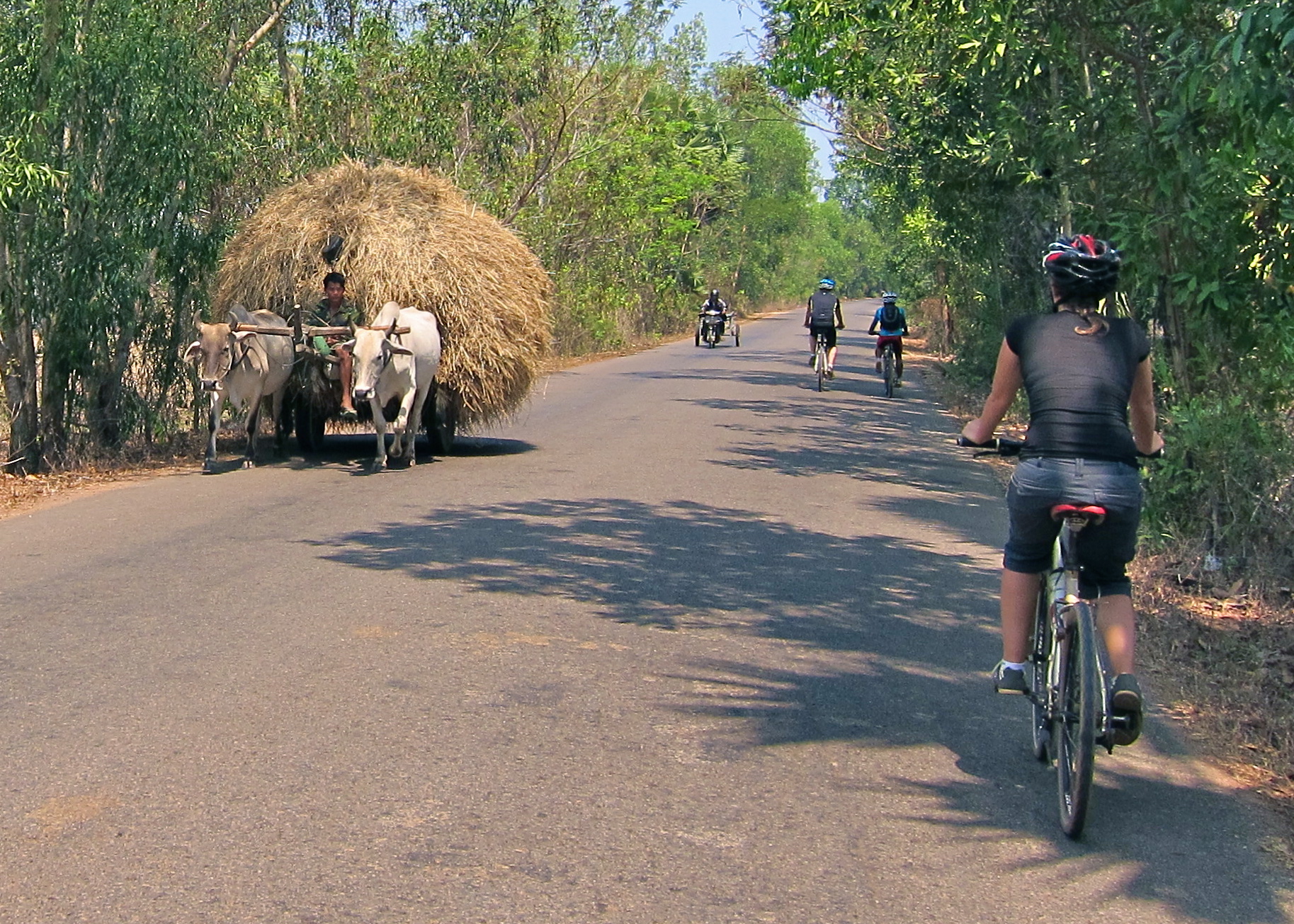
A couple of days earlier, Steph found a tour company online, Grasshopper Tours, that offered guided bike trips to Beng Melea, one of the out-of-town Angkor temples. The idea of visiting a temple by bicycle was already high on our list; in December we toured Angkor Wat and its sister temples in Siem Reap by bike, and the freedom to move about at our own (slow) pace really made the whole experience for us. Of course, we aren’t cyclists by any means, and the tours we had done earlier amounted to maybe 30 kilometers – tops. We carefully read the text on Grasshopper’s website, trying to gauge if it would be at all doable…

“If you ride a bike regularly and have a reasonable level of general fitness, then this ride is for you. The distance is approximately 65km on mainly flat tracks and small roads. We will stop often for photos and refreshments.”

“Regularly” didn’t describe our biking habits in the least; in truth, the last time we’d sat on a bicycle was the aforementioned rides around Angkor Wat. But a “reasonable level of general fitness” sounded like a… well, reasonable , if a little generous, depiction of ourselves, and the words “flat tracks” and “photos and refreshments” made it sound all the more casual. The distance however, did not. 65km was more than twice as far as we’d ridden last time, and definitely farther than we’d ever ridden a bike in our lives. Again in our favor though, the ride would be “assisted” by a trailing van, and that same van would take us all home after the temples, so one-way was all we’d need to do. We mulled it over for a day, and in a moment of “what the heck, we’re traveling around the world, right?”, I called Steph at work and said, “let’s do it, the website does make it sound pretty low-key,” and thus we booked ourselves for Sunday morning, 7am sharp.

A few minutes passed at the bike shop, and a European man in full cycling spandex gear walked in. He had a stout, barrel-chested frame, and like the guys at the shop, had calves like footballs – but unlike the other guys, I’d guess he was in his 50s (a slight advantage for us?…). He sat down on the couch near us, “Hello, are you on the tour today also?” We affirmed, exchanging introductions and nationalities with our tour partner.

“So, are you into cycling?” Steph asked, hoping that he too was here for a relaxing ride to the temple, like us. “Oh no, I’m more into running. I ran in New York once, actually!” – a friendly nod to our homeland. Being a running enthusiast myself (or a former one, at least), I took that to mean the New York Marathon; little did I know just how right I was.

With that, our guide Samnang, “Sam” for short, fitted us with helmets and bikes, while our Norwegian third wheel, who I’ll affectionately refer to as “Lance” from here on out, affixed an action-sports video camera to the top of his helmet. Steph asked if it was for taking pictures along the way – he chuckled, and said no, it was for taking video.

Not seeing any vehicles around, we asked Sam whether the “assisting” van we’d read about would be alongside us the whole way or following shortly behind, but he said that the van was busy on another ride and wouldn’t be able to trail along today – we would meet up with it after seeing the temple.

Screen Shot 2014-12-17 at 6.51.50 AMWarning signs abound, we were off.

http://www.flickr.com/photos/12339764@N00/6910432097/in/set-72157629253597145

Our tour started fast, speeding and weaving us through tuk-tuk traffic and road construction, while we tried to keep up with Sam and Lance, who were already gapped a hundred feet in front of us. Just when I became worried they would lose us entirely, the two of them dove off the shoulder onto a dirt single-track, and we followed; almost instantly, we were deep in the beautiful, rugged Cambodian countryside.

Our speed soon lowered, but not for lack of effort, as the track started to resemble a sandy beach, and the treads on our tires spun and slipped side-ways as we pedaled choppily to keep up. Along the way, we zoomed through villages that probably looked no different than they would have centuries earlier. The cute children in every home shouted from their hammocks, “HELLO!” and “BYE BYE!”, though not always in that order. At first, we responded with “Sousaday!” and “Leahigh!”, respectively, but soon switched to English when we realized the kids were much more excited to practice the words they were learning at school.

Zipping out of the single-track, we merged into a dirt country road, which was equally soft and deep in the shoulders as motoscooters and tractors occasionally passed by up the middle. At one point, my tire twisted and I fell off my bike, looking up to see Sam and Lance charging away without looking back. I hopped back on and Steph and I frustratingly pedaled to catch up, which we finally did once the dirt road merged with a paved one and we all stopped to take a drink.

“10km so far,” Sam said, as he pointed off towards the horizon, “see that hill out there? Beng Melea is just beyond that hill. 75 kilometers.”

“Sixty five. Not seventy five, right?” I corrected.

“No, seventy five,” Lance smiled and nodded to confirm he knew as much.  We let the new distance sink in for a moment as the hot, hazy sun rose up above the treetops and Sam and Lance gathered themselves to begin again.

The next 15km were a bit of a blur. We rode long paved stretches through the rice fields where men and women were tilling and harvesting their crop. Water buffaloes rolled around in the mud to cool off, and the wind shifted to face us head-on, making it even more difficult to keep speed across the plains. It was around that time that Lance checked with Sam before breaking away on what would be the first of many all-out sprints, while Sam kindly hung back with Steph and me. Lance disappeared into a speck as we chugged along on the miragey pavement, shifting back and forth from standing and sitting as our butts were already bruised from the seats. It wasn’t until our first real break that we finally caught up with Lance again, and we sat down, exhausted, for some bananas and a brief chat.

“Sorry we’re a little slow today; we don’t ride bikes very much. Actually, we think we might be in a little over our heads,” I offered to Lance, as he graciously reassured us it was no problem at all. “So, was your run in New York that you mentioned for the New York marathon?” I asked, sheepishly acknowledging his obvious endurance advantage.

“Ah, yes, it was a great time.”

“Oh, cool,” Steph replied, proudly offering for me, “Scott has run some marathons in the past, too!”

I added, “Yeah, I’ve done 3. Well, I finished 2 of them… got sick halfway through one of them and couldn’t finish.”

Lance continued matter-of-factly (and with no hint of cockiness), “I’ve run 157 marathons. New York was the only one I’ve done in America, though! I’ve been running marathons my whole life actually, since 1970. I have also run 265 half-marathons, and many triathlons, including the IronMan, and several of this certain kind of triathlon they have in Norway that’s more difficult than IronMan – the swimming part includes 5 kilometers through the icy fjords.”

It was then we realized what Lance had meant back at the shop. When he said he wasn’t a cyclist, he meant that cycling just wasn’t his strongest leg in THE F$%@ING NORWEGIAN IRONMAN.

“It’s hard to train in the winter, but I video tape rides like this and play them on the screen in front of me while pedaling in my cycling room.”

That said, he assured us he’s even weaker in swimming, which probably just meant he’d have trouble keeping up with a dolphin or something. His best marathon time was 2:20 (an entire hour faster than my own personal best), which would place him firmly in the elite group in his day – plain and simple, the dude was a gazelle.

http://www.flickr.com/photos/12339764@N00/6910434493/in/set-72157629253597145

18 kilometers down, and 57 more to go, we saddled up and continued on. At this point, Steph and I already had doubts we could do very much more, at least not at this pace. Fortunately, the ride soon became much more beautiful, the dirt roads widened and hardened, and the locals became even more excited to see foreigners so far from the city. Each driveway we passed brought 2 to 5 kids running to the road to yell “hello!” as we passed, and that combined with our pace reminded us of fans cheering us along in a race.

http://www.flickr.com/photos/12339764@N00/6910451601/in/set-72157629253597145

IMG_0394IMG_0388http://www.flickr.com/photos/12339764@N00/6910443949/in/set-72157629253597145

At around 40km, we stopped to have some Cokes and eat more bananas, and Steph got to practice her Khmer with some local guys that worked for Leo Beer. Steph had been receiving free language lessons through her work at the hospital, and it was starting to show. Not only were the local guys surprised and excited by her language skills, but our guide Sam was starting to take to us a little more – thankfully, because we were about to become more of a drag on him and Lance.

http://www.flickr.com/photos/12339764@N00/6910447761/in/set-72157629253597145

Back on the road again, Lance chugged off as usual to wait for us up ahead, and Steph rode up alongside Sam to break the news. “Sam, um, so if we don’t uh… think we’re going to make it all the way… can we maybe get picked up by the van out here, or maybe hire a tuk-tuk to take us the rest of the way?”

Sam chuckled with a little sympathy, “Well, there really aren’t any cars or tuk-tuks out here for the rest of the way. We’ll take it slow, and you’ll make it.”

“Have you ever had problems with anyone not making it all the way in your tours before?” we asked.

“Yes, a few times we’ve had some people who needed to ride in the van after some heat exhaustion. Then they’d usually start riding again after they felt better.” Needless to repeat, there was no van for today’s ride – the rest of our day would be a test.

Fortunately, another break came soon, around 55km, where we rested at a local community center, which was an open space that doubled as a Buddhist shrine and a shelter for visitors to sleep under when they came into town. On the walls were paintings of most of the stages of Buddha’s life, and Sam, formerly a monk himself for 8 years, was very happy to oblige in telling the story to us (a story that we already knew in parts, but it was nice to hear again, and it also helped to delay the ride!).

IMG_0396The final 20km was dry, hot, and incredibly tiring. Sam and Lance disappeared up ahead, and Steph and I hung back at our own pace, catching up every 8km or so to stop and drink some water before pressing on. Steph began to feel a little lightheaded and nauseous, and we worried she was feeling the early stages of heat sickness herself. Out in the middle of the desertous fields, all we could do was drink all the water we could and keep pedaling. Luckily too, the pretty sights of the Cambodian countryside continued all around.

IMG_0399IMG_0401

Video:
http://www.flickr.com/photos/12339764@N00/6910516661/in/set-72157629253597145

Finally we were counting down from 5km, and soon enough, we’d reached the entrance to Beng Melea, which had a rest area where we could wash up and celebrate! We’d actually made it, and in decent time too: 5 hours from the start. It felt pretty good. Sam then informed us that our group had made the distance in an entire hour less than it should have taken us, and instead of being proud, we were frankly just peeved. A slightly slower pace would have made the whole day just much more enjoyable.

http://www.flickr.com/photos/12339764@N00/6910522401/in/set-72157629253597145

After a nice included-lunch of traditional Khmer curry and re-hydrating noodle soup for Steph, we received our temple tickets and Sam guided us by foot around the temple. It was a beautiful, crumbling site – much like Ta Prohm, we thought, in its complete lack of preservation and overgrowth. But unlike the better-known temples, many of Beng Melea’s primary structures had completely caved to piles of rubble, and many sections were simply inaccessible to explore.
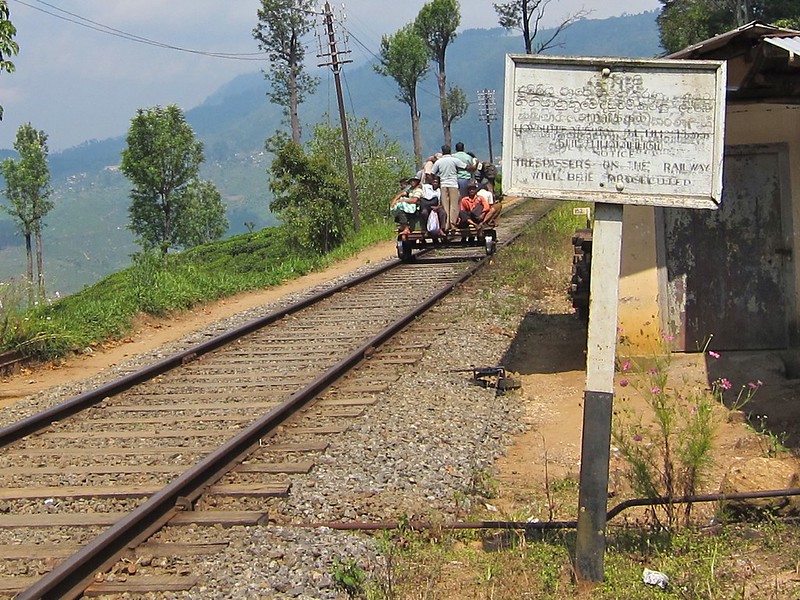
http://www.flickr.com/photos/12339764@N00/6910526311/in/set-72157629253597145

http://www.flickr.com/photos/12339764@N00/6910528967/in/set-72157629253597145

IMG_0419

IMG_0427Once we’d circled the temple grounds, it was time to head back. Lance asked Sam about possibly cycling back on his own, but ended up opting for the van, likely only because of the tricky directions back. We then snapped a quick picture of Lance, Sam, and the two of us, thoroughly exhausted, but happy to have made the trip.

IMG_0429In the van ride home, any self-pity left over from the ride sunk into our seats as Sam shared stories of his childhood, and the sad violence he experienced growing up in a Thai refugee camp, soon after his own parents performed forced field labor under Pol Pot during the rein of the Khmer Rouge. Seemingly everyone we meet in Cambodia has a story similar to his, and it’s these stories that leave us with no way to relate – just a reminder of how good and easy our own childhoods were back home.

To lighten the conversation as we approached town again, Steph asked Sam if he thought we weren’t going to make it all the way.  He replied candidly, “Yeah, haha. I didn’t think you would make it. But you did it. That was a long way. You did a good job.”

We were spent, but Sam seemed energized – good for him, as we learned he would be making the same exact trip again the next day. A Vicious Cycle, indeed.

Baby steps

Being back in Cambodia again was almost like coming home – the sights, the smells, the sounds – they were all familiar. I was happy to be back.

Little had changed in Siem Reap since we had last been here two months ago – the constant barrage of “Lady, lady, you want to buy something?”, “Sir! Tuk tuk? You want to see Angkor Wat?  Floating village?” – even that annoyingly charming young woman in front of Khmer View restaurant who I will forever know as the “Beer.. free popcorn.. fried rice.. fruit salad..” lady. They were all here, and yet this time around, things were different. My work at Angkor Hospital for Children was showing me a side of Cambodia that I had never expected to know.

http://www.flickr.com/photos/12339764@N00/6812898376/in/set-72157629253597145

IMG_0241

I’ve only been working at AHC for 2 weeks now, and I’ve somehow found myself sitting outside a family’s home in the middle of rural Cambodia. I’m sitting across from Sen, a 7-year old boy with beautiful round, brown eyes, wearing a dirty red linen shirt with lace trim around the collar. He’s shy – so shy that he doesn’t say one word in the 45 minutes that Sakan (an AHC nurse) and I spend with him. While Sen’s brothers dart from bush to bush “shooting” me with their fingers and dying laughing anytime I catch their inquisitive stares, Sen doesn’t budge from under his grandmother’s arm. He won’t even open his mouth as part of the physical exam, and we end up leaving that part blank.

We’re here for Sen’s bi-weekly home-care visit from AHC. Sen is HIV positive, and Sakan is here to deliver Sen’s monthly allotment of anti-retroviral pills that keep him alive.

Sakan spends the first 30 minutes of our visit counting out at least 3 different types of pills with Sen’s grandmother, who is his primary caregiver. She helps divide the pills into their correct slots in the weekly-reminder pill box, and there is a lengthy scuffle about how to best divide an oval pill into thirds…

Because Sen must take his pills at the same time every day, Sakan asks to see how the grandmother keeps track of the time. She pulls out a bulky wind-up blue clock from the plastic bag where she keeps Sen’s supplies and proudly holds it up for us; it’s an hour and a half off, and, apparently, she doesn’t know how to read it.

During the social assessment of Sen’s family life, Sakan notes that the pill cutter is dirty and jots it down in his notebook. But the pill cutter is really just the beginning. Behind us, outside the home, sits a single home-made wooden table that serves as the kitchen, which has nothing more than a few plates, a couple mismatched plastic glasses, and a pot, which they put over a fire to boil rice each day. Repeatedly, chickens from the village hop up onto the table and run across the plates, jumping off the other side. The grandmother and the uncle, who has been casually watching the home visit from his squatted perch in their home, both laugh as the chickens scurry across their dinner plates. I just want to scream; just last week, a 2 year old being treated at AHC died from H5N1 flu (transmitted by chickens in the village), and, with Sen’s immunocompromised state, I just know that he can’t afford to get sick any more than he must.

I notice that Sen’s fingernails and clothes are also unwashed, and I ask Sakan if he has reminded the grandmother about the importance of making Sen wash his hands before meals. He simply responds, “I have tried, but this family’s hygiene is not very good.”

“Would it be helpful to go over the importance of it with them again?” I kindly persist. Whether he thinks it will help or not, he stresses its importance again to Sen’s grandmother, and I feel like I’ve made some minuscule difference.

The grandma looks at me and says something that I don’t understand. I ask Sakan to translate, and he points down to 3 wooden mouse traps that have been sitting at my feet the whole time. She says they are for catching rats and mice, which is the family’s only source of meat. She goes on to explain that they rarely have enough food to eat, and they don’t have enough water to drink during the dry season, and I find myself realizing why Sakan’s hands rarely get washed.

Their home consists of nothing more than a raised wooden platform supporting two woven rattan walls and a rattan roof. There’s no furniture in the house, just a few bags of rice siting on the floor and some colorful woven sleeping mats. An old wooden wagon wheel rests against the side of the house, covered in tattered clothes that have been hung out to dry. Noticing my gaze, the grandma directs my attention to the huge 200 kilogram sack of rice sitting in the home, which she says they will try to sell for only $50 at the market – their entire income for the month. I ask Sakan how the family pays for Sen’s life-saving anti-retrovirals that he receives from AHC each month – he tells me they’re given to him by AHC for free, a service that will continue until he’s 18 years old.

After Sakan finishes Sen’s physical assessment (as much as Sen will allow), Sakan pulls out some hand sanitizer for himself and for me, which I just feel awkward using at this point. (Shouldn’t he be giving it to Sen, instead?) We all hike back through the twisting dirt-path village to the donated AHC jeep, where Sakan hands the grandma two full paper sacks of free corn, mangoes, coconut milk, salt, cooking oil, toothpaste, and 4 toothbrushes. Amazing. She turns to thank me, and I embarrassingly shake my head and point to Sakan.

It’s little miracles like these that make Angkor Hospital so great. These home-visits are just one part of its mission to extend its reach beyond the hospital and into the homes of children living with chronic diseases or into homes where families cannot afford to make the often long journey to AHC.

For those who can afford the trip, treatment at AHC is almost completely free from the moment the child arrives. AHC charges a one-time registration fee of only 25 cents to its patients (and even that can be waived if necessary). After that payment, any treatments, medications, lab work, even surgeries, cost nothing. And because few families that travel to AHC can afford to stay in hotels or buy food in restaurants once they’ve arrived, AHC allows the families to sleep inside the gates of the hospitals, where they are provided with bedding and mosquito nets, and the hospital also provides them with free meals throughout their stay. Intertwined with their mission of promoting affordable holistic health to children in Siem Reap province, AHC also teaches families about nutritional requirements and how to maintain a proper garden. When the families leave, AHC provides them with vegetable seeds to start their own garden at home.

http://www.flickr.com/photos/12339764@N00/6959010231/in/set-72157629253597145

But AHC is not only offering free care; it’s offering good care. Care that can change a child’s life in the most unexpected ways –

At AHC, I do no nothing more than work in the hospital’s laboratory. Except for the home visit with Sakan, I never interact with patients or directly see the children that we, the lab workers, are helping to diagnose. We receive samples from the nurse, such as urine, stool, spinal fluid, pus, blood, which we then process using a variety of microbiological methods until we have identified the precise species that is infecting the patient. We also determine which antibiotics the bacteria are sensitive to, providing the doctor with the appropriate knowledge of how best to treat the patient. I don’t think I ever realized the impact that this aspect of patient care could have until one day last week.

We had just received a genital swab taken from a two year old girl, which we began to process just like we would any other sample. My co-worker began streaking out the sample onto the appropriate Petri dishes, while I began staining the sample to examine it under the microscope. One look under the scope, and my heart just broke. I could tell immediately that this baby had a sexually transmitted disease, and I was possibly the only other person on the planet to know what had happened to this little girl except for her perpetrator. I told my co-workers what I saw, and we followed up the tentative findings with a more expensive confirmatory test – unfortunately, our suspicions were confirmed. She had gonorrhea.

We alerted the patient’s nurses and doctors, who I assumed would initiate an investigation involving the police. When I directly asked her doctor what the next steps would be, he was.. unsure at best. He said he would ask the parents what they knew about the abuse and then inform them of how she must have been infected. And that was it… It seemed that there wasn’t much of a plan in place to handle these cases, and not wanting to be too critical of their system, I was forced to let it go.

Yesterday, we received a similar sample from a similar patient – another 2 year old toddler with similar symptoms. And again, the same result.  I did not expect this. I did not expect this. 

My sadness and confusion for the first case was now turning into anger and frustration. Again, I asked the staff what would happen, and again, no one really knew.

Every Friday, I attend the free lunchtime seminars that are given to AHC staff on a range of topics. Last week, the seminar was given by Chang, 1 of 3 social workers at AHC, who started AHC’s first social work program less than 2 months ago. What I found to be a pretty routine lecture, in terms of what social work is and why it’s important, was met by a flurry of questions and eager hands from the nurses and doctors in attendance – they had never heard of social work before. Social work is, apparently, an entirely new concept to Cambodia, with AHC being the pioneer. I was shocked. More so, I knew that this man was the person I needed to speak to about what would be done about the STD cases that we had just diagnosed.

http://www.flickr.com/photos/12339764@N00/6910382425/in/set-72157629253597145

One day as I was heading to my daily Cambodian language classes, I noticed Chang making copies in the administrative office. I put my papers down in the classroom and went back to explain who I was and why I knew about the two STD cases. I expressed my concern and explained that I was interested in knowing how the cases would be pursued.

Chang did not know either. He reiterated much of what I had heard from his lecture about social work being a new field here and that he had talked to the children’s parents (apparently “they didn’t know anything about it”, even though a background check on one father showed that he also had gonorrhea). He did say that the case was passed on to a local NGO working in Cambodia, and that did seem like a great first step.

Chang spent the next 15 minutes getting my opinion on whether there was any way that this type of infection, at that site in the body, could be anything other than abuse. I went over the entire background and lifestyle of the causative organism, and assured him that it is very, very unlikely that it could have been contracted any other way (by clothing, for example). He asked if I would come present a lecture to the social workers on the disease, but unfortunately there was not enough time before I would be leaving AHC.

“Will the police perform a proper investigation?” I persisted.

“Unfortunately, in Cambodia, there is no law that makes this illegal…” he answered. So that was it. All of the hand-slapping and “discussions” with the parents that I had been told about were all that anyone legally could do. There would be no investigation, no arrests.

He continued, “You know that there were 2 different cases of gonorrhea one week apart, yes? Well, the two girls came from the same village.”  I was stunned. Yet more evidence of wrong-doing that would unfortunately go unused by the legal system here.

It’s clear that many of Cambodia’s social and governmental problems are being met with vastly inadequate solutions. But cases like these are not a waste. At the very least, the villagers will talk, and other children from the village might now be spared a similar fate. These two precious little girls might be kept under more vigilant watch by their mothers and sisters in the future. Had they been taken to any other hospital in the country, they would have been given a general antibiotic to clear their infections and would be sent back into potentially a lifetime of abuse. These last few weeks at AHC taught me the importance of proper diagnosis. It doesn’t just save lives. It can make lives worth living.

———————————————————————————

IMG_0510IMG_0525

http://www.flickr.com/photos/12339764@N00/6812899754/in/set-72157629253597145

http://www.flickr.com/photos/12339764@N00/6812896796/in/set-72157629253597145

IMG_0496IMG_0513

http://www.flickr.com/photos/12339764@N00/6812894932/in/set-72157629253597145IMG_0493IMG_0492

Design a site like this with WordPress.com
Get started